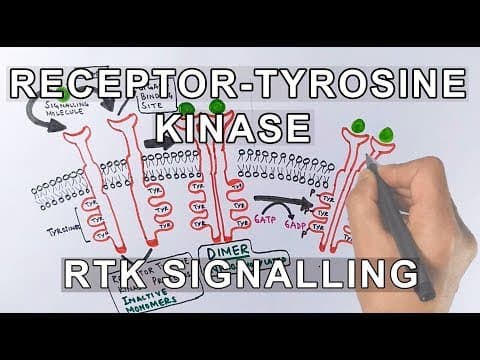
This blog post explores receptor tyrosine kinases (RTKs), detailing their structure, function, and the signaling pathways they initiate upon ligand binding, including the process of dimerization and phosphorylation that leads to cellular responses.
Receptor tyrosine kinases (RTKs) are a crucial class of plasma membrane receptors that play a significant role in cellular signaling. This blog post will delve into the kinase activity of RTKs, the process of ligand binding, the transformations that occur upon this binding, and how these receptors activate signaling pathways within the cell.
RTKs are a type of receptor that possess enzymatic activity, specifically functioning as tyrosine kinases. The intracellular catalytic domains of these receptors are responsible for their kinase activity, which involves the transfer of phosphate groups. This transfer is a fundamental property of kinase enzymes, allowing them to catalyze the addition of phosphate from ATP to the amino acid tyrosine on substrate proteins. Conversely, phosphatases are enzymes that remove phosphate groups from targets, counteracting the action of kinases.
RTKs are embedded in the plasma membrane, with their intracellular domains rich in tyrosine amino acids. Before a signaling molecule binds to the receptor, the RTKs exist as individual units, known as monomers. Each monomer has a ligand binding site on its extracellular portion.
When a signaling molecule, such as a growth factor, binds to the ligand binding site of an RTK, it triggers a process known as dimerization. This process causes two receptor monomers to associate closely, forming a complex called a dimer. However, dimerization alone does not fully activate the receptors; phosphorylation is required to achieve full activation.
The kinase activity of the receptor facilitates the transfer of phosphate groups from ATP to the tyrosine residues on the receptor itself. This phosphorylation results in the formation of a phosphorylated dimer, which is the activated form of the receptor tyrosine kinase. Once activated, the RTK can interact with specific proteins inside the cell.
The activated RTK is recognized by specific proteins that bind to the phosphorylated tyrosine residues. This binding induces a structural change in the proteins, activating them. Initially, these proteins are inactive, but upon recruitment by the activated RTK, they undergo a conformational change that triggers a cascade of signaling events, leading to a cellular response.
RTKs comprise a large family of receptors, including:
Epidermal Growth Factor Receptor (EGFR) Family
This family is associated with signaling in the nervous system. Insufficient signaling through EGFR has been linked to neurodegenerative diseases.
Fibroblast Growth Factor Receptor (FGFR) Family
FGFRs receive fibroblast growth factors, which are involved in various biological processes, including angiogenesis, bone healing, and embryonic development.
Receptor tyrosine kinases are essential for mediating cellular responses to external signals. Their ability to undergo dimerization and phosphorylation allows them to activate various intracellular pathways, influencing numerous physiological processes. Understanding the mechanisms of RTK signaling is crucial for insights into their roles in health and disease.
If you found this information helpful, consider sharing it with others interested in cellular biology and signaling pathways.