This blog post explores the process of sequencing by synthesis, detailing the steps involved in clonal amplification, sequencing, and data analysis, highlighting its significance in generating high-quality genomic data.
Sequencing by synthesis (SBS) is a revolutionary technique in genomics that allows for the high-throughput sequencing of DNA. This blog post will break down the intricate steps involved in this process, emphasizing the importance of data quality and the technology behind it.
Clustering is the initial step in the sequencing process, where each fragment of DNA is isothermally amplified. This occurs on a flow cell, which is essentially a glass slide divided into lanes. Each lane acts as a channel coated with a lawn of two types of oligonucleotides (oligos).
The first type of oligo on the surface of the flow cell is complementary to the adapter region of one of the fragment strands. When a fragment binds to this oligo, a polymerase enzyme synthesizes a complementary strand. This results in a double-stranded molecule, which is then denatured, allowing the original template strand to be washed away.
The remaining strand undergoes clonal amplification through a process known as bridge amplification. Here, the strand folds over and hybridizes to the second type of oligo on the flow cell. This creates a double-stranded bridge, which is subsequently denatured, yielding two single-stranded copies of the molecule tethered to the flow cell. This process is repeated multiple times, leading to the clonal amplification of millions of fragments simultaneously.
After bridge amplification, the reverse strands are cleaved and washed away, leaving only the forward strands. The three-prime ends of these strands are blocked to prevent unwanted priming during sequencing.
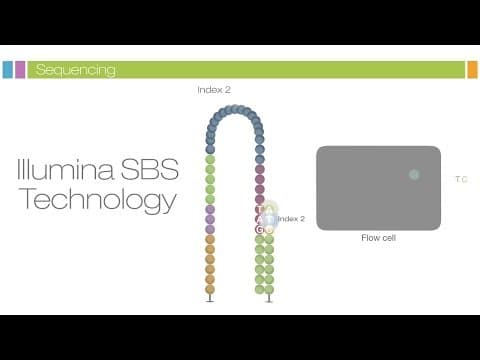
Sequencing begins with the extension of the first sequencing primer, which produces the first read. In each cycle, fluorescently tagged nucleotides compete for incorporation into the growing DNA chain. Only one nucleotide is added at a time, based on the sequence of the template strand. After each addition, the clusters are excited by a light source, emitting a characteristic fluorescent signal. This proprietary method is known as sequencing by synthesis.
The number of cycles determines the length of the read, while the emission wavelength and signal intensity are used to determine the base call for each cluster. This massively parallel process allows for the simultaneous reading of hundreds of millions of clusters.
Once the first read is completed, the read product is washed away, and the index 1 read primer is introduced. This primer hybridizes to the template, generating a read similar to the first. After the index read is completed, the product is again washed off, and the three-prime end of the template is deprotected.
The template then folds over to bind the second oligo on the flow cell, and the index 2 read is performed in the same manner as index 1. After this step, the read product is washed off, and the process continues with the introduction of the read 2 sequencing primer.
The sequencing steps are repeated until the desired read length is achieved. The read 2 product is then washed away, resulting in millions of reads that represent all the fragments sequenced from pooled sample libraries. These reads are separated based on unique indices introduced during sample preparation.
Reads with similar stretches of base calls are locally clustered, and forward and reverse reads are paired to create contiguous sequences. These sequences are then aligned back to a reference genome for variant identification. The paired-end information is crucial for resolving ambiguous alignments, ensuring high accuracy in the sequencing data.
Sequencing by synthesis is a complex yet fascinating process that has transformed the field of genomics. By understanding the steps involved—from clustering and amplification to sequencing and data analysis—we can appreciate the technology's role in generating high-quality genomic data. This method not only enhances our ability to analyze genetic information but also paves the way for advancements in personalized medicine and genetic research.