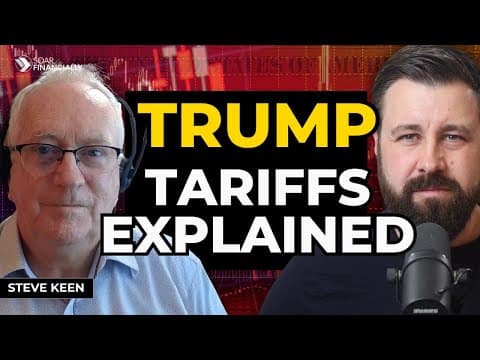
In this blog post, we explore the insights of Professor Steve Keen on the complexities of tariffs, private versus public debt, and the implications for the U.S. economy. Keen argues that the focus on public debt is misplaced, emphasizing the dangers of private debt and the role of government spending in economic stability. He also critiques the effectiveness of tariffs and discusses their impact on inflation and the U.S. dollar's status as a reserve currency.
In a recent discussion, Professor Steve Keen, a visiting scholar at the University of Amsterdam and author of "Debunking Economics" and "New Economics: A Manifesto," shared his contrarian views on the current economic landscape, particularly focusing on tariffs, public and private debt, and the implications for the U.S. economy. This blog post summarizes his key insights and arguments.
Many people believe that the government is creating too much money and will eventually run out of funds to pay its debts. Keen argues that this perspective is fundamentally flawed. He points out that the government can create money in its own currency, which makes the notion of running out of money nonsensical. The real issue lies in the bond market, which is the largest market globally, and the misunderstanding of how government and private debts function.
Keen emphasizes that there is no actual borrowing occurring in the traditional sense; rather, it is a matter of changing the nature of the assets backing the money created by government deficits. He illustrates this with an analogy: if offered a swap of $2 trillion earning no interest for an equivalent amount that does earn interest, it would be foolish to refuse.
Keen highlights the critical distinction between private and public debt. He argues that while public debt is often scrutinized, private debt is the real concern. The aftermath of the 2008 financial crisis was largely due to excessive private debt, which has been overlooked by mainstream economics. According to Keen, private debt drives economic booms and busts, especially when it is used for speculative rather than productive purposes.
As of now, private debt in the U.S. stands at approximately 150% of GDP, while public debt is around 100% of GDP. Keen points out that the focus on the smaller public debt figure distracts from the more significant issue of rising private debt. He argues that the conventional wisdom that prioritizes public debt over private debt is misguided.
Keen asserts that the only way to maintain economic activity is for the government to spend more than it collects in taxes. This was evident during the Biden administration, where government spending increased significantly. However, he warns that the current administration's reversal of this trend under Trump could lead to economic chaos.
The government stimulus during the COVID-19 pandemic was crucial in preventing a collapse of the private sector. Without this support, many businesses, particularly in the hospitality and transportation sectors, would have failed. Keen argues that the withdrawal of government support could lead to a significant downturn in the economy, as private sector businesses struggle to cope with reduced cash flow.
Keen discusses the recent imposition of tariffs, particularly on imports from Mexico, Canada, and China. He critiques the conventional economic view that tariffs are harmful, arguing instead that they can protect domestic industries and encourage investment. However, he also notes that tariffs can lead to increased costs for consumers, as businesses pass on the costs of tariffs to end-users.
In today's interconnected world, tariffs can disrupt global supply chains, leading to chaos within multinational corporations. Keen points out that the complexity of modern production means that tariffs can have far-reaching effects, increasing costs at multiple stages of production.
Keen concludes by addressing the implications of tariffs and economic policy on the U.S. dollar's status as the world's reserve currency. He argues that the U.S. is trying to maintain a strong dollar while simultaneously imposing tariffs, which is contradictory. A strong dollar can harm the manufacturing sector by making U.S. goods more expensive compared to foreign products.
Keen expresses concern about the potential for a global economic downturn driven by poor government policies. He believes that the obsession with reducing government deficits could lead to a stifling of aggregate demand and innovation. In contrast, countries like China, which maintain higher government deficits, may fare better in the long run.
Professor Steve Keen's insights challenge conventional economic wisdom regarding tariffs, public and private debt, and the role of government spending. His arguments highlight the complexities of the current economic landscape and the potential consequences of misguided policies. As the U.S. navigates these challenges, understanding the interplay between these factors will be crucial for policymakers and citizens alike.