This blog post explores terrestrial biomes, focusing on their global distribution, environmental conditions, and the adaptations of organisms that inhabit them. It discusses the defining characteristics of biomes, such as temperature and precipitation, nutrient availability, and how climate change is shifting these biomes.
In this post, we will delve into terrestrial biomes, which are defined as areas that share a combination of average yearly temperature and precipitation, commonly referred to as climate. Our objective is to describe the global distribution and environmental conditions of these biomes, explore how plants and animals adapt to their unique climates, and discuss the potential changes in biomes due to climate change.
Biomes are characterized primarily by their climate, which is a combination of average temperature and precipitation trends over a year. For instance, the tropical rainforest is known for its high rainfall and warm temperatures, while the desert is characterized by very low precipitation, which is its defining feature.
The organisms that inhabit these biomes are uniquely adapted to survive in their specific climate conditions. For example:
The two most critical characteristics of biomes are temperature and precipitation. These factors define the types of organisms that can thrive in each biome.
Different biomes exhibit predictable patterns based on their temperature and precipitation ranges:
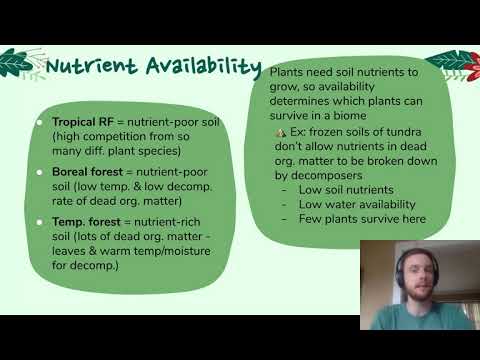
Nutrient availability in the soil is another crucial characteristic that influences which plants and animals can survive in a biome. For example:
Biomes are not static; they can shift in response to changing climate conditions. Human activities are currently accelerating these changes. For instance, as global temperatures rise, biomes like the boreal forest are moving northward. The soils that were once frozen are thawing, allowing tree species to expand their range further north, while southern regions may become too warm for these species to survive.
A notable example is the predicted shift of the Aspen tree species, which is characteristic of the boreal forest. Historical data from 1971 to 2000 shows its range, while projections for 2100 indicate a significant northward shift due to warming temperatures.
Photographic evidence from the Arctic shows the gradual encroachment of forests into previously barren land, illustrating the impact of climate change on biome distribution.
Understanding terrestrial biomes is essential for recognizing the intricate relationships between climate, organisms, and environmental changes. As we continue to study these biomes, it is crucial to consider how their characteristics influence the communities of organisms that inhabit them and how climate change may alter these ecosystems in the future.
To reinforce your understanding, identify one characteristic of a biome and explain how that characteristic determines the community of organisms found in that biome.
Thank you for engaging with this exploration of terrestrial biomes. Stay curious and continue to think critically about our environment.