This article explores the Austrian theory of the business cycle, explaining how monetary expansion leads to economic booms and busts. It covers the structure of production, the role of savings and investment, the impact of interest rates, and the phases of the business cycle including boom, bust, liquidation, and recovery. The theory emphasizes the importance of savings, capital accumulation, and the dangers of artificial credit expansion.
The Austrian theory of the business cycle offers a unique perspective on economic fluctuations, emphasizing the role of monetary expansion, interest rates, and capital structure in driving booms and busts. This article delves into the core concepts of this theory, explaining how economies grow, why cycles occur, and what causes recessions and recoveries.
Modern macroeconomic models often fail to provide a satisfying explanation for business cycles. Many rely on shocks to the system, treating economic fluctuations as responses to random events rather than systematic phenomena. These models typically suggest that central banks can only manage aggregate demand, with no real cure for negative supply shocks or cycles.
The Austrian theory seeks to answer three fundamental questions:
To answer these, the theory focuses on two key economic elements that affect the entire economy: money and time.
Money is not neutral; changes in the money supply affect real economic relationships. Time is embodied in the production process and reflected in the interest rate, which connects present and future consumption.
The Austrian macroeconomic model incorporates both money and time to explain economic growth and cycles.
The goal of an economy is to improve living standards by producing more goods and services. This requires increased productivity, which comes from better tools, machines, and equipment—collectively known as capital.
Capital accumulation results from investment, which in turn comes from savings. Thus, the growth process follows this sequence:
Consumption is the ultimate goal but cannot drive prosperity on its own. This sequence is known as Say's Law.
The Austrian business cycle is characterized by distinct phases:
There is no guarantee of recovery; poor policy choices can prolong downturns.
Production involves multiple stages, from raw materials to finished consumer goods. These stages are sequential and complementary, not interchangeable. Capital goods at different stages are heterogeneous and must be coordinated.
Financial capital flows backward through these stages, funding production based on consumer demand.
The many stages of production can be represented as a triangle, illustrating the complexity and roundabout nature of capital structure. Increasing roundaboutness means more complex and efficient production processes, which can lead to higher productivity.
The PPF shows the trade-off between consumer goods and investment goods. Points on the frontier represent full employment and efficient resource use, while points inside indicate recession or underutilization.
Economic growth shifts the PPF outward, allowing for more consumption and investment.
Interest rates are determined by the supply and demand for loanable funds:
The equilibrium interest rate balances savings and investment, reflecting time preferences.
Roger Garrison's model combines the structure of production, the PPF, and the loanable funds market to explain economic dynamics. Changes in savings behavior or interest rates affect investment, production structure, and ultimately consumption.
If people become more patient, savings increase, interest rates fall, and investment rises. This leads to a lengthening of the production structure and economic growth, with consumption temporarily reduced.
A price ceiling below the equilibrium interest rate causes a credit shortage, reducing investment and shortening the production structure. This leads to economic contraction.
The cycle begins with artificial credit expansion by central banks, lowering interest rates below natural levels. Entrepreneurs respond by investing in projects that appear profitable at these low rates but are unsustainable.
This malinvestment leads to a boom, followed by an inevitable bust when reality sets in:
During the recession, malinvested capital is liquidated. Businesses fail, and resources are reallocated to more productive uses. This process is painful but necessary for recovery.
Historical examples show that allowing liquidation and reducing government intervention can shorten recessions and restore growth.
Recovery follows the same growth formula: savings lead to investment, capital accumulation, and higher productivity. Increasing savings is crucial to provide the foundation for sustainable growth.
Policies that encourage consumption at the expense of savings hinder recovery.
The Austrian theory of the business cycle provides a comprehensive framework for understanding economic fluctuations. It highlights the dangers of artificial credit expansion and the importance of savings, capital structure, and interest rates in driving cycles.
While recessions are painful, they are necessary to correct malinvestments and restore economic balance. Recovery depends on allowing liquidation and fostering savings to rebuild the capital structure.
Understanding these dynamics can inform better economic policies and help avoid prolonged downturns.
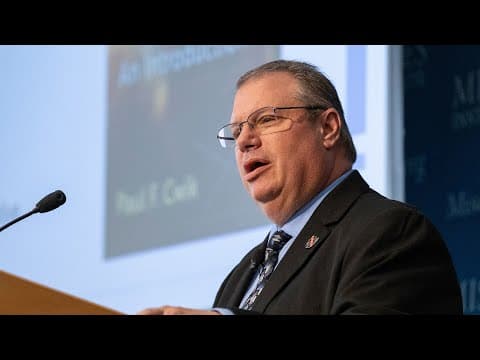
For those interested in a deeper dive, a free PDF and PowerPoint presentation are available through the Mises Institute, providing detailed explanations and graphical models of these concepts.