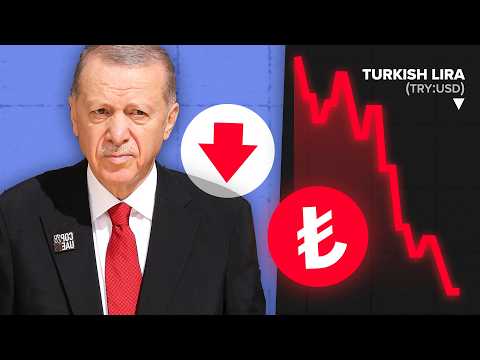
Despite initial hopes for recovery, the Turkish Lira continues to fall due to a combination of unorthodox monetary policies, high inflation, and political instability. President Erdogan's actions and economic mismanagement have led to a lack of confidence among investors and the public, exacerbating the currency's decline.
The Turkish Lira has been on a downward trajectory for several years, and despite recent attempts to stabilize the economy, it continues to fall. This blog post explores the factors contributing to the Lira's decline and the broader implications for Turkey's economy.
The decline of the Lira began around 2018, but it accelerated significantly after the COVID-19 pandemic. As inflation surged globally, most central banks responded by raising interest rates. However, President Recep Tayyip Erdogan took a different approach by cutting rates and dismissing central bankers who opposed him. This unorthodox strategy led to a dramatic depreciation of the Lira, which halved in value against the dollar between 2018 and 2020, and halved again between 2020 and 2022.
In early 2023, the central bank intervened to stabilize the Lira at just under 20 Lira to the dollar, despite inflation peaking at around 85% year-on-year in late 2022. Erdogan's rationale for low interest rates was rooted in his belief that they were un-Islamic, but it became clear that political motivations were at play, particularly with the presidential elections approaching in May 2023.
Following Erdogan's re-election, he appointed Mehmet Simsek as finance minister and Hafize Gaye Erkan as central bank governor. Both were seen as capable leaders who opposed Erdogan's previous monetary policies. They raised interest rates from 8.5% in May 2023 to 50% by March 2024, which initially seemed to stabilize the economy, with inflation decreasing and the Lira stabilizing around 32 to the dollar.
However, this progress was short-lived. By early 2024, inflation remained stubbornly high at around 38%, and the Lira began to slide again, reaching a record low of 39 to the dollar. This decline was exacerbated by several factors.
Erdogan's crackdown on opposition media and politicians, particularly targeting Istanbul Mayor Ekrem İmamoğlu, created uncertainty among international investors. This political climate led to a withdrawal of foreign investment, which had tentatively returned after the appointments of Simsek and Erkan.
The economic uncertainty stemming from global events, including tariffs imposed by the United States, has made investors wary of riskier assets like the Lira. Many have shifted their investments to safer assets such as gold.
While a 46% interest rate may seem high, it is only marginally above Turkey's current inflation rate of about 40%. This results in a real interest rate of only 5-6%, which does not provide sufficient incentive for investors to hold Lira-denominated assets.
Erdogan's government has maintained a loose fiscal policy, running a budget deficit of about 5% of GDP in 2023 and 2024. This deficit has led to increased money supply and demand in the economy, further pressuring the Lira and fueling inflation.
Perhaps the most critical issue is the lack of public confidence in Erdogan's ability to control inflation. Recent data indicates that households expect inflation to reach 60% within a year. This persistent high inflation expectation can lead to a self-fulfilling prophecy, as businesses raise prices and workers demand higher wages in anticipation of future inflation.
The combination of political instability, economic mismanagement, and public skepticism about the government's ability to manage inflation has created a perfect storm for the Turkish Lira. While Erdogan's recent shift towards more orthodox monetary policies may have been a step in the right direction, it appears to be too little, too late. Without significant changes in both policy and public perception, the Lira's decline is likely to continue, posing serious challenges for Turkey's economy in the future.