China presents a paradox of wealth and poverty, with a booming economy and significant income inequality. This blog explores the reasons behind China's dual economic identity, including its massive population, income inequality, and government policies that favor exports over domestic consumption.
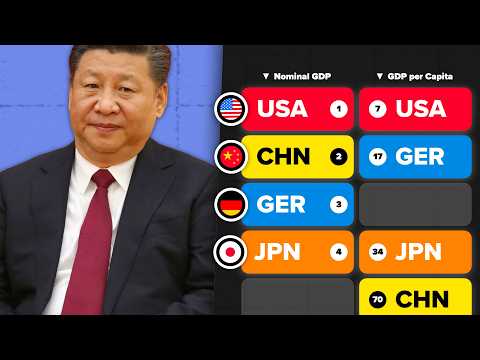
China is often perceived as a nation of contradictions, appearing both incredibly rich and profoundly poor. On one hand, Chinese companies like BYD and Huawei are at the forefront of technological innovation, and the government has invested trillions in ambitious projects like the Belt and Road Initiative. On the other hand, China's GDP per capita stands at just $13,500, comparable to countries like Montenegro and Turkmenistan, indicating a persistent economic crisis for many citizens. This blog post aims to unravel the complexities behind China's dual identity as both a wealthy nation and a country with widespread poverty.
One of the primary reasons for the contrasting perceptions of wealth in China is its sheer size. With a population of approximately 1.4 billion, China is not just another country; it is a vast entity that dwarfs nations like Germany or the UK. For context, the most populous province, Guangdong, has over 125 million residents, making it larger than many European countries. This immense population leads to significant disparities in wealth distribution across the country.
China's economic landscape is marked by stark income inequality, particularly between urban and rural areas. The Gini coefficient, a common measure of income inequality, reveals that China has a coefficient of about 0.46, making it one of the most unequal large economies globally, second only to South Africa. This inequality is exacerbated by the fact that urban households earn more than double the disposable income of their rural counterparts. In 2020, it was reported that 600 million rural Chinese lived on less than 1,000 yuan a month (approximately $140), highlighting the severe economic challenges faced by a significant portion of the population.
The duality of China's economic identity is not only a result of its size and inequality but also stems from the structural policies implemented by the Chinese government. The Chinese Communist Party (CCP) has adopted several strategies that effectively suppress household incomes and keep workers underpaid.
One of the most significant factors is the deliberate undervaluation of the yuan, which enhances the competitiveness of Chinese exports but limits the purchasing power of Chinese citizens. Additionally, labor unions are illegal in China, and the tax system is heavily skewed towards consumption taxes rather than income taxes, creating a regressive fiscal environment. These taxes often fund state-owned enterprises rather than public services, further disadvantaging workers.
China's unique form of state-directed capitalism contributes to the economic imbalance. The CCP signals its intent to dominate specific industries, prompting provincial governments to support numerous competing companies. This competition occurs without adequate worker protections, leading to a relentless race to the bottom in terms of wages and working conditions. The term "involution" has emerged in Chinese discourse to describe this unsustainable competition, particularly among overqualified graduates facing a stagnant job market.
The result of these policies is a situation where, despite the efficiency and productivity of Chinese companies, workers and households lack sufficient income to drive domestic consumption. This imbalance leads to a surplus of production that must be exported, contributing to China's persistent trade surpluses. While the international success of Chinese exporters creates an image of wealth, it is achieved at the expense of domestic economic well-being.
The Chinese banking system, dominated by state-owned institutions, further complicates the economic landscape. The CCP imposes capital controls that restrict how much money households and businesses can transfer abroad, limiting their ability to earn returns on savings. This control allows the government to finance large-scale projects using domestic savings, reinforcing the perception of state power while neglecting the financial needs of citizens.
In summary, the apparent contradiction of China being both rich and poor is a reflection of its vast size and the underlying structure of its economy. The combination of significant income inequality, government policies that favor exports over domestic consumption, and a tightly controlled banking system creates a complex economic environment. Understanding these dynamics is crucial for grasping the realities of life for many Chinese citizens amidst the backdrop of a seemingly prosperous nation.