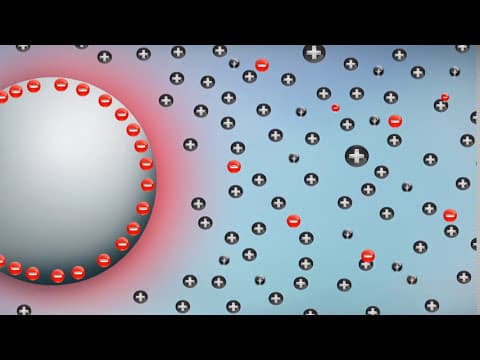
The electrical double layer forms around particles in water due to interactions between solid and liquid phases, leading to a stationary layer of ions and a diffuse layer that influences electrochemical behavior.
The electrical double layer is a fundamental concept in electrochemistry, particularly relevant when discussing the behavior of particles dispersed in liquid media. This article delves into the formation of the electrical double layer around particles, its structure, and its implications in various scientific fields.
When a particle larger than 1 nanometer is dispersed in water, a reaction occurs at the solid-liquid interface. Both the solid particle and the liquid water possess different energy levels, which leads to interactions at their interface.
All substances inherently carry a negative surface charge when dispersed in water. This phenomenon is primarily due to the high dielectric constant of water. In contrast, media with a lower dielectric constant tend to carry an anionic surface charge.
Water contains ions from dissolved salts that are attracted to the negatively charged surface of the particle. These ions accumulate around the particle, forming a well-ordered and immovable layer known as the stationary layer or Stern layer.
Cationic ions present in the water help neutralize the anionic surface charge. However, since these ions are often surrounded by water molecules, they are relatively large and cannot completely neutralize the surface charge. As a result, a residual anionic charge remains on the particle's surface.
The remaining anionic charge attracts additional ions from the surrounding water, leading to the formation of a second layer around the particle. This layer, known as the diffuse layer or Gouy-Chapman layer, is located further away from the particle's surface.
The attractive force of the anionic charges diminishes with distance, resulting in the diffuse layer being less ordered and more mobile compared to the stationary layer. This layer is often referred to colloquially as the cloud of counter ions.
The boundary between the stationary and diffuse layers is defined by a line known as the shear plane. The potential at this boundary is referred to as the Stern potential or streaming potential.
When the diffuse ions are displaced from the particle, a potential difference is created, which can be measured. This potential difference is crucial for understanding various electrochemical processes and behaviors in colloidal systems.
The electrical double layer plays a significant role in the behavior of particles in liquid media, influencing electrochemical reactions and stability in colloidal systems. Understanding its formation and structure is essential for advancements in fields such as materials science, chemistry, and environmental science. By comprehending the interactions at the solid-liquid interface, researchers can better manipulate and utilize these systems for various applications.