This article explores the life cycle of pteridophytes, including the processes of reproduction, the roles of gametophytes and sporophytes, and the unique characteristics of different groups such as lycophytes and ferns.
Pteridophytes, commonly known as ferns and their allies, are a fascinating group of spore-bearing plants. This article delves into their life cycle, highlighting the processes of reproduction and the distinct characteristics of various pteridophyte groups.
Pteridophytes are divided into several groups, including the Silophytes (or Silatums), Lycophytes, and Ferns. Each group exhibits unique reproductive strategies and structures, contributing to the diversity of this plant category.
Silophytes can reproduce both sexually and vegetatively. They produce structures called gemmae, which can germinate to form new plants. The gametophyte stage is crucial, as it develops structures like rhizomes and prothalli.
Mature Silophytes produce trilocular sporangia known as synangia. Each synangium consists of three lobes, with each lobe corresponding to a sporangium. The development of these sporangia involves the division of superficial initial cells, leading to the formation of spore mother cells that produce haploid spores.
When the spores germinate, they develop into gametophytes, which contain both antheridia (male gametophytes) and archegonia (female gametophytes). The fusion of sperm and egg within the archegonium results in the formation of a diploid zygote, which then develops into a young sporophyte.
Lycophytes, including Lycopodium and Selaginella, exhibit distinct life cycles. Their sporophytes can be either simple or branched, and their leaves, known as microphylls, differ from those of Silophytes.
In Lycopodium, sporangia are often found in clusters called strobili. These structures contain spore mother cells that produce spores, which are dispersed by air currents. Upon germination, the spores develop into gametophytes that undergo fertilization, leading to the formation of new sporophytes.
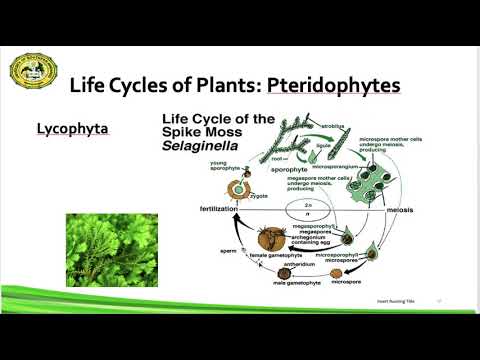
Selaginella, or spike moss, has a unique appendage called a ligule and produces both microspores and megaspores. The development of male and female gametophytes occurs before the spores are released, ensuring successful fertilization and sporophyte development.
Ferns are characterized by their fronds and sporangia, which are often clustered in structures called sori. The sporangia produce spores that germinate into gametophytes, known as prothalli.
The prothalli are typically one cell thick and contain both antheridia and archegonia. A single antheridium can produce numerous sperm, which swim to fertilize the egg, resulting in a zygote that develops into a young sporophyte.
The young sporophyte grows and eventually matures into a fully developed fern, completing the life cycle. This cycle illustrates the alternation of generations, where the sporophyte and gametophyte stages are distinct yet interconnected.
The life cycle of pteridophytes showcases the complexity and diversity of plant reproduction. From the gemmae of Silophytes to the strobili of Lycophytes and the fronds of ferns, each group contributes to the rich tapestry of plant life. Understanding these processes not only enhances our knowledge of botany but also highlights the evolutionary significance of these ancient plants.