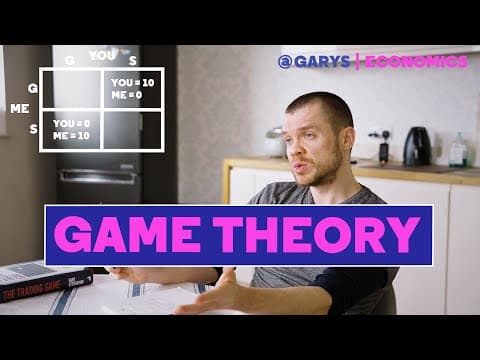
This blog post explores the concept of game theory through the lens of the Prisoner's Dilemma, illustrating how individual selfishness can lead to collective negative outcomes, particularly in the context of economic inequality. It argues for the importance of cooperation and collective action to address societal issues.
Welcome back to Gary's economics. Today, we are going to delve into the fascinating world of game theory, a mathematical framework that has significant implications for economics and our understanding of human behavior. This discussion is particularly relevant as we face challenges in fixing our economic system.
Game theory is a popular field of mathematics that has found its way into economics. It allows us to model real-life situations as games, where players make decisions that lead to various outcomes. By analyzing these decisions, we can better understand the strategies that individuals should adopt to achieve optimal results.
One of the simplest and most famous games in game theory is known as the Prisoner's Dilemma. This scenario illustrates how rational individuals might not cooperate, even if it appears that cooperation would benefit them both.
Imagine two prisoners who have been arrested for a crime. The police have enough evidence to convict them, but not enough to impose severe penalties. They are placed in separate rooms and offered a deal: if one prisoner betrays the other (or "grasses"), they will go free, while the other will face a long prison sentence. If both remain silent, they will each serve a short sentence. The possible outcomes are:
From a game theory perspective, each prisoner must consider their options:
In both scenarios, whether the other prisoner betrays or remains silent, the dominant strategy for each is to betray. This leads to a Nash equilibrium where both prisoners betray each other, resulting in a worse outcome for both (5 years each) than if they had cooperated (1 year each).
The Prisoner's Dilemma highlights a critical insight: individuals acting in their self-interest can lead to suboptimal outcomes for everyone involved. This scenario is often used to argue that people are inherently selfish. However, this interpretation may overlook important nuances.
The analysis of the Prisoner's Dilemma assumes that the only goal of the players is to minimize their prison time. In reality, individuals may have other motivations, such as loyalty, trust, or a desire to cooperate. Many experiments have shown that people often choose not to betray their partners, valuing relationships over personal gain.
Reflecting on the Prisoner's Dilemma, I have been considering its implications for our current economic situation. Over the past three years of running this YouTube channel, I have emphasized the need for collective action to address economic inequality. The argument is simple: if we work together to advocate for policies that benefit ordinary people, we can improve living standards and reduce inequality.
However, when discussing these ideas with politicians and the public, I often encounter resistance. Many individuals, particularly those in comfortable positions, face a dilemma similar to the prisoners. They must decide whether to invest their time and energy into supporting efforts to reduce inequality or to focus solely on their own interests. The choice to engage in collective action often feels like a guaranteed loss of time, especially when individual contributions seem insignificant.
This situation presents a philosophical dilemma for society. If enough individuals choose to act selfishly, the collective outcome will be detrimental. Conversely, if enough people are willing to sacrifice their time and effort for the greater good, we can create a positive change. The challenge lies in convincing individuals that their participation matters.
The culture of individualism has grown over the past few decades, leading many to prioritize personal gain over collective well-being. This mindset can empower the wealthy and powerful to exploit the vulnerabilities of ordinary people. If we continue down this path, we risk perpetuating a cycle of poverty and inequality.
Game theory teaches us that while individuals may act selfishly, the collective consequences can be dire. The key to addressing economic inequality lies in fostering a culture of cooperation and mutual support. We must recognize that our individual actions can contribute to a larger movement for change.
I believe we can fix the economy, but it requires a collective effort to confront inequality. The rich will not support this change, but together, we can challenge the status quo. I encourage everyone to engage with these ideas, share knowledge, and work towards a more equitable future. Together, we can overcome the challenges posed by the Prisoner's Dilemma and create a better society for all.