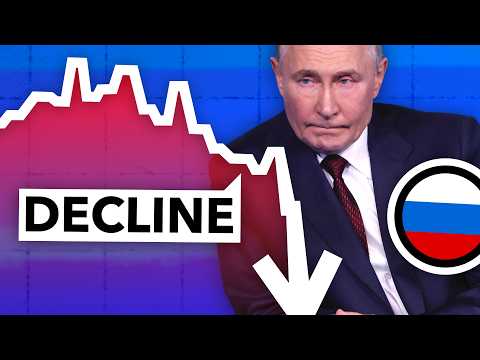
The Russian Ruble has seen a significant decline recently, dropping from 85 to 108 rubles per dollar. This decline is attributed to increased money supply due to war spending, sanctions, a struggling economy, policy changes affecting exporters, and fears of military escalation in Ukraine. The Russian Central Bank's independence and actions may provide some stability, but long-term solutions remain unclear.
The Russian Ruble has experienced a dramatic decline in value, falling from a stable rate of around 90 rubles per dollar to a new low of 108 rubles per dollar. This blog post explores the factors driving this decline and its implications for the Russian economy and government.
Initially, following the sanctions imposed after Putin's invasion of Ukraine, the Ruble suffered a sharp decline. However, it quickly recovered, reaching a seven-year high of 50 rubles to the dollar in June 2022. For most of the past year, the Ruble stabilized around 90 rubles to the dollar. The recent drop marks a significant shift in this trend, raising concerns about the economic stability in Russia.
One challenge in understanding the Ruble's value is that it cannot be easily traded at local currency exchanges. After the U.S. sanctioned the Moscow Exchange in June, the Russian Central Bank began measuring the Ruble's value through over-the-counter trades. These trades typically occur between banks or large exporters like Gazprom, which are among the few entities in Russia still generating significant foreign currency.
Despite skepticism about the data from the Russian Central Bank, its operational independence, as outlined in the Russian Constitution, lends credibility to its reports. The Central Bank has demonstrated its independence through significant interest rate hikes in response to sanctions, indicating a commitment to stabilizing the economy.
Several key factors have contributed to the Ruble's recent decline:
The Russian government has significantly increased its spending to fund the ongoing war, leading to a dramatic rise in the money supply. Historically, the number of rubles in circulation grew by about 10% annually, but this has surged to 20-25% since the invasion. This increase in supply, without a corresponding rise in demand for rubles, has led to a decrease in its value.
The imposition of fresh sanctions, particularly on Gazprom Bank, has further exacerbated the Ruble's decline. Previously, Gazprom Bank was one of the last major non-sanctioned banks in Russia, facilitating foreign currency transactions. The escalation of secondary sanctions has deterred banks in countries like China and Turkey from engaging with Russian companies, limiting their access to foreign currency.
The perception that the Russian economy is struggling has also contributed to the Ruble's decline. Government stimulus measures aimed at countering the effects of sanctions have led to inflation, which the Central Bank is struggling to control. This situation has prompted international investors to withdraw their investments and has encouraged Russians to move their cash abroad.
To alleviate pressure on exporters facing sanctions and high-interest rates, the Kremlin has introduced policy changes. Exporters were previously required to convert half of their foreign currency earnings into rubles, but this requirement has been reduced to 25%. Additionally, the obligation to keep 60% of earnings in Russia has been lowered to 40%. These changes have led to a decrease in foreign currency sales, putting downward pressure on the Ruble.
Growing concerns about the potential for military escalation in Ukraine have also influenced the Ruble's decline. Recent actions, such as Russia's use of an intercontinental ballistic missile, have heightened fears of further conflict, negatively impacting both the European and Russian economies.
The Russian government has limited options to address the Ruble's decline. The Central Bank could intervene by using foreign exchange reserves or tightening capital controls to prevent the sale of rubles abroad. However, these measures are not sustainable in the long term. The only viable solutions to slow the Ruble's decline would be a significant rise in global energy prices or a reduction in government spending, both of which pose challenges for the Kremlin.
The decline of the Russian Ruble is a complex issue influenced by various economic and geopolitical factors. While the Central Bank's independence and actions may provide some stability, the long-term outlook remains uncertain. Understanding these dynamics is crucial for assessing the future of the Russian economy and its implications for both domestic and international stakeholders.