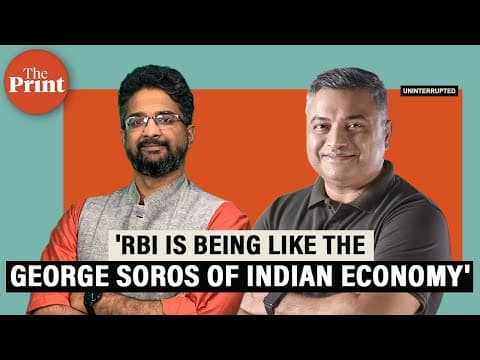
The depreciation of the Indian rupee is a significant concern, driven by various economic factors and the Reserve Bank of India's (RBI) policies. Deepak Shenoi argues that the RBI's approach to managing the currency is flawed, suggesting that the rupee is undervalued and that the central bank should allow it to appreciate in line with foreign inflows. He emphasizes the need for a reevaluation of the metrics used to assess currency value and advocates for a more market-driven approach to currency management.
In recent discussions surrounding the Indian economy, the depreciation of the rupee has emerged as a critical topic. TCA Sharad Ragavan, Deputy Editor at The Print, engages with Deepak Shenoi, founder and CEO of Capital Mind, to explore the implications of the rupee's decline and the role of the Reserve Bank of India (RBI) in this context.
The rupee has been on a steady decline for several years, raising concerns about its impact on the Indian economy. Shenoi asserts that a depreciating currency makes India poorer, as it reduces purchasing power for both domestic and imported goods. This depreciation is particularly alarming given that India is a net importer, leading to increased import costs and inflation, which further erodes the purchasing power of citizens.
Shenoi highlights that inflation acts as a tax on the economy, and currency depreciation exacerbates this issue. He notes that while the Indian economy is currently experiencing foreign inflows, the rupee's depreciation does not align with these positive economic indicators. The core inflation rates in India are significantly higher than those in the U.S., suggesting that the rupee should not be depreciating at the current rate.
A significant point of contention in the discussion is the RBI's intervention in the foreign exchange market. Shenoi criticizes the RBI for its approach, arguing that it has been buying dollars to force the rupee's depreciation while failing to sell enough dollars when foreign investors withdraw their funds. This imbalance has led to a situation where the rupee has depreciated from 70 to 84 against the dollar, despite substantial foreign inflows.
Shenoi emphasizes that the RBI should allow the rupee to appreciate when foreign capital flows in, rather than absorbing all the dollars and preventing appreciation. He argues that the RBI's current strategy is misguided, as it does not reflect the actual demand and supply dynamics in the market. Instead, he advocates for a more balanced approach where the RBI participates in both buying and selling dollars to stabilize the currency effectively.
One of the critical issues Shenoi raises is the outdated metrics used by the RBI to assess the rupee's value. He argues that the focus on goods imports and exports neglects the significant contributions of services and remittances to the economy. By considering only goods, the RBI miscalculates the real effective exchange rate, leading to an undervaluation of the rupee.
Shenoi points out that India has a thriving services sector that generates substantial revenue through remittances and service exports. He believes that if the RBI were to incorporate these factors into its calculations, it would reveal that the rupee is not overvalued but rather undervalued. This perspective challenges the prevailing narrative that the rupee's depreciation is necessary for competitiveness.
The discussion also touches on the role of foreign institutional investors (FIIs) in the rupee's depreciation. Shenoi argues that the recent outflows of foreign capital are not significant enough to justify the extent of the rupee's decline. He suggests that the RBI's failure to manage these outflows effectively has contributed to the currency's instability.
Shenoi advocates for a more market-driven approach to currency management, where the RBI allows the rupee to fluctuate based on market forces rather than attempting to control its value artificially. He believes that if the market were allowed to operate freely, the rupee would appreciate significantly, reflecting India's economic growth and attractiveness to foreign investors.
The conversation with Deepak Shenoi sheds light on the complexities surrounding the depreciation of the Indian rupee and the RBI's role in managing it. His insights challenge conventional wisdom and call for a reevaluation of the metrics used to assess currency value. As India continues to attract foreign investment, a more flexible and market-driven approach to currency management may be essential for ensuring economic stability and growth.