The scientific method is a systematic process used by scientists to investigate questions and test hypotheses. It involves six key steps: asking a question, forming a hypothesis, conducting experiments, making observations, analyzing data, and drawing conclusions. This method is fluid and can vary across different scientific disciplines, as illustrated by a personal example of troubleshooting an internet connection.
When you first took a science class in school, you probably learned about the basic steps of a scientific investigation. Terms like hypothesis, experiment, and observation may have become familiar to you. The scientific method is a set of procedures that scientists follow to gain knowledge about the world. However, the steps involved in this method can vary widely among different scientific disciplines. Chemists, psychologists, geologists, and botanists each have their own unique approaches. This raises the question: is there really one scientific method that encompasses all of science?
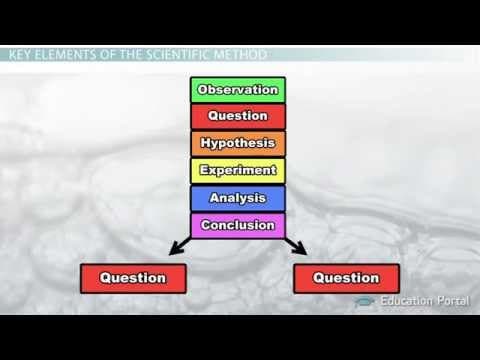
There are six key steps that tend to characterize the scientific method:
The first step is to pose a question. This is where a scientist identifies a problem they want to solve. A well-conceived question usually leads to the next step: forming a hypothesis.
A hypothesis is a potential answer to the question at hand. Sometimes, hypotheses resemble predictions about what the outcome will be when the hypothesis is tested.
The next step is conducting an experiment. Experiments are ordered investigations designed to prove or disprove a hypothesis. Important data is gathered from performing these experiments.
During the experiment, the scientist must make observations of the results. An observation is a statement of knowledge gained through the senses or scientific equipment. Observations are crucial for collecting data.
Once the results are in, the scientist begins data analysis. This involves comparing the results of the experiment to the predictions made by the hypothesis. Based on the observations, the scientist determines whether the hypothesis was correct.
Finally, the scientist sums up their findings with a conclusion. This statement indicates whether the original hypothesis was supported or refuted by the gathered observations.
While the scientific method typically employs all six steps, they do not always occur in a linear order. Real scientists may revisit and repeat steps multiple times before reaching any conclusions. It is more accurate to refer to these steps as elements of the scientific method, as the first step—question—does not always come first. For instance, an observation may spark the initial question, and observations made during an experiment can lead to further inquiries.
To illustrate how the steps can feed back and branch out from one another, let me share a personal experience from last weekend involving my internet connection at home.
I started my laptop and was frustrated to find that I couldn't connect to the internet. My first observation was that my laptop wasn't receiving an internet connection.
I asked myself, "Is something wrong with the internet itself, or is it just my laptop?"
To begin answering this question, I formed a hypothesis: If the internet isn't working on the desktop either, then the problem is beyond my laptop.
My experiment involved checking the connection on the desktop computer. My observation was that the internet didn't work there either.
By analyzing the evidence, I concluded that nothing was wrong with my laptop and that there was indeed an issue with the internet connection.
This conclusion led me to pose another question: Where exactly was the problem occurring in the chain of internet devices? Was it the cord between the modem and the router, the cord between the router and my computer, or was the problem in the router itself?
I hypothesized that if both my internet cords were properly plugged in, then there must be a problem with the router.
I checked both cords and the router. My observation revealed that both cords were plugged in, but the router was off.
Upon analyzing this evidence, I concluded that I couldn't connect to the internet because my router was not functioning.
The scientific method is a dynamic and iterative process that allows scientists to explore questions and test hypotheses. By understanding its steps and how they interconnect, we can appreciate the fluid nature of scientific inquiry. Whether in a laboratory or in everyday life, the scientific method provides a framework for problem-solving and discovery.