This article explores the incomplete picture taught in universities about electric resonance, emphasizing the often neglected displacement current alongside electrostatic and magnetic fields. It explains how energy flows between capacitors and coils in resonance, the significance of displacement current, and how understanding these concepts can lead to innovations like Tesla coils producing high voltages and potentially free electricity.
Electric resonance is a fundamental concept taught in universities worldwide, yet the traditional explanation often misses a vital component: the displacement current. This omission leads to an incomplete understanding of how energy flows in resonant systems, which has significant implications for electrical engineering and the pursuit of free, continuous electricity.
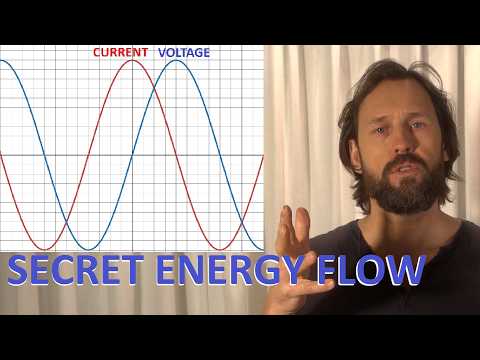
Typically, university courses present electric resonance using graphs that plot voltage and current over time. These graphs show two sine waves: one representing voltage and the other current. The voltage wave is depicted as leading the current wave, meaning the voltage reaches its maximum before the current does.
However, this conventional depiction is based on an outdated understanding dating back to Benjamin Franklin's experiments, which assumed current flows from positive to negative voltage. Modern physics reveals that current actually flows from negative to positive, implying that the current should lead the voltage by 180 degrees, contrary to what is commonly taught.
The key element missing from the traditional explanation is the displacement current. To fully grasp electric resonance, it is essential to understand the three types of electric fields present in such systems:
Electrostatic Field (Dielectric Field): This is the static electric field you experience when, for example, removing a plastic sweater and hearing a crackle. It is the field between the plates of a capacitor when charged.
Magnetic Field: This field arises from energy flow around a coil when current passes through it. It is associated with the inductance of the coil and the spatial change in voltage.
Displacement Current: This is the energy flow between the plates of a capacitor as it charges and discharges. Unlike the magnetic current, which depends on spatial voltage changes, the displacement current depends on the change of voltage over time.
The displacement current is often misunderstood or neglected but is crucial for describing the dynamic energy flow in capacitors during resonance.
In a resonant circuit composed of a coil (inductor) and a capacitor, energy oscillates back and forth between the magnetic field of the coil and the electrostatic field of the capacitor:
When plotting these phenomena, both the displacement current and magnetic current lead the voltage, overlapping in phase. This overlap suggests they represent the same energy flow, just defined differently—one by the coil's inductance and spatial voltage changes, the other by the capacitor's capacitance and temporal voltage changes.
The characteristics of the coil and capacitor significantly influence the resonance behavior:
In Tesla coils, the capacitance is often the parasitic capacitance between coil windings, which is very small, while the inductance is very large. This configuration exemplifies how manipulating inductance and capacitance can control voltage and current characteristics in resonance.
Understanding the equivalence of magnetic current and displacement current opens new possibilities for power generation. Since the displacement current is an energy flow associated with the electrostatic field, it can potentially be harnessed to replace or supplement the magnetic current when powering loads.
The concept of parasitic capacitance, often viewed negatively in traditional engineering, can be leveraged positively. Coils inherently possess some capacitance, enabling them to store energy electrostatically as well as magnetically.
By exploiting high voltages and the associated fringing fields, it may be possible to tap into external energy sources, including the vacuum energy that permeates the universe. This approach aligns with the idea that the universe is a manifestation of energy, suggesting that free, continuous electricity could be engineered by properly utilizing displacement currents in resonant systems.
The traditional university teaching of electric resonance omits the critical role of displacement current, leading to an incomplete understanding of energy flow in resonant circuits. Recognizing the interplay between electrostatic fields, magnetic fields, and displacement currents provides a more comprehensive picture.
This deeper understanding not only clarifies the behavior of resonant systems like Tesla coils but also opens avenues for innovative energy solutions. By harnessing displacement currents and parasitic capacitance, engineers may develop technologies capable of generating free, 24/7 electricity, revolutionizing how we think about and use electrical energy.
The journey to free electricity requires revisiting and expanding foundational concepts, and embracing the full complexity of electric resonance is a crucial step forward.