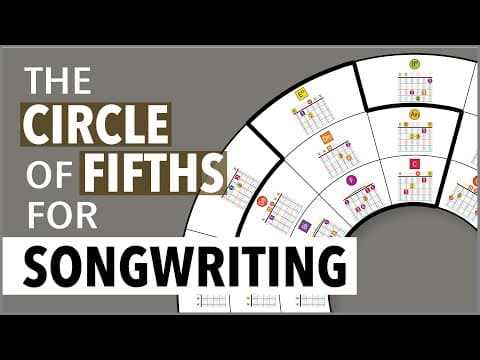
The Circle of Fifths is a powerful tool for songwriters, providing a visual representation of chord relationships and modes that can enhance creativity and facilitate the creation of compelling chord progressions.
The Circle of Fifths is a valuable resource for songwriters, yet many people misunderstand its purpose and complexity. Contrary to popular belief, it is not merely a complicated diagram of key signatures; rather, it serves as a powerful aid in the songwriting process, helping to generate unique chord progressions. This article explores how the Circle of Fifths organizes chords into groups, allowing songwriters to create unexpected sounds and expand their musical palette.
At its core, the Circle of Fifths illustrates how musical scales and keys are interconnected. While many visualize it as a ring of key signatures, it actually represents a continuous loop where all keys relate to one another. For instance, starting from the C major scale, the fifth note leads to the G major scale, which in turn connects to the D major scale, and so forth. This overlapping pattern forms a daisy chain that reveals the relationships between different keys.
To better understand the Circle of Fifths, it can be helpful to view it as a ring of chords instead of scales. Each neighboring chord is related, such as C, F, and G. By including minor chords and diminished chords, we can see how chords in each key are grouped together, indicating which harmonies are compatible. For example, in the key of C, the chords are:
This grouping allows songwriters to easily identify chords that work well together, facilitating the creation of harmonious chord progressions.
The Circle of Fifths not only helps in identifying compatible chords but also aids in transposing songs into different keys. For instance, the song "Can't Help Falling in Love" utilizes chords from the key of C, which can be easily transposed to other keys using the same chord relationships.
In addition to transposing, the Circle of Fifths allows songwriters to explore different modes. Modes are variations of the major scale, each with a unique sound based on its interval pattern. For example, the C major scale can produce the following modes:
Each mode shares the same set of notes but establishes a different tonic, or home base, which influences the overall sound.
By substituting the individual notes of each mode with their corresponding chords, songwriters can create progressions that reflect the unique character of each mode. For example, the Dorian mode can be expressed through its chords, allowing songwriters to explore new harmonic landscapes.
The Circle of Fifths provides a framework for experimenting with various chord progressions. For instance, the popular Pachelbel progression can be played in different keys while maintaining its harmonic integrity. By shifting the progression to different modes, songwriters can achieve fresh and unexpected sounds. For example, playing the Pachelbel progression in D Aeolian results in a more haunting and melancholic feel compared to its original major key.
The Circle of Fifths is an incredibly powerful tool for songwriters, offering insights into chord relationships and modes that can enhance creativity. By utilizing this diagram, songwriters can experiment with different keys and modes, leading to a nearly endless array of musical ideas. Understanding and applying the Circle of Fifths can significantly elevate the songwriting process, making it a crucial resource for musicians looking to expand their craft.