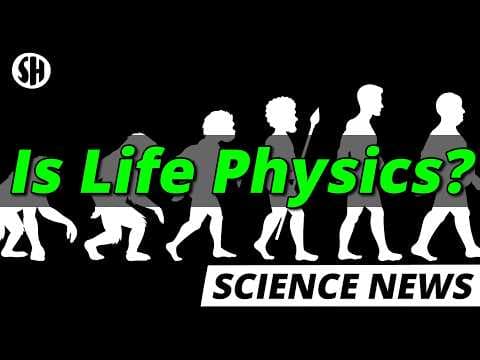
Recent research reveals how fundamental physics shapes life on Earth and potentially on other planets. By understanding the laws of physics, scientists can predict organism growth, movement, and resilience, leading to a unified theory of life that bridges biology and physics.
Physics has long been regarded as the "Queen of the Sciences," a title that underscores its foundational role in understanding the universe. This perspective is particularly relevant when considering how physics governs the laws of life, influencing everything from the growth of organisms to their movement. Recent research has shed light on these hidden rules, offering insights that not only apply to life on Earth but also to the search for extraterrestrial life.
Life does not operate in a vacuum; it is subject to the same physical laws that govern the universe. These include fluid dynamics, gravity, electrodynamics, friction, material strength, elasticity, and viscosity. These principles are not merely academic; they dictate how organisms grow and move, establishing a framework that is consistent across different environments and planets.
One fascinating aspect of physics in biology is how size affects movement. For instance, smaller creatures, like flies, are less influenced by gravity and more by friction and contact forces, allowing them to perform feats such as crawling on ceilings. In contrast, larger animals experience greater effects from inertia and gravity. This distinction leads to observable patterns in animal behavior, such as the correlation between body size and wing flap frequency in birds or the number of steps taken by animals with longer legs.
A groundbreaking paper published recently proposes that the growth of organisms can be predicted using fundamental constants of nature. The researchers argue that chemical bond energies and reaction rates, which are rooted in physics, play a crucial role in determining how organisms develop. They conclude that while the growth rate of life is sensitive to environmental temperature, the efficiency of energy use remains constant. This finding suggests that life could evolve on colder planets, albeit at a slower pace, expanding our understanding of where life might exist beyond Earth.
Another ambitious study explores scaling laws across various species of plants and animals. By applying principles of fluid dynamics and the physics of elastic materials, the researchers identified general relationships that govern how organisms of different sizes function. They discovered a parameter that distinguishes between viscous and inertial motion, effectively categorizing small and large animals. Their findings indicate that as organisms increase in size, they must either enhance their structural stiffness to prevent deformation or reduce their movement speed.
A third study delves into cellular biology, proposing a method to calculate the lifespan of a cell based on its power generation capabilities. The researchers suggest that the purity of the fluid within a cell is a critical factor in its functional resilience. This approach, while seemingly simplistic, offers a quantifiable way to assess cellular health across different tissues, potentially revolutionizing our understanding of biological aging and resilience.
While the integration of physics into biological research presents exciting possibilities, it is not without challenges. Historically, physicists have struggled to apply their theories to the complexities of biological systems, often leading to oversimplifications that fail to capture the nuances of life. However, the ongoing collaboration between these fields is essential for advancing our understanding of biology through a mathematical lens.
As research continues to evolve, it is likely that biology will increasingly adopt mathematical frameworks akin to those used in physics. This shift could lead to a more profound understanding of life’s complexities and the development of a unified theory of life that encompasses both disciplines. The future of biological research may very well hinge on the successful integration of these scientific domains.
The exploration of the physics underlying life is a burgeoning field that promises to reshape our understanding of biology and the potential for life beyond Earth. As researchers continue to uncover the hidden rules that govern living organisms, we stand on the brink of a new era in science—one where the boundaries between physics and biology blur, leading to groundbreaking discoveries and insights into the nature of life itself.