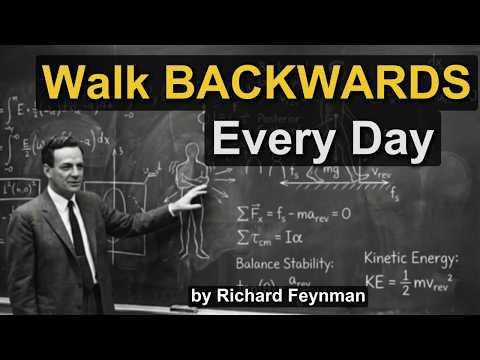
Forward walking is an automated motor pattern controlled by subcortical circuits, requiring minimal cognitive effort but providing little challenge to the brain's motor and sensory systems. Walking backwards disrupts this automation, forcing the cerebellum to actively compute each step, enhancing proprioception, balance, cognitive function, and reducing knee joint stress. Studies show reverse walking improves forward gait, flexibility, and brain regions affected by aging, making it a powerful, 0
Walking is one of the most automated motor functions our brain performs. The cerebellum manages the complex coordination of foot placement, stride length, hip extension, and arm swing without conscious effort, repeating this pattern thousands of times daily. However, this automation, while efficient, leads to a lack of challenge for the brain's motor control systems, especially as we age.
Central pattern generators located in the lumbar spinal cord produce the rhythmic flexion and extension of walking without direct brain input. The brain sets parameters like speed and direction, but the spinal circuits execute the pattern. The cerebellum coordinates timing, basal ganglia manage initiation and termination, and the motor cortex intervenes only when conscious adjustments are needed.
By adulthood, forward walking is deeply ingrained, with an estimated 100 million steps per year. Neural pathways controlling this gait are heavily myelinated and consolidated, requiring almost no cognitive engagement. This efficiency frees the cortex for other tasks but also means the cerebellum and proprioceptive systems are barely challenged during walking.
Because forward walking is so automated, the cerebellum operates on autopilot, making only minor corrections. This lack of challenge means the motor control systems that degrade with age receive almost no novel input. For older adults, walking on flat surfaces maintains cardiovascular fitness but does little to stimulate the brain regions responsible for balance, coordination, and motor planning.
This explains why forward walking does not reverse age-related decline in motor control or cognitive function. The cortex remains disengaged, and the proprioceptive system operates at minimal resolution, relying heavily on vision for spatial information.
Walking backwards disrupts the automated forward walking pattern entirely. The cerebellum must rebuild the gait cycle from scratch, actively computing foot placement, muscle activation timing, and balance without visual confirmation of foot placement.
This increased computational load forces the cerebellum into a learning state, recruiting more neural circuits and generating error signals that drive synaptic plasticity. This learning state contrasts with the execution state of forward walking, which maintains existing patterns at minimal metabolic cost.
Reverse walking changes the loading pattern on the knee joint, reducing patellofemoral compressive force by 30 to 40%. Unlike forward walking, which loads the knee eccentrically at heel strike, reverse walking involves concentric quadriceps contraction and forefoot or midfoot ground contact.
This altered loading vector distributes stress differently across the joint surfaces, reducing pain associated with patellofemoral pain syndrome common in adults over 50. The cartilage receives more balanced mechanical stimulation, improving nutrition and potentially slowing degenerative changes.
Forward walking relies heavily on vision for spatial planning, with proprioception supplementing. Reverse walking removes visual input for foot placement, forcing the cerebellum to increase reliance on proprioceptive signals. This recalibration enhances proprioceptive acuity, which typically declines with age.
Studies show that older adults engaging in reverse walking training improve single-leg balance scores within 4 to 6 weeks, even when forward walking metrics remain unchanged. The novelty of reverse walking challenges the integration system, leading to functional improvements.
Reverse walking is not only a motor task but also a cognitive challenge. It activates brain regions involved in working memory, executive function, and motor planning, such as the dorsolateral prefrontal cortex, premotor cortex, and supplementary motor area. These regions typically thin with age-related cognitive decline.
By forcing activation of these areas, reverse walking may help maintain cortical thickness and cognitive function. This dual motor-cognitive demand is unique compared to forward walking, which requires minimal cortical involvement.
These findings demonstrate that reverse walking can upgrade the entire locomotor system and promote neural plasticity even in damaged brains.
Safety is paramount, especially for older adults. Recommended protocols include:
The adaptation curve is steep initially, with the greatest neural benefit occurring in the first sessions. Initial instability and hyper-awareness are signs of effective cerebellar engagement.
Walking backwards is a simple, equipment-free intervention that challenges the brain and body in ways forward walking does not. It reactivates dormant neural circuits, improves balance and proprioception, reduces joint stress, and engages cognitive regions vulnerable to aging.
For older adults and those seeking to maintain or improve motor and cognitive function, incorporating reverse walking into daily routines offers a powerful, targeted approach to counteract the decline caused by decades of automated forward walking.
Ten minutes of walking backwards can make the cerebellum and brain work again, promoting health and function beyond what forward walking alone can achieve.