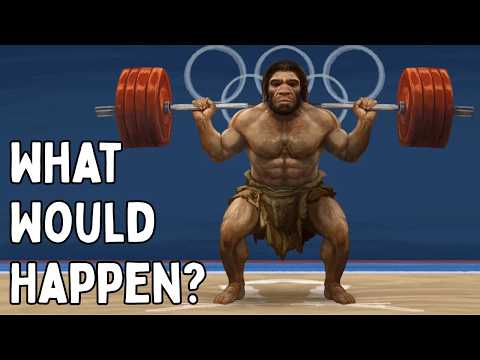
Exploring the hypothetical scenario of Neanderthals competing in the Summer Olympics reveals their potential dominance in strength and power sports due to their robust build and muscle composition. However, modern humans might excel in endurance and flexibility events. This analysis covers various Olympic sports, comparing physical and anatomical traits of Neanderthals and modern humans to predict outcomes.
The Summer Olympics, or the Olympiad, is one of the most prestigious and widely watched international sporting events, occurring every four years since 1896 (with some exceptions). It pits nation against nation to determine the best athletes on the planet. However, the competition is exclusively among modern humans (Homo sapiens), which makes the outcome somewhat predictable. But what if extinct human species, such as Neanderthals, were included in the Olympics? How would they fare against us?
Neanderthals are our closest extinct human relatives, belonging to the same genus Homo. They were physically quite different from modern humans, with a more robust and muscular build. Despite being shorter on average, Neanderthals were significantly stronger and built like "little tanks." Their average height was about 5.5 inches (14 cm) shorter than modern humans, with the tallest individuals reaching around 5'10" (1.78 m).
Neanderthals' immense strength and shorter limbs would give them an advantage in Olympic weightlifting events like the snatch and clean and jerk. Estimates suggest an average male Neanderthal could bench press up to 500 lbs (200 kg), and females could clean 350 lbs (160 kg), placing them at elite modern human standards even without training.
Their lower center of gravity, wider pelvis, and massive muscles would make Neanderthals formidable in wrestling and judo. Their dense bones and thick skulls would provide resilience against blows, making them tough opponents in boxing despite shorter reach. Their powerful punches would be a significant offensive advantage.
Thanks to their explosive power and lung capacity, Neanderthals might outperform modern humans in short sprints and certain cycling events. Their fast-twitch muscle fibers would enable rapid bursts of speed.
Neanderthals' strength would be advantageous in throwing events requiring raw power. However, modern humans' longer arms and greater range of motion might give them an edge in events like the javelin throw.
Despite their robust build, Neanderthals might be natural climbers due to their lifestyle in rugged mountainous terrain, strong grip, and muscular upper bodies. Olympic climbing requires speed and power, which align with Neanderthal physical traits.
Their strong grip and speed could make Neanderthals competitive in fencing and ping pong, where quick reflexes and powerful strikes are essential.
Modern humans have a longer, thicker Achilles tendon acting as a biological spring, making us more efficient at endurance running. Neanderthals' longer, thinner Achilles tendons and higher energy expenditure would cause them to fatigue faster.
These sports require sustained energy, agility, and reach. Modern humans' longer limbs and endurance would likely give them an advantage over Neanderthals.
Height is crucial in these sports. Neanderthals' shorter stature would be a disadvantage, especially in reaching above the net or opponents.
Rowers tend to be tall with long limbs for powerful strokes. Although Neanderthals have great strength and lung capacity, their shorter limbs might limit their rowing efficiency.
Flexibility, nimbleness, and fluidity are essential in gymnastics. Neanderthals' robust and likely less flexible bodies would struggle in these events.
These sports require sustained focus, planning, and adaptability. Modern humans' larger frontal neocortex might provide better cognitive abilities for these sports. However, Neanderthals' large brains and possible seafaring skills could make them competitive sailors.
While Neanderthals likely swam frequently (evidenced by a high prevalence of surfer's ear), their stocky build and dense bones would increase drag and weight, making them less efficient swimmers compared to tall, slim modern humans.
Contrary to stereotypes, Neanderthals were intelligent and capable of complex behaviors. They had large brains (males averaging 1,640 cm³, females 1,460 cm³), larger than modern humans by about 30%. Their brains were shaped differently, with enhanced visual processing areas, which could aid in sports requiring sharp eyesight like archery and shooting.
They possessed fine motor skills and strong grip strength, enabling them to handle tools and weapons effectively. This suggests they could learn and apply techniques, strategies, and teamwork necessary for Olympic sports.
If Neanderthals joined the Olympics, they would dominate in strength and power-based sports such as weightlifting, wrestling, and throwing events. Their explosive power and lung capacity would make them competitive sprinters and climbers. However, modern humans would likely outperform them in endurance, flexibility, and height-dependent sports.
Overall, including Neanderthals in the Olympics would add a fascinating dynamic, showcasing the diverse capabilities of human relatives. Unfortunately, this remains a hypothetical scenario, as Neanderthals are extinct and unlikely to make a comeback in competitive sports.
The thought experiment highlights the remarkable adaptations of both species and how physical and anatomical differences influence athletic performance across various disciplines.