This blog post explores the significance of storytelling in healthcare and community building, emphasizing how narratives shape our beliefs, behaviors, and sense of agency. Elizabeth Mutreax discusses the importance of recognizing and rewriting our personal and collective stories to foster fulfillment and connection, particularly in the context of burnout and purpose-driven lives.
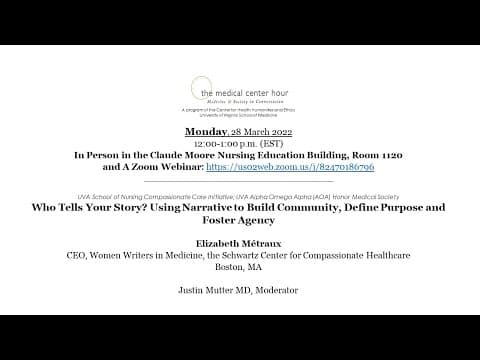
In a recent discussion at the UVA Medical Center, Elizabeth Mutreax, founder and director of Women Writers in Medicine, explored the profound impact of storytelling in healthcare and community building. The event, moderated by Justin Mutter, highlighted how narratives shape our identities, influence our behaviors, and can be harnessed to foster agency and purpose.
Mutreax opened the conversation by emphasizing that we are all steeped in stories—those we tell about ourselves and those told about us. These narratives can be loud or subtle, and they intersect in various ways, particularly in the realm of health and healthcare. The key question posed was: How do we take hold of our many stories and steer them toward good?
To illustrate the power of storytelling, Mutreax engaged the audience in a familiar tale: the story of a knight slaying a dragon. This exercise prompted participants to explore the motivations behind the knight's actions, the role of the dragon as a villain, and the community represented by the knight. Through this interactive approach, Mutreax demonstrated how stories can reflect societal values and beliefs.
Mutreax, who has a background in medical anthropology, discussed her research on burnout among healthcare professionals. She noted that narratives in healthcare often focus on exhaustion and distress, particularly in the wake of the COVID-19 pandemic. However, she encouraged a shift in perspective by asking clinicians to recount their last great day at work, revealing that fulfillment often comes from a sense of purpose and community.
Language plays a crucial role in shaping our narratives. Mutreax highlighted how the words we choose can influence our beliefs and behaviors. For instance, the difference between saying "something made me happy" versus "something brings me joy" reflects a shift from external validation to internal fulfillment. This distinction is vital in creating a narrative that empowers individuals rather than one that reinforces feelings of inadequacy or burnout.
Mutreax emphasized the importance of questioning the narratives we accept about ourselves and our environments. She encouraged participants to consider whose stories they are living and to challenge societal norms that dictate what success and fulfillment should look like. By actively engaging in the process of storytelling, individuals can reclaim their agency and rewrite their narratives.
A significant takeaway from Mutreax's discussion was the importance of community in fostering a sense of belonging and purpose. She cited research indicating that strong community ties are linked to greater happiness and fulfillment. Identifying and nurturing these connections can help individuals navigate the challenges of burnout and find meaning in their work.
To facilitate the process of rewriting narratives, Mutreax suggested several practical steps:
The conversation concluded with a call to action: to actively engage in the stories we tell and to recognize the power of narrative in shaping our identities and communities. By embracing our roles as storytellers, we can foster agency, redefine our experiences, and build supportive networks that enhance our well-being.
In a world where narratives can often feel overwhelming, the ability to rewrite our stories offers a path toward fulfillment and connection. As Mutreax poignantly stated, "There is no greater tragedy than bearing the untold story."