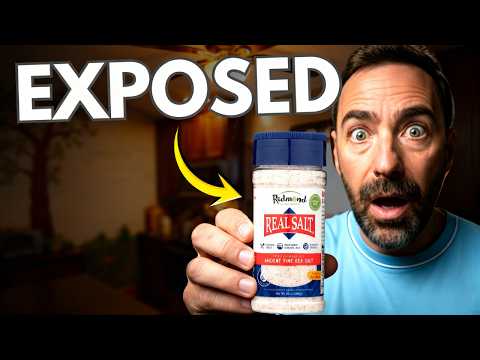
After years of recommending Redmond's Real Salt, I decided to switch due to concerns about heavy metal contamination, ancestral appropriateness, and mineral content. This article explores the reasons behind my decision, including insights from experts, lab tests, and comparisons with alternative sea salts that offer safer and more beneficial mineral profiles.
In this article, I want to share my journey and reasoning behind switching away from Redmond's Real Salt, a product I have recommended for a long time. This decision was not made lightly, and I hope to provide you with comprehensive information so you can make your own informed choices about the salt you consume.
Talking about salt, especially within the carnivore and keto communities, can be as sensitive as discussing politics or religion. Many people have strong tribal loyalties to certain salt brands, particularly Redmond's Real Salt, which has been the de facto standard for many in the metabolically healthy space.
I urge readers to be open-minded. I am not telling anyone what to do but sharing my personal experience and the reasons behind my switch. This is especially important for newcomers who may be unfamiliar with the different types of salts like Redmond salt, Maldon salt, or Himalayan pink sea salt.
My awareness of potential issues with salt began over a year ago after watching a video by Paul Saladino. He highlighted concerns about heavy metals such as aluminum, arsenic, cadmium, and lead present in some salts, including Redmond's. Paul Saladino's detailed breakdown of major salts and their heavy metal content was eye-opening.
Following that, I watched a video by Max German, who provided a deep dive into popular salt brands and their toxic contaminants. Max's research showed that many salts marketed as clean and healthy actually contain substances that can inflame the gut and accumulate in the body over time.
Despite the backlash Max received, including accusations of being unfair or overly critical, his video was well-researched and supported by studies. This further pushed me to investigate the salt I was using.
As a carnivore, salt is a significant part of my diet. Unlike the standard American diet, where much sodium comes from processed foods, I add salt to nearly every meal—beef, butter, bacon, eggs, and water. This means the quality and safety of the salt I consume have a much larger impact on my health.
I follow simple rules based on what is ancestrally appropriate. Humans have consumed meat, water, and salt for millennia, but the way salt is harvested today is very different from ancestral methods.
Redmond's salt is mined from deep underground using heavy machinery, explosives, and dynamite. This mining process exposes the salt to heavy metals and other contaminants present in the earth. In contrast, our ancestors harvested salt from the surface or by evaporating seawater, methods that are more natural and less likely to introduce harmful substances.
Redmond's own documentation acknowledges lead levels up to 200 parts per billion (ppb) in their salt, with independent lab tests showing even higher levels around 290 ppb, along with arsenic at 91 ppb. These levels are considered unsafe, especially for children.
For comparison, the alternative salt I switched to, Salter Electrolyte Mineral Sea Salt from Norway, contains only about 30 ppb of lead. While some may argue that the dose matters, the frequency of consumption is critical. Consuming salt with elevated heavy metals multiple times daily over years can lead to bioaccumulation, particularly since lead has a half-life in bones of 20 to 30 years.
Redmond's Real Salt is approximately 99% sodium chloride with only 1% trace minerals. In contrast, Salter's Norwegian sea salt contains about 89.7% sodium chloride and 10.25% trace minerals such as magnesium, potassium, and calcium.
Salter further enhances their product by adding magnesium and potassium, resulting in a final composition of 84.3% sodium chloride and 15.7% trace minerals. These minerals are essential electrolytes that the body needs, especially on a carnivore diet.
This difference means that with Salter, you get significantly more beneficial minerals and far fewer harmful heavy metals.
Another concern with sea salts is microplastics contamination. While some sea salts have been found to contain microplastics, I have researched and concluded that the risk from heavy metals in mined salts like Redmond's is more concerning due to their long-term accumulation in the body.
I hope that more testing will be done to compare sea salts and mined salts regarding both heavy metals and microplastics, so consumers can better understand the pros and cons.
After learning all this, I have stopped using Redmond's Real Salt for myself and my family. I am no longer offering it on my website and have switched to Salter's sea salt, which I believe is a safer and more ancestrally appropriate choice.
We now offer portable travel-sized Salter salt shakers, which are convenient for use on the go. This is especially useful since many restaurants and family gatherings only provide processed table salt, which often contains anti-caking agents and dextrose (sugar).
Purchasing these supports Healing Humanity, an initiative focused on promoting a proper human diet and health education.
Salt is a fundamental part of the carnivore diet and overall health. Choosing the right salt matters, especially when consumed multiple times daily over a lifetime.
I share this information not to criticize but to inform and empower you to make your own decisions. If you have additional knowledge or differing opinions, I welcome your comments and discussion.
Thank you for reading and considering this important aspect of your diet and health.