
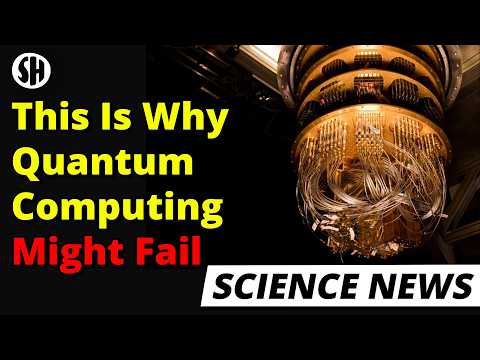
Quantum computers, which rely on quantum physics and entanglement, hold promise for solving complex problems faster than classical computers. However, a small minority of physicists and computer scientists are skeptical about their feasibility due to fundamental issues like noise, error correction, and the true nature of quantum mechanics. This article explores these skeptical viewpoints and the challenges quantum computing faces.
Quantum computing is often hailed as the next frontier in technology, promising to revolutionize how we solve complex problems. These devices operate on quantum bits, or qubits, leveraging the principles of quantum physics, particularly entanglement, to perform calculations that are impossible for classical computers. However, despite the excitement, there exists a small but significant minority of physicists and computer scientists who doubt that quantum computers will ever truly work as intended. This article delves into their arguments and the challenges facing quantum computing.
Quantum computers already exist in prototype forms, albeit very small ones. Their power lies in qubits, which can exist in multiple states simultaneously thanks to quantum superposition and entanglement. Entanglement is a unique quantum correlation that enables quantum computers to perform certain mathematical operations much faster than classical computers.
Physicists are excited because, if quantum computers can be scaled up sufficiently, they could solve difficult calculations rapidly. These calculations could translate into valuable products or services, potentially generating significant economic returns. However, practical and commercially useful quantum computers are still a long way off.
While most physicists remain optimistic, some experts express skepticism about the feasibility of quantum computing. Their concerns stem from fundamental issues in quantum physics and the practical challenges of building large-scale quantum machines.
One major concern is that quantum physics is not fully understood, especially when it comes to large-scale systems. Quantum effects tend to diminish as objects become larger, a phenomenon not yet fully explained. Since quantum computers require maintaining quantum effects like entanglement across many qubits, this lack of understanding raises doubts about whether such machines can ever be realized.
Noise—unwanted disturbances affecting qubits—is a critical problem. Some experts argue that noise will inevitably prevent quantum computers from outperforming classical ones:
Although these experts have relevant credentials, their arguments lack precise quantitative predictions, which may explain why their views are not widely accepted.
Some physicists believe that quantum mechanics itself is not the ultimate theory of nature, which would imply limitations on quantum computing:
If Palmer's estimate is correct, the window for useful quantum computing is very narrow.
Other skeptical views come from proposed modifications to quantum mechanics, such as spontaneous localization and Penrose's collapse model. These models treat the collapse of the wave function as a real physical process rather than a mysterious phenomenon.
It is important to note that skepticism about quantum computing comes from a small minority. Most physicists believe quantum computers will eventually work as predicted by quantum mechanics. However, history shows that some ideas once considered fringe—like tectonic plate theory or germ theory—were later proven correct. This underlines the value of considering skeptical perspectives.
Quantum computing remains an exciting but uncertain field. While the majority of experts are optimistic, a small group raises valid concerns about fundamental physics, noise, error correction, and the nature of quantum mechanics itself. Whether quantum computers will ultimately fulfill their promise or face insurmountable obstacles remains to be seen.
Personally, the outcome is worth celebrating either way: if quantum computers work, it will be a monumental achievement; if they don't, it will deepen our understanding of the universe.
As we look forward to future developments in quantum computing and science, it is essential to maintain a critical and open-minded approach to new technologies and theories. The journey of discovery is ongoing, and every perspective contributes to our collective knowledge.



















