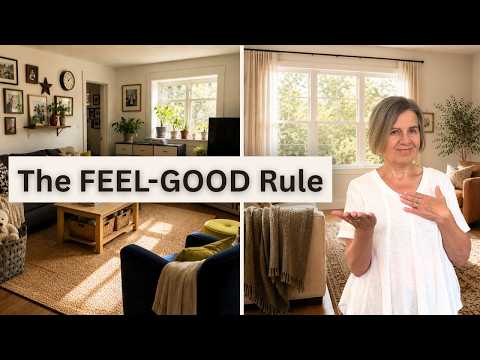
This article explores the psychology behind why certain homes feel more relaxing and inviting. It discusses how ease of movement, natural elements, personal touches, and thoughtful attention to the environment contribute to a home's comforting atmosphere, often more than expensive decor or perfect matching. The key to a beautiful home lies in creating a space that supports presence, recovery, and emotional well-being.
We've all experienced walking into a home and immediately feeling more relaxed, comfortable, or even lighter. Sometimes, these homes aren't large or expensive, yet something about them makes you want to stay. Conversely, some homes look objectively beautiful with everything perfect and new, but somehow they feel forgettable.
For a long time, it was assumed that this feeling came down to money, better taste, or expensive furniture. However, years of observing homes and how people experience living in them reveal something deeper.
When you enter certain spaces, your body reacts instantly. You might find yourself moving around furniture awkwardly, your eyes jumping from object to object with no place to settle. Homes that feel good often feel surprisingly easy to navigate. The moment feels effortless.
For example, when you open the door, nothing fights you. The entryway is well organized, and your eyes naturally land somewhere pleasant—perhaps a piece of art or a window. Nothing screams for attention all at once. Your body feels no friction and can relax. This ease of movement and processing is a key reason why some homes immediately feel good.
Interestingly, ease often reads as luxury.
The design world has long taught that beautiful homes should match perfectly—matching sofas, chairs, colors, and sets. At first glance, this can look polished but often feels flat, too controlled, and too finished.
Homes that feel beautiful usually do something different: they repeat instead of match. For instance, the same warm wood tone might appear in several places, or curved shapes might repeat throughout the room. There may be contrast, but it follows a rhythm. Nothing is identical, but everything feels related.
Nature works this way too. A forest repeats colors, textures, and shapes without anything perfectly matching. People unconsciously respond to this feeling.
Perhaps the most important difference is that homes that feel good almost always contain more living and natural elements—not necessarily expensive ones. This includes wood floors, wood furniture, natural fibers, stone, and plants.
Our bodies recognize these elements instinctively because, for most of human history, these were the environments we lived in. Homes with mostly manufactured surfaces—glass tables, plastic finishes, artificial plants, highly processed materials—often feel colder and disconnected.
Even expensive silk plants rarely create the same feeling as real plants. They may look convincing but don't bring growth, change, or life into the room.
If real wood furniture isn't in the budget, wood veneers with visible grain often feel warmer and more grounded than perfectly smooth synthetic surfaces. People often underestimate how much materials influence a room's feel. Our nervous system feels soothed by nature.
There are many affordable ways to incorporate nature. For example, nature art instead of abstract art, or keeping shades open during the day to enjoy views of trees, sky, and clouds. A home begins to feel more alive when more life is actually present.
Another noticeable difference in memorable homes is that they feel like they have a soul—not because they're dramatic or expensive, but because they feel personal.
You might see books someone clearly loves, objects collected over time, art that reminds them of a place or memory, plants with character, and things chosen slowly. Nothing feels random or staged.
In contrast, some homes feel assembled. Everything is technically beautiful but could belong to almost anyone. This often happens because people are surrounded by images of perfect interiors and buy objects to complete the look.
Homes that feel good usually don't feel assembled; they feel collected over time. You can sense when someone lives with things instead of merely arranging them. Sometimes, decorated and staged homes feel like museums of dead things.
A home starts feeling good when it reflects a real person. This feeling has almost nothing to do with budget.
Some homes are beautiful yet tiring because there is a lot happening—too much to look at, too many competing elements. Even beautiful things become exhausting when everything competes equally.
Other homes feel different. They don't demand anything from you. The lighting is softer, there is more breathing room, and your eyes can rest. Maybe there is texture instead of visual noise, fewer objects but each one matters more. The room still has personality but also gives something back.
Many homes people describe as beautiful are actually helping the nervous system slow down. This is especially important in bedrooms. When nothing constantly asks for your attention, you can finally feel yourself better.
For a long time, it was thought that beautiful homes were mostly about taste. Now, it seems they are more often about attention.
Homes that stay with us usually reveal something about the people who live there—not status or trends, but attention. Someone cared about how it feels to come back home from a stressful day or how to wake up there. Someone slowly shaped the space around what nourishes them.
People feel this immediately—not consciously with their mind, but emotionally. The homes we remember usually aren't the most expensive ones. They're the ones that make us slow down and feel more like ourselves.
Maybe what we call a beautiful home isn't beauty at all. Maybe it's ease, presence, recovery, and life. Maybe the homes that stay with us are the ones that quietly support us instead of constantly demanding something from us.
The good news is that creating this feeling usually has much less to do with money than people think. It starts with paying attention and slowly shaping your environment around the way you actually want to feel there.
By focusing on ease of movement, incorporating natural elements, personalizing your space, and allowing for simplicity and rest, anyone can create a home that feels both beautiful and supportive.
If this topic resonates with you, exploring how our homes affect us in ways we don't always notice can be deeply rewarding. Creating a soulful home is about nurturing your well-being through thoughtful design and attention.