This article explores the mathematical improbability of random mutations and natural selection generating new functional genetic information. It discusses the combinatorial problem in DNA evolution, critiques the punctuated equilibrium theory, and presents the intelligent design perspective as a more plausible explanation for the origin of complex biological information and major innovations in life.
When discussing the information encoded in DNA, a common argument in favor of evolution is that given enough time and enough trials, random mutations combined with natural selection will eventually produce complex life forms that appear designed, even though they are not. The idea is that beneficial mutations are preserved, leading to new functional biological structures. But why might this explanation not work?
A profound mathematical problem, often called the combinatorial problem or combinatorial inflation, challenges the idea that random mutations can generate new functional information in DNA. To understand this, consider an analogy from software development. In functional software code, random changes to the sequence of zeros and ones almost always degrade the code rather than improve or create new functionality.
DNA operates similarly to digital code or machine code, as noted by biologists like Richard Dawkins and Leroy Hood. Random changes in such a system overwhelmingly lead to non-functional sequences (gibberish) rather than functional ones. This is because there are vastly more ways to arrange the characters in a non-functional manner than in a functional one.
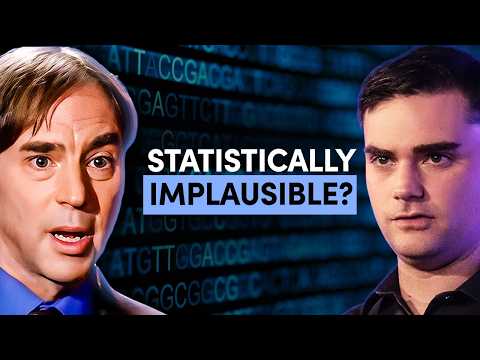
Douglas Axe, a scientist with extensive molecular biology research experience, quantified this rarity. For a relatively short protein of about 150 amino acids, he found that the ratio of functional to non-functional sequences is approximately 1 in 10^77. To put this in perspective, there are only about 10^65 atoms in the Milky Way galaxy. This means that searching randomly for a new functional protein sequence is like looking for one marked atom among a trillion galaxies the size of the Milky Way.
Even considering four billion years of life's history, this search space is too vast to be realistically explored by random mutation and natural selection. There have only been about 10^40 organisms in Earth's history, which is insufficient to search a space as large as 10^77. Therefore, the probability that random mutation and natural selection alone could generate new functional genetic information is overwhelmingly low.
This mathematical challenge suggests that the hypothesis that mutation and natural selection produce new information is more likely false than true. Consequently, it is more plausible that the complex information in DNA is designed rather than the product of random processes.
This perspective aligns with observations in the fossil record, where there are abrupt jumps rather than a continuous, gradual accumulation of mutations. This phenomenon is discussed in the book "Darwin's Doubt," which highlights the discontinuities in the fossil record that challenge the traditional Darwinian model.
Stephen J. Gould proposed the theory of punctuated equilibrium to explain these jumps, suggesting that small groups of organisms diverged, underwent rapid evolutionary changes, and then reintegrated. However, this theory faces criticism because it relies on species selection, which itself depends on the mutation and natural selection mechanism that requires vast amounts of time to generate new information.
The abrupt jumps observed in the fossil record do not allow enough time for this mechanism to work effectively. Thus, while punctuated equilibrium describes the fossil record more accurately, it lacks a plausible mechanism to explain the origin of new complex biological information.
From a design perspective, the question arises: how do one species become another suddenly? Is it due to activation of dormant DNA or injection of new information?
The concept of "envelopes of variability" suggests that while there is evolution within certain limits, the major innovations in life require new information beyond these envelopes. James Shapiro, a biologist at the University of Chicago, introduced the theory of natural genetic engineering, which posits that many mutations are not random but are pre-programmed adaptive responses to environmental stress.
This pre-programmed adaptive capacity means organisms have built-in genetic information that can be expressed in response to external triggers. While this explains some evolutionary changes, it raises the question of the origin of this pre-programming.
Intelligent design proposes that the input of new information from an intelligence is responsible for this pre-programmed capacity. This theory acknowledges evolution within limits but attributes the origin of new complex information to an intelligent cause rather than random mutation.
The mathematical improbability of random mutations generating new functional genetic information, combined with the fossil record's abrupt jumps and the limitations of punctuated equilibrium, challenges the traditional Darwinian model of evolution. The concept of pre-programmed adaptive capacity and the intelligent design perspective offer alternative explanations that better account for the origin of complex biological information and major innovations in life.
This discussion invites further exploration into the mechanisms behind life's complexity and encourages a critical examination of evolutionary theory in light of mathematical and empirical evidence.