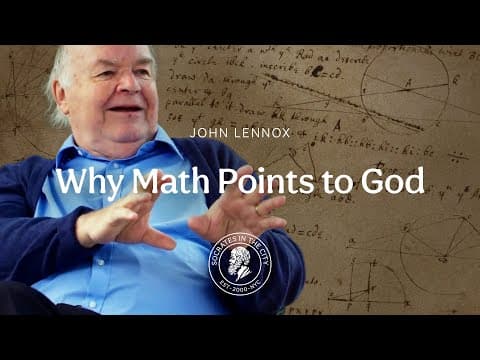
Professor John Lennox explores the profound connection between mathematics, science, and faith in God. He argues that the astonishing ability of mathematics to describe the natural world is not a mere coincidence but points to a divine creator. Drawing on insights from great scientists like Einstein and Wigner, Lennox explains why science and belief in God are not only compatible but mutually reinforcing.
Mathematics has fascinated many, but few have explored its deeper implications as profoundly as Professor John Lennox. Growing up in Northern Ireland with inquisitive Christian parents, Lennox was encouraged to think freely and explore various worldviews, including those vastly different from his own. This early intellectual freedom set him on a lifelong journey to understand the relationship between mathematics, science, and faith.
From a young age, Lennox was captivated by mathematics. Unlike many who find math difficult or uninteresting, he was drawn to its beauty and logic. However, his curiosity extended beyond pure mathematics; he wanted to understand how math fit into the broader scientific picture and, ultimately, how science related to faith.
His parents played a crucial role in nurturing this curiosity. For example, at age 13, his father gave him a copy of the Communist Manifesto, encouraging him to read it despite not having read it himself. This openness to diverse ideas helped Lennox develop a Socratic approach to questioning and understanding the world.
Lennox challenges the common notion that science and faith are opposing forces. He points out that the word "faith" has multiple meanings: it can refer to religious belief or to trust and confidence in something. Importantly, he argues that science itself is founded on a form of faith — trust in the consistency and reliability of natural laws.
He emphasizes that faith in God and science are not mutually exclusive but deeply intertwined. This perspective aligns with the views of historical figures like Galileo, Kepler, and Newton, who saw their scientific work as revealing the divine order of the universe.
One of the most compelling points Lennox discusses is the "unreasonable effectiveness of mathematics," a phrase coined by physicist Eugene Wigner in 1961. Wigner marveled at how abstract mathematical concepts, developed without any direct reference to the physical world, so accurately describe natural phenomena.
Albert Einstein famously remarked that the most incomprehensible thing about the universe is that it is comprehensible. Similarly, Nobel laureate Richard Feynman expressed amazement that mathematics works so well in explaining the physical world.
Lennox highlights examples such as Newton's laws of motion and gravity, which, despite being centuries old, still enable us to send astronauts to the moon. This remarkable correspondence between mathematical theory and physical reality raises profound questions about why the universe is so orderly and intelligible.
For Lennox, the only reasonable explanation for the effectiveness of mathematics in science is faith in God. He argues that without belief in a rational creator who designed the universe with order and purpose, the success of mathematics in describing nature would be inexplicable.
This is a radical stance, as it reverses the common assumption that science leads away from belief in God. Instead, Lennox suggests that doing science well actually requires a foundation of faith in a rational, law-giving deity.
Professor John Lennox's reflections invite us to reconsider the relationship between science and religion. Far from being in conflict, he presents a compelling case that the mathematical order of the universe points to a divine creator. The faith that underpins scientific inquiry and the Christian faith in God are not only compatible but mutually reinforcing.
This perspective encourages a holistic understanding of reality, where the pursuit of scientific knowledge and spiritual belief enrich and inform each other, continuing a tradition established by some of history's greatest thinkers.