The US is facing a precarious financial situation where a recession could exacerbate an already high federal deficit, leading to catastrophic economic consequences. This post explores the relationship between government spending, revenue, and the implications of a recession on national debt.
The prospect of a recession in the United States raises significant concerns, particularly regarding the federal deficit, which currently stands at a staggering 7% of GDP. This blog post delves into the reasons why the US cannot afford a recession and explains how a recession acts as a margin call on the nation’s debt.
To understand the financial dynamics at play, we must first examine the two sides of the government’s balance sheet: expenditures and revenue. The government does not create value in the same way businesses do; instead, it derives its income primarily from taxes, skimming off the economic output generated by the private sector.
Government expenditures have been on a parabolic uptrend for decades. When adjusted for GDP, it becomes evident that government spending has consistently outpaced economic growth. For instance, during the dot-com bubble in the early 2000s, government spending grew significantly faster than GDP. This trend continued through the Great Financial Crisis of 2008 and the COVID-19 pandemic in 2020.
In a recession, government expenditures typically increase due to automatic stabilizers such as unemployment benefits and social safety nets. Historical data shows that during the dot-com recession, expenditures rose by 13%, and during the 2008 recession, they increased by 9%. On average, government spending is expected to rise by about 11% during a recession, which would push the current federal budget of approximately $7 trillion to around $8 trillion.
Conversely, government revenue, primarily derived from taxes, tends to decline during economic downturns. This decline is particularly pronounced during recessions, as businesses fail and unemployment rises, leading to a reduced taxable base. For example, during the dot-com bubble, revenue as a share of GDP fell by 24%, and during the 2008 recession, it dropped by 32%. Currently, government revenues stand at about $5.4 trillion, and a similar decline could reduce this figure to approximately $3.9 trillion.
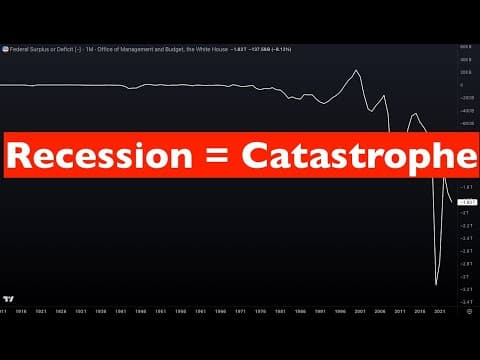
The interplay between rising expenditures and falling revenues during a recession leads to a widening fiscal deficit. Historical data shows that during the 2008 recession, the fiscal deficit increased significantly, reflecting the growing gap between government spending and revenue.
As of now, the US is operating with a $2 trillion deficit, which is about 7% of GDP. If a recession were to occur, and GDP were to fall by 7% (similar to past recessions), the deficit could balloon to approximately $4 trillion, representing nearly 18% of GDP. This level of deficit is unprecedented outside of wartime or severe economic crises.
The relationship between government debt and GDP is critical to understanding the potential consequences of a recession. Since the end of the gold standard in 1971, US debt has grown at an alarming rate, outpacing GDP growth significantly. While GDP has increased by 2,300%, the gross federal debt has surged by 8,500%, and interest expenses have risen by 5,500%. This trend indicates that the US is accumulating debt at a rate that far exceeds its economic growth, creating a precarious financial situation.
As the deficit increases, the government faces higher interest expenses, which are often financed by issuing more debt. This creates a vicious cycle where rising debt leads to higher interest payments, further exacerbating the deficit. If the economy contracts during a recession, the government’s ability to manage this debt becomes increasingly strained, leading to potential financial instability.
The current fiscal landscape suggests that the US is ill-prepared for a recession. With a starting deficit of 7% of GDP, any economic downturn could push the deficit to levels that would necessitate extreme measures, such as quantitative easing or significant money printing. This scenario could lead to high inflation and a further erosion of purchasing power for everyday Americans.
In summary, the US cannot afford a recession without facing dire economic consequences. The interplay between government spending, revenue, and debt dynamics creates a precarious situation that requires careful consideration and proactive measures to avoid a financial crisis.