The IMF's July 2025 World Economic Outlook Update highlights a modest recovery in global growth, driven by reduced tariffs and improved trade conditions. However, persistent uncertainties, geopolitical tensions, and high public debt pose significant risks. Key recommendations include restoring trade stability, maintaining central bank independence, and implementing structural reforms to enhance productivity.
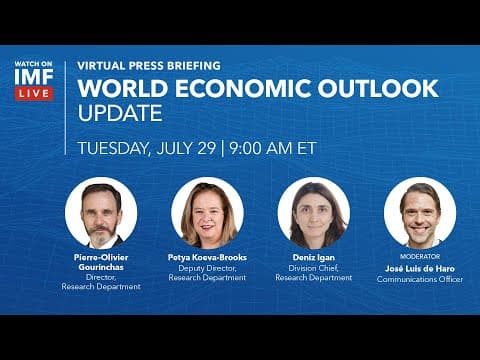
In a recent virtual press briefing, the International Monetary Fund (IMF) introduced its latest World Economic Outlook (WEO) update titled "Global Economy: Tenuous Resilience Amid Persistent Uncertainty." This update provides insights into the current state of the global economy, highlighting both positive developments and ongoing challenges.
The IMF publishes two comprehensive World Economic Outlook reports annually, in April and October, during its spring and annual meetings, respectively. In addition, two interim updates are released in January and July. The July update focuses on a limited set of countries and includes new global outlooks, risks, and policy recommendations.
Global trade developments have significantly influenced the economic outlook. Following a period of heightened tariffs, the United States has partially reversed its course, pausing higher tariffs for most trading partners. This de-escalation, particularly in trade tensions with China, has led to a modest reduction in the U.S. effective tariff rate from 24% to approximately 17%. Despite these improvements, tariffs remain historically high, contributing to ongoing uncertainty in global policy.
The IMF has revised its global growth projections upward, increasing the forecast from 2.8% to 3% for 2025 and from 3% to 3.1% for 2026. Most regions are experiencing modest growth upgrades, driven by improved financial conditions and a depreciation of the U.S. dollar by about 8% since January. However, global growth remains disappointingly below pre-COVID averages, with a persistent decline in global trade as a share of output expected.
Despite the positive revisions, the outlook remains precarious. The potential for tariffs to reset at higher levels after August 1st poses a significant risk, with model-based simulations suggesting a possible 0.3% reduction in global output by 2026. Additionally, ongoing trade uncertainty could weigh heavily on investment and economic activity, particularly if demand for stockpiled goods does not materialize.
While global inflation continues to decline, recent data indicates that inflation pressures are gradually building in the U.S. Import prices have remained stable or increased, suggesting that the burden of tariffs will ultimately fall on U.S. retailers and consumers. High public debt and elevated deficits in many countries remain a concern, particularly as financial conditions tighten.
The IMF emphasizes the need for prudent policies and improved collaboration among nations. Key recommendations include:
China's growth projection has been raised by 0.8 percentage points to 4.8% for 2025, driven by strong export performance and reduced tariff levels. However, domestic demand remains weak, raising concerns about the sustainability of this growth momentum.
The U.S. economy is experiencing a modest recovery, but the potential for renewed tariff increases poses risks to growth and inflation.
India's growth remains stable at 6.4% for 2025, supported by reforms and public investment. Continued efforts in job creation and infrastructure investment are essential for sustaining this momentum.
Saudi Arabia's growth outlook has been revised upward due to increased oil production, while Egypt's growth has been adjusted based on better-than-expected data in non-manufacturing sectors.
Sub-Saharan Africa is projected to grow at 4% in 2025, with challenges including regional conflicts and high debt levels. Structural reforms are critical for enhancing growth prospects in the region.
The IMF's July 2025 World Economic Outlook Update underscores a fragile recovery in the global economy, characterized by modest growth and persistent uncertainties. Policymakers are urged to prioritize stability in trade, maintain central bank independence, and implement structural reforms to foster long-term productivity. As the world navigates these challenges, collaboration and prudent policy measures will be essential for sustaining economic resilience.