Editorial Team
5 min read
Alibaba fell 5% by midday in Hong Kong as investors faced reported U.S. plans to restrict offshore access to advanced AI chips, alongside concerns over its chip spin-off and consumer demand.
Alibaba Group, the Chinese e-commerce and cloud-computing company, fell 5% by midday in Hong Kong on November 12 as investors weighed several pressures alongside reported U.S. plans to restrict access to advanced AI chips overseas. The policy report raises a supply question for a company that announced at least RMB380 billion in cloud and AI infrastructure investment over three years in February 2025.
The potential restriction concerns computing services as well as hardware: Chinese companies could lose access to processors they use remotely without importing the chips. But the reported rule was still undergoing interagency consultation, and the share decline cannot be attributed to that prospect alone.
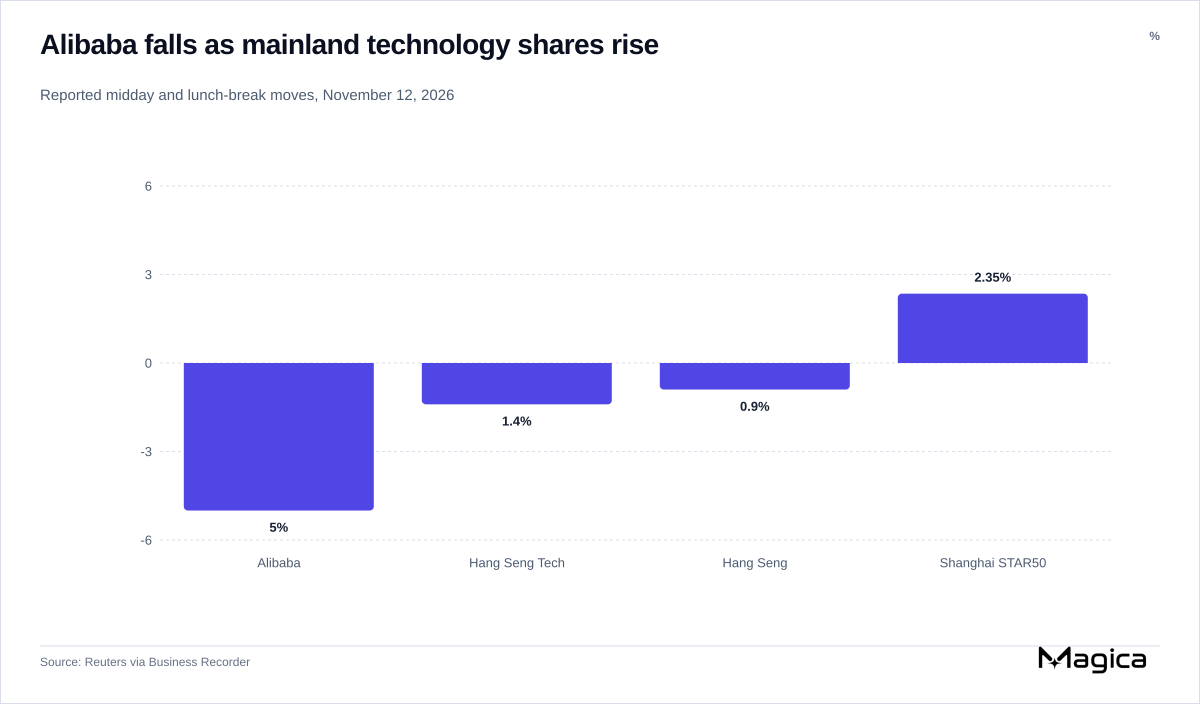
Reported midday moves on November 12, 2026. These intraday observations show differing market performance and do not isolate the effect of chip-access concerns. Chart: Magica; data: Reuters via Business Recorder. Source: Business Recorder.
The U.S. Commerce Department is preparing to finalize a rule preventing Chinese AI companies from remotely accessing advanced chips through data centers in other countries, according to an account of reporting by The Information, which cited two people familiar with the matter.
The account said Chinese internet companies Alibaba, Tencent and ByteDance had signed offshore data-center agreements to access advanced processors from AI chip supplier Nvidia for training their models. It also said those arrangements faced scrutiny abroad and at home as Beijing pushed for greater use of domestic chips. Offshore computing is therefore an access route already in use, rather than a hypothetical workaround.
The rule could be announced in November and would expand semiconductor-related controls administered by Commerce’s Bureau of Industry and Security to seven additional countries, including Malaysia, Singapore and Thailand, the report said. Commerce was still consulting other government agencies before finalizing it. The account does not establish that the restrictions have taken effect.
Anthropic finished above its IPO price after a reported $81.35 billion offering, while US and Asian stocks fell. Its financing success leaves questions about computing costs and enterprise demand unresolved.
A separate legislative effort shows how remote access could fall within export controls. The Remote Access Security Act text passed by the House on January 12, 2026, and referred to a Senate committee the next day proposed amending the Export Control Reform Act of 2018 to cover remote access by foreign persons, including through internet or cloud connections to equipment elsewhere.
That text ties its definition to a Commerce secretary determination that use of the equipment could pose a serious U.S. national-security or foreign-policy risk. It supplies legislative context, not proof of enactment or the terms of the rule now being reported.
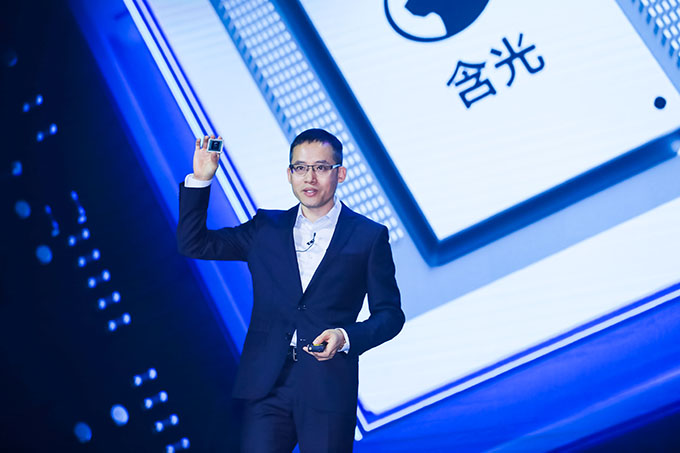
Jeff Zhang presents Alibaba’s Hanguang 800 inference chip in September 2019. Archival photo: Alibaba Group. Source: Alibaba Group — Hanguang 800 announcement.
Alibaba’s interest in AI infrastructure predates this report. In its February 24, 2025 announcement, the company described a strategic shift toward AI outlined in a May 2024 shareholder letter. It identified cloud computing as its clearest AI revenue driver and pointed to demand for hosting services, alongside applications across e-commerce, enterprise services and consumer products.
The company pledged at least RMB380 billion—equivalent to $53 billion in that announcement—over the following three years for cloud and AI infrastructure. Alibaba said the commitment exceeded its total spending in those areas over the preceding decade. That comparison indicates the intended expansion’s scale; the figure is a plan, not money already deployed or the value of capacity exposed to a new restriction.
Alibaba also has a history of designing its own chips. T-Head, the chip business now being spun off, developed Hanguang 800, which Alibaba unveiled in September 2019 as its first AI inference chip. At the time, the company said it was already using the processor internally for tasks including product search, translation and recommendations.
That is relevant experience, but inference—running a trained model—is a different workload from the model training described in the offshore agreements. The earlier launch does not establish T-Head’s current ability to replace the advanced Nvidia capacity at issue, its available production capacity or the economics of switching.
The midday market account recorded Alibaba down 5%, compared with declines of 0.9% for the Hang Seng and 1.4% for the Hang Seng Tech index. It linked Alibaba’s fall to the company saying it would push ahead with T-Head’s spin-off, and noted muted expectations for the Singles’ Day shopping festival as consumers tightened spending.
Those concurrent pressures prevent a clean estimate of how much of the sell-off reflected chip-access concerns. The figures are midday observations, rather than closing returns.
Nor did Chinese technology shares move uniformly lower. In the same lunch-break snapshot, Shanghai’s technology-focused STAR50 index rose 2.35%, while mainland semiconductor and AI-related shares outperformed. That divergence limits any claim of a broad Chinese AI-stock retreat.
The final rule would need to establish which customers, chips and services it covers, whether existing contracts are affected, when restrictions begin and what approvals remain available. Reported plans and a prior House-passed bill cannot answer those implementation questions.
For Alibaba, the consequential missing evidence is how much of its computing demand depends on the offshore agreements and what capacity could replace them. The reporting does not quantify that exposure, replacement costs or likely development delays. Until those details emerge, the investment pledge explains the stakes without measuring the financial exposure.
Smith Point Capital led the financing, with customer GE Vernova also investing. BrightAI aims to connect equipment sensing with field repairs, but established maintenance tools set a tougher benchmark than its estimate of trillions of dollars in infrastructure waste.
Everful has raised $48.5 million to expand its AI-assisted factory sourcing and fulfillment business. Its pitch rests on integrating work that smaller retailers struggle to manage, though rivals offer overlapping services and its reported scale remains company-provided.
Bajaj Finance and its investee Pennant Technologies have invested roughly $2 million each in Soket AI. The backing connects Indian model research with potential financial-sector users, but costs, performance and production deployments remain undisclosed.
OpenAI is testing its persistent ChatGPT agents with selected Plus subscribers and expanding Business Standard access in the United States. Usage allowances remain unclear for the new tiers, while Enterprise customers face a January billing start.
The Senate voted 62–33 for BAAJA, pairing faster energy approvals with data-center transmission-cost rules. The House must still act, while opponents dispute environmental safeguards and which computing facilities would have to pay.
Anthropic’s debut put multibillion-dollar values on venture investors’ holdings, though estimates disagree. The offering also supplies about $79.4 billion in gross company proceeds as the Claude developer expands its computing infrastructure, while founders and a special trust retain unusual authority.
Only two submissions supported Western Downs Digital Park in two differing accounts of its consultation. The proposed A$32 billion campus has a conditional first-stage Anthropic lease, while water, power and local benefits remain contested.
Epic says it is using AI to rewrite parts of Unreal Engine and plans to let developers connect their preferred models to UE6. The strategy combines claimed maintenance gains with a broader overhaul of programming, distribution and portable game assets, while rival Unity already offers outside-model connections.
At Ignite, Nvidia and Microsoft are expanding local coding AI, cloud desktop streaming and Azure infrastructure. The announcements build on an existing Windows AI strategy, with AMD alternatives, staggered availability and no comparable deployment-cost results in the announcements.
Microsoft and Nvidia are expanding Azure’s Vera Rubin virtual-machine preview, with systems already running in its data centers. Microsoft’s separate confidential-AI showcase covers four GPUs, while the announcements leave pricing, regions and general availability unspecified.
Meta is reconsidering its 2030 climate deadline after net emissions reached 11.8 million tonnes in 2025. Hardware and infrastructure purchases dominate its reported footprint, while new gas generation adds a longer-term challenge.
Three House committee chairs want the Remote Access Security Act in the annual defense bill as scrutiny of Nvidia intensifies. The available Senate text would authorize controls on specified foreign users’ remote access, with computing limits left to Commerce.
Google Quantum AI reports tests of quantum contextuality spanning up to 105 qubits on Willow processors. The experiments expose hardware errors and beat restricted classical strategies, while the largest task relies on an unproven classical benchmark.
A bipartisan House disclosure shows requests to sell 3.4 million AI chips to China and approvals for more than 879,000. The oversight question is whether Commerce verified the buyers, supply protections and access restrictions behind those authorizations.
OpenAI says its internal Performance Factory tracked more than 1,700 investigations in just over three months. About 400 cases reached proposed fixes, but far fewer shipped repairs used Codex’s code unchanged, and engineers retain approval.
Activists protested Anthropic’s stock-market debut outside Nasdaq, with at least one arrest and conflicting accounts of the total. Their campaign targets retirement-fund exposure to AI shares, alongside concerns about jobs, data centers and public accountability.
Anthropic says cash, growing revenue and multiyear payment schedules support its vast compute commitments. Its filing shows why flexibility matters: short-term capacity costs more, while major cloud contracts require payment regardless of usage.
OpenAI is rolling out live transcription for dictated ChatGPT prompts across free and paid plans. Users can see words as they speak and review the text before sending, but the company has not supplied performance measurements or a replacement recording maximum.
Boltz has raised a Bessemer-led $110 million Series A to expand molecular-design tools sold by usage. Its open-source research brought broad adoption; the commercial test is whether paid computation delivers repeatable gains in laboratory discovery.