Editorial Team
8 min read

Amazon’s Fauna Robotics hiring spans manipulation, companionship and cloud operations. Sprout brings a developer platform and research customers, but Amazon has yet to disclose a household product, price or launch date.
Amazon is building another home-robot effort around acquired humanoid developer Fauna Robotics after Astro, its wheeled home-monitoring robot, reached only a few thousand customers. The acquisition and job listings establish a development program, without a disclosed household product, price or launch date.
The report detailing the effort describes hiring for a new robot product and the redeployment of much of Astro’s team earlier this year. The significance lies in the combination of capabilities Amazon is recruiting: making a robot move and manipulate objects, making people comfortable living with it, and operating the services that keep it useful after delivery.
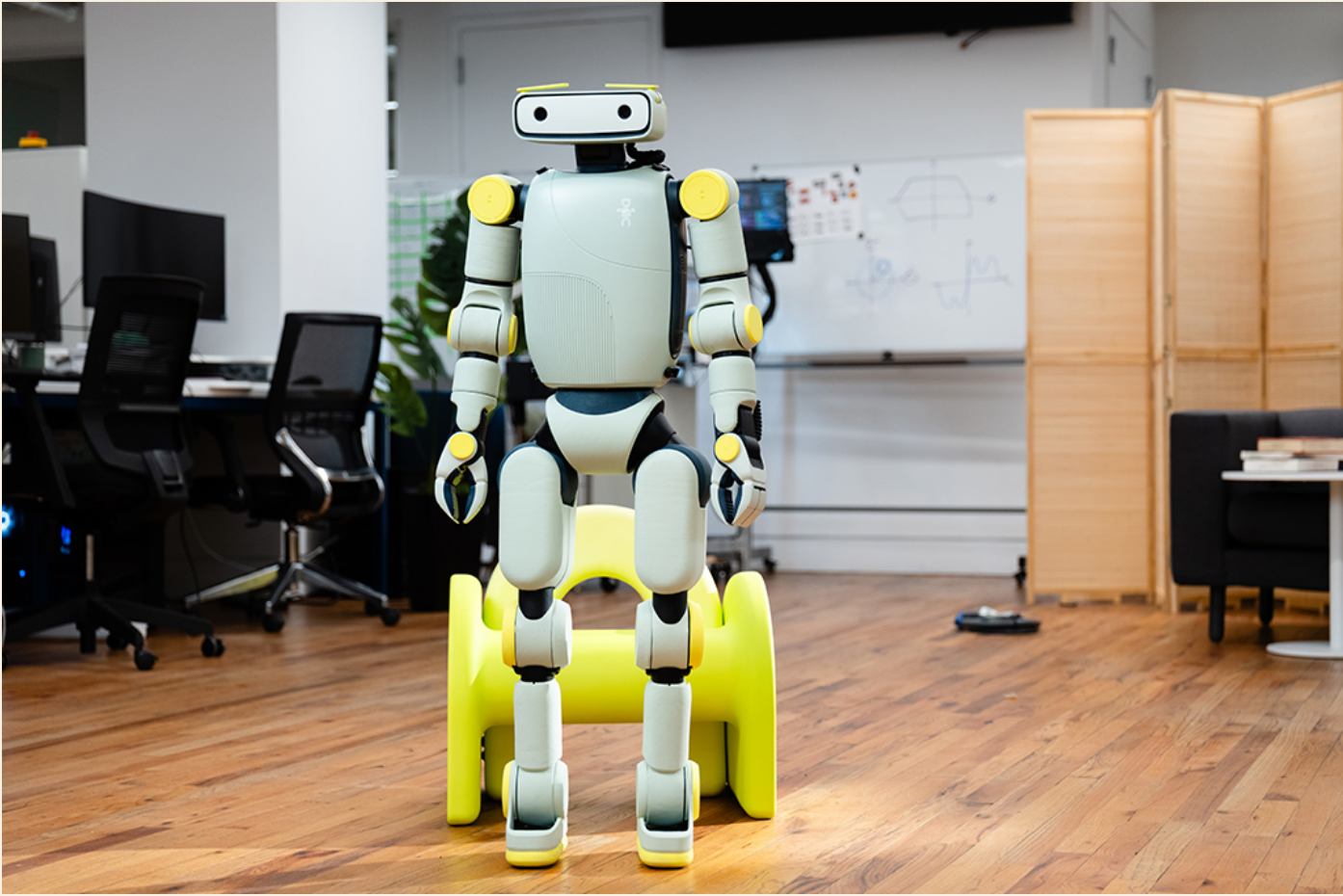
Sprout in Fauna Robotics’ official launch photograph. The Creator Edition is a developer platform; Amazon has not disclosed its household product’s form. Credit: Fauna Robotics. Source: Unite.AI.
Amazon acquired New York-based Fauna in March, bringing the maker of Sprout, a 3.5-foot humanoid, into its new Personal Robotics Group. Some staff in that group previously worked at Lab126, the hardware research unit behind Kindle, Echo and Fire devices—as well as the unsuccessful Fire Phone, according to the report.
Fauna had launched in February 2024, making it a roughly two-year-old business when Amazon bought it. Its March 24, 2026 announcement promised continued Sprout Creator Edition sales and support for existing customers.
Fauna brings a different starting point from Astro, the Alexa-equipped wheeled screen Amazon introduced in 2021 for autonomous navigation, face recognition and mobile home monitoring. Sprout launched on January 27, 2026 as a Creator Edition for researchers, educators and commercial developers. Fauna describes a soft exterior and motor controls that yield to external forces, alongside a modular AI architecture that accepts developers’ own models, as detailed in this account of its launch announcement.
A launch report and demonstration supplies a record beyond those design claims. Early customers included Disney and industrial robot maker Boston Dynamics; New York University researchers were using Sprout for manipulation and human-robot interaction work. Robert Cochran, identified at launch as Fauna’s cofounder and CEO and a former Meta employee, said the robot was designed to be easy to program. Other founding team members came from Google.
In the demonstration, Sprout interpreted a request using a large language model, walked to a refrigerator and reported drinks visible through its glass door. That showed navigation and a limited interaction with its surroundings, rather than retrieving an item. The platform also supported remote human operation out of the box.
Sprout started at $50,000 at launch. Some humanoids from Chinese robot maker Unitree cost less than $20,000, the same report noted, but equipping them with sensors and computers brought their cost roughly level with Sprout. Bare hardware prices therefore offer a misleading comparison. None of these figures establishes the price or capability of Amazon’s prospective household robot.
The acquisition also does not establish that the eventual home product will be Sprout. The original reporting leaves its form and intended tasks unresolved. Amazon spokesperson Brad Glasser said in the report on the new effort that the company acquired Fauna to help tackle the challenges of personal robotics, while acknowledging a substantial gap between controlled laboratory performance and operation in living rooms or lobbies.
Amazon’s scientist recruitment identifies manipulation, reinforcement learning and transferring capabilities from simulation to physical robots as areas of work. It explicitly distinguishes homes from structured warehouses and highlights the limitations of consumer-grade sensors and actuators. These are research problems to solve, rather than proof of tasks the product can already perform.
The human side is equally deliberate. A design vacancy covers how the machine earns trust, communicates its intentions and develops a personality. Its human-robot interaction team aims to make robots feel like companions, spanning reasoning, perception, audio and physical expression.
Companionship is one possible source of value. Sustained usefulness is another. A research role calls for studies in homes and offices, observation over weeks, and measures ranging from task success to satisfaction and retention. Those proposed measures are better tests of a household product than an engaging demonstration, although the listing supplies no results.
The infrastructure hiring adds a less visible commitment. A software vacancy describes cloud services connecting robots to customer experiences and internal operations, including pipelines for high-frequency operational signals. Preferred experience includes updates delivered over the air, devices that lose connectivity and later reconnect, and connected-device security.
This makes service reliability part of the product proposition. The listing explicitly calls for tradeoffs among privacy, security, reliability, speed and cost. It does not disclose a consumer data policy, subscription model or the eventual division of work between the robot and the cloud.
Support extends beyond software. The account of the hiring also describes a field-support role covering remote diagnosis, on-site repair handoffs and troubleshooting procedures. A household product needs support for both a physical machine and its connected services.
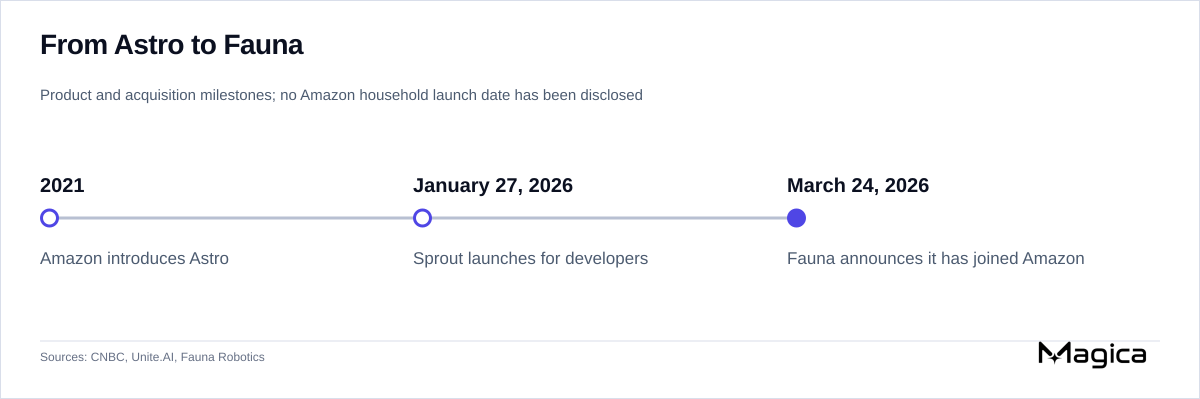
Milestones from Astro’s introduction to Sprout’s developer launch and Fauna joining Amazon. No Amazon household-product launch date has been disclosed. Source: CNBC.
The report describes Astro as a $1,450 device that never progressed beyond invitation-only availability. A business version introduced in 2023 was discontinued less than a year later. Owners’ experiences show both why Amazon might persist and why a more capable machine alone will not settle the business case.
Greater physical capability was considered before. Ken Washington, Amazon’s vice president of consumer robotics until 2023, told the report that executives had discussed adding an arm to Astro. He said he had advocated a bipedal robot but leadership disagreed. Buying a humanoid platform follows earlier internal debate about moving beyond a wheeled monitor.
Emily Lugo Velez, an Astro owner since 2023, said she still uses it to check pets and appliances remotely but otherwise finds little use for it. Joe Martin, another owner interviewed in the report, felt he had received value over four years and would consider a robot that could do more around the house. These accounts illustrate different expectations; they are not a measure of satisfaction across Astro’s customer base.
Some owners have complained about diminished service and the absence of Alexa+ support. Glasser said Amazon continues to support Astro customers and has transferred learning, talent and experience from the project into other robotics work. A new program therefore should not be read as an announced shutdown of the existing consumer robot.
Amazon has substantial robotics experience: the report traces its warehouse expansion to the $775 million acquisition of Kiva Systems in 2012 and describes more than one million robots across its facilities. But that operating record comes from a different environment. A household robot must cope with changing layouts and people and pets moving around it. Amazon also previously pursued Roomba maker iRobot before abandoning that acquisition in 2024 amid regulatory opposition.
There are reasons to revisit the problem. Colin Angle, iRobot’s cofounder and former CEO, told the report that robotics tools had advanced sharply since Astro’s development. Improvements in AI models, sensors, batteries and actuators underpin the new wave of development. Angle also has a stake in that market: he launched Familiar Machines & Magic in May to build companion robots.
The report describes alternatives ranging from the $399 Microduck robot released by Hugging Face in August to household-chore robots from Sunday, Tau and Nori, still mostly prototypes or niche devices. These are different propositions, rather than equivalent machines at different prices. They challenge Amazon to establish whether its product’s value comes from companionship, monitoring, manipulation or a combination.
Robotics company 1X provides a more direct humanoid comparison. Its October 2025 NEO announcement describes a home robot succeeding its NEO Beta and Gamma models. It offered $20,000 early access with priority delivery in 2026 and a $499 monthly subscription option shipping later, with initial deliveries primarily in the United States. These are the announcement’s terms and schedule, not verification that deliveries occurred.
1X says NEO can handle household tasks and that owners can schedule a company expert to guide unfamiliar chores. That assistance mechanism qualifies the company’s autonomy claims. A chore completed with human guidance and one completed independently have different implications for convenience, privacy and service cost. The announcement provides no independent measure of intervention rates.

NEO in 1X promotional imagery. Household-task capabilities are company-reported; 1X offers expert guidance for unfamiliar chores. Credit: 1X / Eli Russell Linnetz. Source: 1X.
Amazon’s next consequential disclosure would connect a specific task list to performance in occupied homes: how often jobs succeed, how often someone intervenes, and what purchase, service and repair costs users face. Fauna’s advertised research agenda includes measures that could help answer those questions, but hiring for that work is not evidence that the tests have been passed.
The unresolved decision is which household need Amazon will ask customers to pay for. Sprout’s developer customers establish a starting market; Astro’s small installed base and rival offers show why a consumer product needs its own evidence of value.
NextDC is prioritising community support and contracted customers after Melbourne power delays forced a spending retreat. The risks extend to customer rights and access to debt, even as rivals take a 9.9% stake.

Meta is expanding an existing system that places suspected teenagers into Instagram’s protective settings despite adult birthdays. Its global rollout follows legal settlements, but the announcement provides no numerical accuracy results.
Developer Iain Kay’s Linux script turns available RAM into parody emails after Sam Altman’s remarks about local AI. Its own documentation preserves Altman’s clarification—and explains why its measurements cannot test his utilization claim.
Oppenheimer upgraded AMD to Outperform with a $600 target as it forecasts 135% data-center growth in 2027. The bullish call faces tests in supply, customer infrastructure and cash generation.
Statnett has paused new data center grid reservations pending technical safety rules, while the government plans licensing for existing and future facilities. The proposals would determine both connection requirements and which computing uses receive priority.
Google’s TPU 8tx targets confidential AI workloads, while TPU 8i Max combines two chips for larger contexts. Both reuse existing silicon, putting the competitive test on system design, software and delivered cost.
Reported app code points to a paid Galaxy AI tier with higher usage limits and new features. Samsung says core tools will stay free, while prices, allowances and a commercial launch remain unconfirmed.
Citi cut US equities and technology to neutral and upgraded Europe outside the UK, citing lower exposure to AI turbulence and benefits from falling oil prices while retaining a positive market outlook.
ByteDance is rolling out Seedream 5.5 with a 100-edit demonstration, native transparent output and a lower reported editing price. Its predecessor and Google already offered parts of that workflow; production reliability remains unproven.
DeepSeek says its open-source agent framework reached 1.54 million daily active users through its official API. Its model-agnostic framework is gaining plugins, but DeepSeek’s own terms caution against treating it as ready for production.
Animoca Brands co-founder Yat Siu will become CEO on December 1 while remaining executive chairman. His AI agent strategy comes alongside a target to clear overdue financial reporting during 2027, with no relisting date announced.
Linux creator Linus Torvalds says eBPF fixes may now be arriving faster than new reports, offering a limited sign of relief from AI-driven maintenance work. Most other kernel areas probably have not reached that point, and the release note supplies no counts to establish a wider turnaround.
Dialpad and Ada plan to combine a communications network with customer-service AI agents. Reported terms suggest a sharp reset from Ada’s 2021 valuation, while the product test is whether the merger improves on automation and human handoffs Dialpad already advertised.
Data-centre developers are turning to second-hand turbines, refurbished machines and aeroderivative generators to accelerate power supplies. Lower equipment prices and shorter waits come with maintenance risks, scarce inventory and permitting obstacles.
Nvidia plans to back three Korean AI startups spanning enterprise software, language models and robotics. Its investment amounts remain undisclosed, limiting what the announcement reveals about the financing it will provide.
Independent directors and outside counsel will investigate reports involving Nvidia’s founder and CEO, who has admitted infidelity. The board says it has no reason to believe national security or company secrets were compromised.
Apple reportedly wants Siri to pursue goals without prompts at every step. A possible 2027 debut is a reporter’s assessment, while Apple experiments with its iOS 28 development process after earlier Siri delays.
Apple led Nvidia by roughly $615 billion in market value at the November 5 close. Nvidia’s rapid sales growth contrasts with financing and construction risks for AI infrastructure, while Apple faces rising costs and uses Nvidia chips in its own cloud.
Councils, transport officials and MPs’ staff report more demanding AI-assisted correspondence. Official records show pressure alongside successful appeals, while regulators seek to protect access and contain excessive submissions.
Anthropic has reportedly taken over commitments for Caterpillar generators ordered by OnePWR, gaining access to scarce equipment and installation capabilities as it seeks greater control over data-center power.