Editorial Team
5 min read
Citi cut US equities and technology to neutral and upgraded Europe outside the UK, citing lower exposure to AI turbulence and benefits from falling oil prices while retaining a positive market outlook.
Citigroup’s equity strategists cut their recommendation on US stocks to neutral on November 9 after a selloff over AI spending and regulatory risks. The bank’s research team shifted its preference toward Europe outside the UK, making a relative allocation call while retaining its positive outlook for equities.
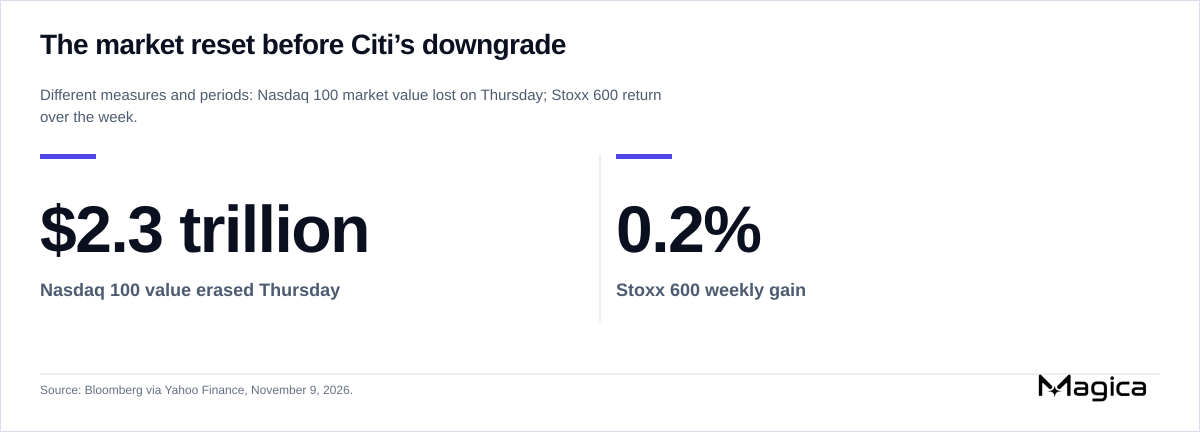
The Nasdaq 100 lost $2.3 trillion in market value Thursday; the Stoxx 600 finished the week 0.2% higher. The figures cover different periods and measures. Source: Bloomberg via Yahoo Finance.
Beata Manthey, Citi’s head of European equity strategy, leads the team making the allocation calls; she outlined an earlier Europe downgrade in February. The strategists lowered US equities and global and European technology from overweight to neutral, according to an account of Monday’s note. Neutral removes the preference for extra exposure conveyed by overweight.
The move followed a week in which the S&P 500 suffered its biggest weekly loss since April 2025. The Nasdaq 100 lost $2.3 trillion in market value on Thursday alone, while Europe’s Stoxx 600 finished the week 0.2% higher, according to the account of the selloff and Citi’s response.
Democratic victories in the US midterm elections, including in states where opposition to new data centers had grown, heightened concerns that tighter regulation could slow the AI infrastructure buildout. Those are concerns about future restrictions; the reports do not identify an enacted measure behind Citi’s change.
Citi’s immediate warning was about investor positioning—the balance of bets on rising and falling prices. Manthey wrote in the client note:
NextDC is prioritising community support and contracted customers after Melbourne power delays forced a spending retreat. The risks extend to customer rights and access to debt, even as rivals take a 9.9% stake.

“We worry that positioning on key indices, such as the Nasdaq, could reset lower into net-short territory.”
That is a warning about a possible shift toward bets on declines, without a forecast for a specific index loss. Citi also said selling had spread across regions and sectors, so the risk extended beyond technology.
Citi raised Europe excluding the UK to overweight because of its lower exposure to technology volatility and greater sensitivity to falling oil prices. It also upgraded global healthcare and European food and beverage to overweight. Its global sector recommendations now combine economically sensitive businesses with defensive stocks; materials remains overweight.
In a Citi podcast recorded February 2 and published February 3, Manthey said the team had downgraded Europe to neutral for the first time in more than a year. Geopolitical risks and euro-dollar volatility had raised the hurdles for European earnings, particularly in internationally exposed sectors. Citi still forecast gains for the region then, but upgraded Japan to overweight alongside its existing preference for emerging markets.
That earlier call matters to the latest upgrade: Europe’s relative appeal depends on the earnings and market backdrop, rather than its smaller technology exposure alone.
A separate analysis by Goldman Sachs, the investment bank, quantifies the concentration difference. Its strategists estimated that AI infrastructure stocks represent about 15% of the Stoxx 600, against roughly 40% of the S&P 500. In the report’s account of Goldman’s note, those stocks contribute less than a quarter of the European benchmark’s forecast 9% earnings growth for 2027, compared with more than two-thirds of projected earnings growth for the US benchmark.
These are Goldman’s exposure estimates and earnings forecasts, not realized growth. The report does not detail its classification of AI infrastructure stocks. Goldman also said Europe outperformed the US in each of the eight largest AI-led selloffs since 2023. That selected sample illustrates the diversification argument without establishing protection against every market decline.
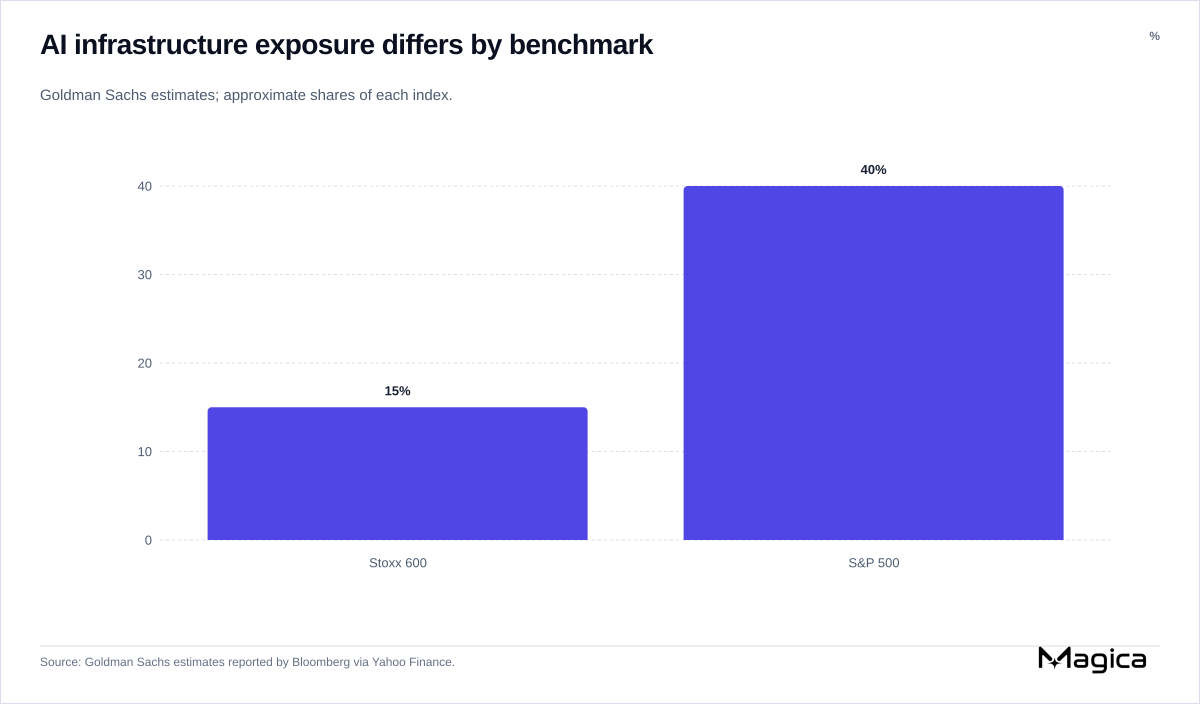
Goldman Sachs estimated AI infrastructure stocks at about 15% of the Stoxx 600 and roughly 40% of the S&P 500. Its classification is not detailed in the report. Source: Bloomberg via Yahoo Finance.
Citi remains positive about AI, but wants cleaner positioning, more stable sentiment and earnings revisions that give the trade a firmer foundation. Its market targets for 2027 remain positive, supported by expectations for lower interest rates, resilient economic data and potentially easing geopolitical risks.
The tension between AI spending and returns predates this selloff. In the February podcast, David Groman, Citi’s senior global equity strategist, said the team’s outlook had identified a potential source of volatility: AI revenues might not grow as quickly as the capital spending required. Yet he also said the team had not seen a broad deterioration in technology fundamentals at that point, and distinguished hardware businesses involved in the buildout from software companies whose existing business models might face AI risks.
Those February observations do not establish November earnings conditions. They explain why spending concerns alone cannot settle the allocation question. The next test is whether earnings revisions and steadier positioning support renewed exposure. The reports give no numerical threshold or timetable for Citi to restore an overweight recommendation.
Meta is expanding an existing system that places suspected teenagers into Instagram’s protective settings despite adult birthdays. Its global rollout follows legal settlements, but the announcement provides no numerical accuracy results.
Developer Iain Kay’s Linux script turns available RAM into parody emails after Sam Altman’s remarks about local AI. Its own documentation preserves Altman’s clarification—and explains why its measurements cannot test his utilization claim.
Oppenheimer upgraded AMD to Outperform with a $600 target as it forecasts 135% data-center growth in 2027. The bullish call faces tests in supply, customer infrastructure and cash generation.
Statnett has paused new data center grid reservations pending technical safety rules, while the government plans licensing for existing and future facilities. The proposals would determine both connection requirements and which computing uses receive priority.
Google’s TPU 8tx targets confidential AI workloads, while TPU 8i Max combines two chips for larger contexts. Both reuse existing silicon, putting the competitive test on system design, software and delivered cost.
Reported app code points to a paid Galaxy AI tier with higher usage limits and new features. Samsung says core tools will stay free, while prices, allowances and a commercial launch remain unconfirmed.
ByteDance is rolling out Seedream 5.5 with a 100-edit demonstration, native transparent output and a lower reported editing price. Its predecessor and Google already offered parts of that workflow; production reliability remains unproven.
DeepSeek says its open-source agent framework reached 1.54 million daily active users through its official API. Its model-agnostic framework is gaining plugins, but DeepSeek’s own terms caution against treating it as ready for production.
Animoca Brands co-founder Yat Siu will become CEO on December 1 while remaining executive chairman. His AI agent strategy comes alongside a target to clear overdue financial reporting during 2027, with no relisting date announced.

Amazon’s Fauna Robotics hiring spans manipulation, companionship and cloud operations. Sprout brings a developer platform and research customers, but Amazon has yet to disclose a household product, price or launch date.
Linux creator Linus Torvalds says eBPF fixes may now be arriving faster than new reports, offering a limited sign of relief from AI-driven maintenance work. Most other kernel areas probably have not reached that point, and the release note supplies no counts to establish a wider turnaround.
Dialpad and Ada plan to combine a communications network with customer-service AI agents. Reported terms suggest a sharp reset from Ada’s 2021 valuation, while the product test is whether the merger improves on automation and human handoffs Dialpad already advertised.
Data-centre developers are turning to second-hand turbines, refurbished machines and aeroderivative generators to accelerate power supplies. Lower equipment prices and shorter waits come with maintenance risks, scarce inventory and permitting obstacles.
Nvidia plans to back three Korean AI startups spanning enterprise software, language models and robotics. Its investment amounts remain undisclosed, limiting what the announcement reveals about the financing it will provide.
Independent directors and outside counsel will investigate reports involving Nvidia’s founder and CEO, who has admitted infidelity. The board says it has no reason to believe national security or company secrets were compromised.
Apple reportedly wants Siri to pursue goals without prompts at every step. A possible 2027 debut is a reporter’s assessment, while Apple experiments with its iOS 28 development process after earlier Siri delays.
Apple led Nvidia by roughly $615 billion in market value at the November 5 close. Nvidia’s rapid sales growth contrasts with financing and construction risks for AI infrastructure, while Apple faces rising costs and uses Nvidia chips in its own cloud.
Councils, transport officials and MPs’ staff report more demanding AI-assisted correspondence. Official records show pressure alongside successful appeals, while regulators seek to protect access and contain excessive submissions.
Anthropic has reportedly taken over commitments for Caterpillar generators ordered by OnePWR, gaining access to scarce equipment and installation capabilities as it seeks greater control over data-center power.