Editorial Team
5 min read
Linux creator Linus Torvalds says eBPF fixes may now be arriving faster than new reports, offering a limited sign of relief from AI-driven maintenance work. Most other kernel areas probably have not reached that point, and the release note supplies no counts to establish a wider turnaround.
Linus Torvalds, Linux’s creator and kernel development leader, says BPF developers may now be producing fixes faster than new bug reports arrive, a tentative improvement in the project’s AI-driven maintenance workload. The kernel is the core software that manages hardware resources and services for applications, underpinning systems from smartphones to cloud servers. A change in its maintenance burden matters well beyond its developers.
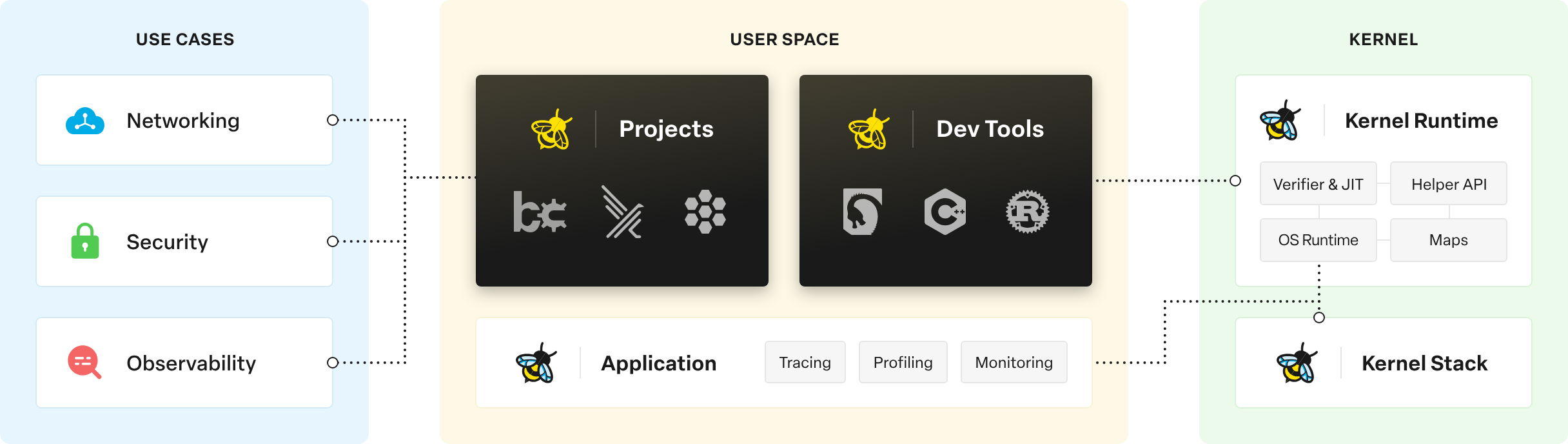
The eBPF project's diagram connects its use cases, user-space tools and kernel components. Credit: eBPF.io authors, CC BY 4.0. Source: Linux Foundation.
In his Linux 7.4-rc2 announcement, dated November 8 in the mailing-list archive, Torvalds attributed the assessment to Alexei Starovoitov, eBPF’s co-creator and lead developer:
But this time around Alexei claims that on the bpf side at least the fixes are now coming in faster than the new reports, and that sounds lovely if true.
That is a statement about the balance between repair work and incoming reports. It does not establish that the existing backlog has disappeared or that AI tools have stopped finding flaws. Torvalds says much of the release was driven by AI fixes and suggests developers can now take their presence for granted.
Extended Berkeley Packet Filter, or eBPF, allows sandboxed programs to run inside the Linux kernel, as the accompanying report explains. Its uses include networking, security and system observability. The Linux Foundation, a nonprofit that hosts open-source collaboration, identified Starovoitov as an eBPF co-creator and maintainer in its of the eBPF Foundation. It said Meta was already using eBPF as its primary software-defined load balancer in its datacenters, illustrating the infrastructure at stake.
NextDC is prioritising community support and contracted customers after Melbourne power delays forced a spending retreat. The risks extend to customer rights and access to debt, even as rivals take a 9.9% stake.

Torvalds thinks most other kernel areas have not reached the same point. A second account of his remarks repeats that caveat; it supplies no independent measurement of BPF’s progress. The evidence supports a possible local improvement, not a measured peak in the kernel-wide surge.
Linux 7.4-rc2, the second release candidate, follows what Torvalds calls the largest-ever first release candidate. But he says its change statistics are dominated by automated updates made with Coccinelle, a tool for identifying and changing source-code patterns. He held those updates over from the merge window because he was traveling and subsequently lacked motivation to handle them.
Those scripted edits are largely one- and two-line changes distributed across thousands of files. Torvalds describes them as straightforward; their breadth creates statistical noise. His announcement discusses these separately from the AI-related fixes, so treating all automated changes as AI-discovered bug repairs would misread the release.
After setting that noise aside, Torvalds describes a familiar distribution: roughly a third of the changes concern drivers, another third networking and BPF, and the remainder mostly filesystems, memory management and architecture updates. These are descriptions of the release’s changes, not counts of AI findings or security vulnerabilities.
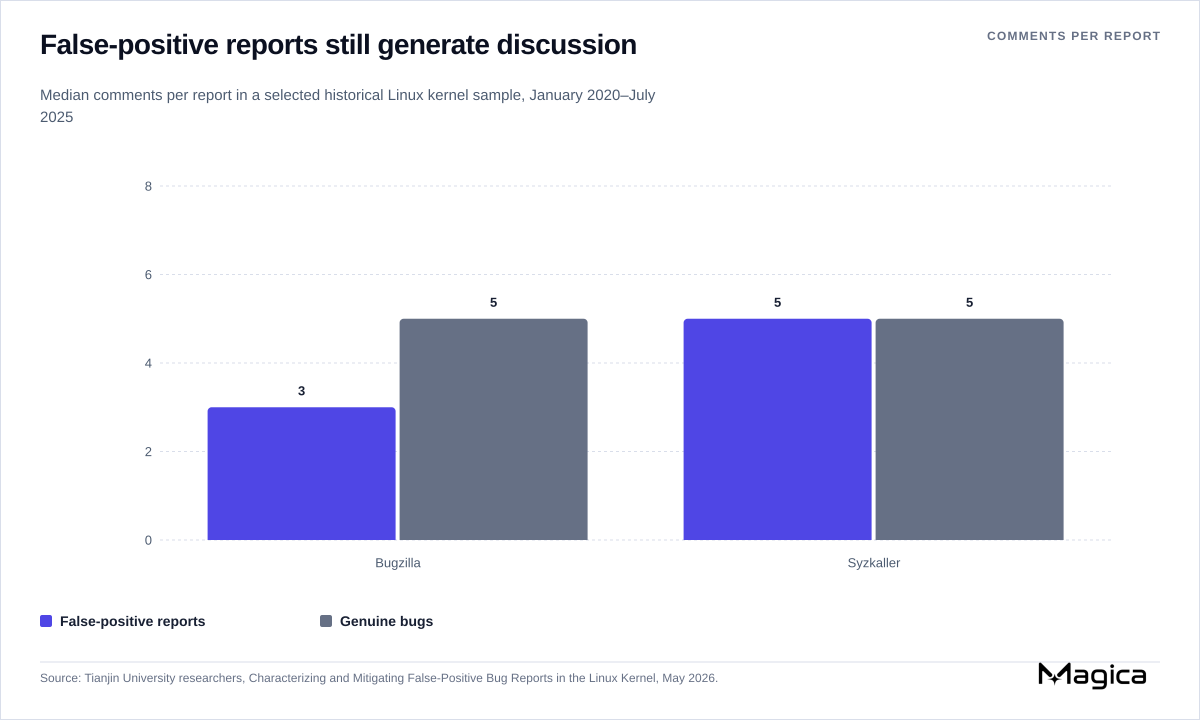
False-positive reports still generated discussion in the selected January 2020–July 2025 sample. Comment counts are a proxy for effort, not working hours, and do not measure current AI-generated reports or BPF's workload. Source: Linux kernel false-positive bug report study.
A study by Tianjin University researchers submitted in May 2026 examined 2,006 kernel reports from January 2020 through July 2025. It combined Bugzilla, a tracker for user reports, with Syzkaller, Google’s automated fuzzing system, which tests the kernel with generated inputs. The researchers classified 497 reports as false positives: reported problems that required no corrective kernel patch.
The sample shows why triage cannot be measured through fix counts alone. On Bugzilla, the median false-positive report had three comments, against five for a genuine bug; on Syzkaller, both medians were five. False positives generally reached closure faster, but still involved comparable discussion and participation. These are proxies for effort, not measurements of developers’ working hours. The study’s time metric runs from report creation to the last comment and, for Syzkaller, sums durations across associated discussions.
The researchers selected resolved reports with sufficient diagnostic evidence and used model-assisted labeling followed by manual verification. Their historical sample therefore does not establish the false-positive rate of all incoming reports, today’s AI-generated findings or BPF’s current workload.
AI could also help with that burden. In experiments limited to Bugzilla, the study’s best prompting approach supplied the DeepSeek-V3 language model with similar previously labeled reports. It achieved 81% classification accuracy, compared with 70% when given basic instructions without examples. That is evidence of potential triage assistance, not a demonstrated reduction in kernel maintenance work; the researchers also warn that wrongly dismissing a genuine bug could delay a fix.
The release announcement provides no BPF report count, fix count, measurement interval or outstanding backlog. It also does not explain how reports and fixes were matched. Those omissions prevent a numerical estimate of how quickly developers are catching up or a comparison with other subsystems.
The next useful evidence would track incoming reports, confirmed defects, resolved issues and remaining backlog over the same intervals, first in BPF and then across other kernel areas. That would distinguish a sustained improvement in maintenance capacity from a brief change in the flow of reports. For now, Torvalds’s concrete request is to keep testing Linux 7.4.
Meta is expanding an existing system that places suspected teenagers into Instagram’s protective settings despite adult birthdays. Its global rollout follows legal settlements, but the announcement provides no numerical accuracy results.
Developer Iain Kay’s Linux script turns available RAM into parody emails after Sam Altman’s remarks about local AI. Its own documentation preserves Altman’s clarification—and explains why its measurements cannot test his utilization claim.
Oppenheimer upgraded AMD to Outperform with a $600 target as it forecasts 135% data-center growth in 2027. The bullish call faces tests in supply, customer infrastructure and cash generation.
Statnett has paused new data center grid reservations pending technical safety rules, while the government plans licensing for existing and future facilities. The proposals would determine both connection requirements and which computing uses receive priority.
Google’s TPU 8tx targets confidential AI workloads, while TPU 8i Max combines two chips for larger contexts. Both reuse existing silicon, putting the competitive test on system design, software and delivered cost.
Reported app code points to a paid Galaxy AI tier with higher usage limits and new features. Samsung says core tools will stay free, while prices, allowances and a commercial launch remain unconfirmed.
Citi cut US equities and technology to neutral and upgraded Europe outside the UK, citing lower exposure to AI turbulence and benefits from falling oil prices while retaining a positive market outlook.
ByteDance is rolling out Seedream 5.5 with a 100-edit demonstration, native transparent output and a lower reported editing price. Its predecessor and Google already offered parts of that workflow; production reliability remains unproven.
DeepSeek says its open-source agent framework reached 1.54 million daily active users through its official API. Its model-agnostic framework is gaining plugins, but DeepSeek’s own terms caution against treating it as ready for production.
Animoca Brands co-founder Yat Siu will become CEO on December 1 while remaining executive chairman. His AI agent strategy comes alongside a target to clear overdue financial reporting during 2027, with no relisting date announced.

Amazon’s Fauna Robotics hiring spans manipulation, companionship and cloud operations. Sprout brings a developer platform and research customers, but Amazon has yet to disclose a household product, price or launch date.
Dialpad and Ada plan to combine a communications network with customer-service AI agents. Reported terms suggest a sharp reset from Ada’s 2021 valuation, while the product test is whether the merger improves on automation and human handoffs Dialpad already advertised.
Data-centre developers are turning to second-hand turbines, refurbished machines and aeroderivative generators to accelerate power supplies. Lower equipment prices and shorter waits come with maintenance risks, scarce inventory and permitting obstacles.
Nvidia plans to back three Korean AI startups spanning enterprise software, language models and robotics. Its investment amounts remain undisclosed, limiting what the announcement reveals about the financing it will provide.
Independent directors and outside counsel will investigate reports involving Nvidia’s founder and CEO, who has admitted infidelity. The board says it has no reason to believe national security or company secrets were compromised.
Apple reportedly wants Siri to pursue goals without prompts at every step. A possible 2027 debut is a reporter’s assessment, while Apple experiments with its iOS 28 development process after earlier Siri delays.
Apple led Nvidia by roughly $615 billion in market value at the November 5 close. Nvidia’s rapid sales growth contrasts with financing and construction risks for AI infrastructure, while Apple faces rising costs and uses Nvidia chips in its own cloud.
Councils, transport officials and MPs’ staff report more demanding AI-assisted correspondence. Official records show pressure alongside successful appeals, while regulators seek to protect access and contain excessive submissions.
Anthropic has reportedly taken over commitments for Caterpillar generators ordered by OnePWR, gaining access to scarce equipment and installation capabilities as it seeks greater control over data-center power.