Editorial Team
5 min read
Developer Iain Kay’s Linux script turns available RAM into parody emails after Sam Altman’s remarks about local AI. Its own documentation preserves Altman’s clarification—and explains why its measurements cannot test his utilization claim.
Developer Iain Kay has published Ram-Altman, a Linux Bash script that turns available PC memory into a mock daily report for Sam Altman, OpenAI’s chief executive. Altman was also a co-chair when the AI developer launched as a nonprofit research company in December 2015. The joke targets his argument about allocating scarce memory between personal computers and AI infrastructure.
The project’s documentation also records qualifications that complicate the backlash: Altman was discussing running AI models locally, later said he wanted people to have abundant memory, and was talking about utilization over time. The script measures how much memory is available at each sample. Those are different quantities.
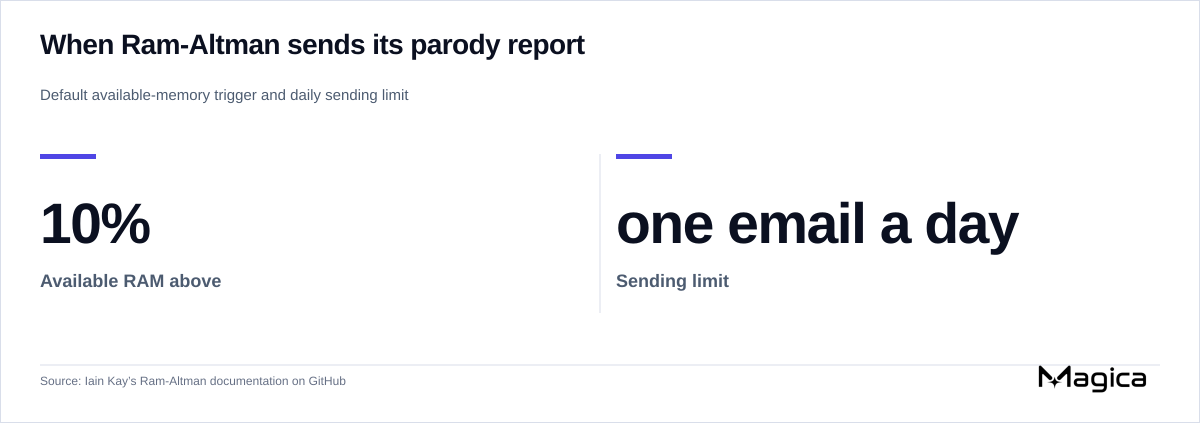
Ram-Altman defaults to a trigger above 10% available memory and sends at most one email a day. Graphic: Magica; source: Iain Kay’s project documentation. Source: GitHub.
On the Cheeky Pint podcast, Altman questioned the allocation of limited DRAM—the memory used in computers—when it sits in personal machines and, in his estimate reproduced by the repository, is used perhaps 5% of the time. The context was running AI models on users’ own computers, putting local computing and centralized infrastructure at the center of the disagreement.
The backlash became a meme. Altman briefly adopted the display name Ram Altman on X, which the project's documentation identifies as the source of its name. He also disputed the interpretation of his remarks. A report dates his clarification to November 4; the repository reproduces his statement that he wanted abundant memory and people to install as much as they wanted.
The same report describes rising consumer memory prices as manufacturers shift capacity toward industrial and AI demand. It supplies no price series or quantified allocation breakdown. That account helps explain the grievance the parody addresses, but does not measure how much any one AI buyer has affected PC upgrade costs.
NextDC is prioritising community support and contracted customers after Melbourne power delays forced a spending retreat. The risks extend to customer rights and access to debt, even as rivals take a 9.9% stake.

The script converts that dispute into a configurable alert. It requires Linux, Bash and a working mail command. With the documented cron setup, it samples memory every five minutes and sends at most one email a day when available RAM exceeds the threshold. Users must configure a recipient and sender themselves. There is no bundled Altman email address.
Its author recommends the dry-run mode, which displays an email without sending it. An account of the project also highlights that recommendation and the absence of an address. The repository asks users to avoid spoofing, fleet-wide deployments and continued messages after a request to stop. A browser-based sample viewer offers another way to read the jokes without installing anything.
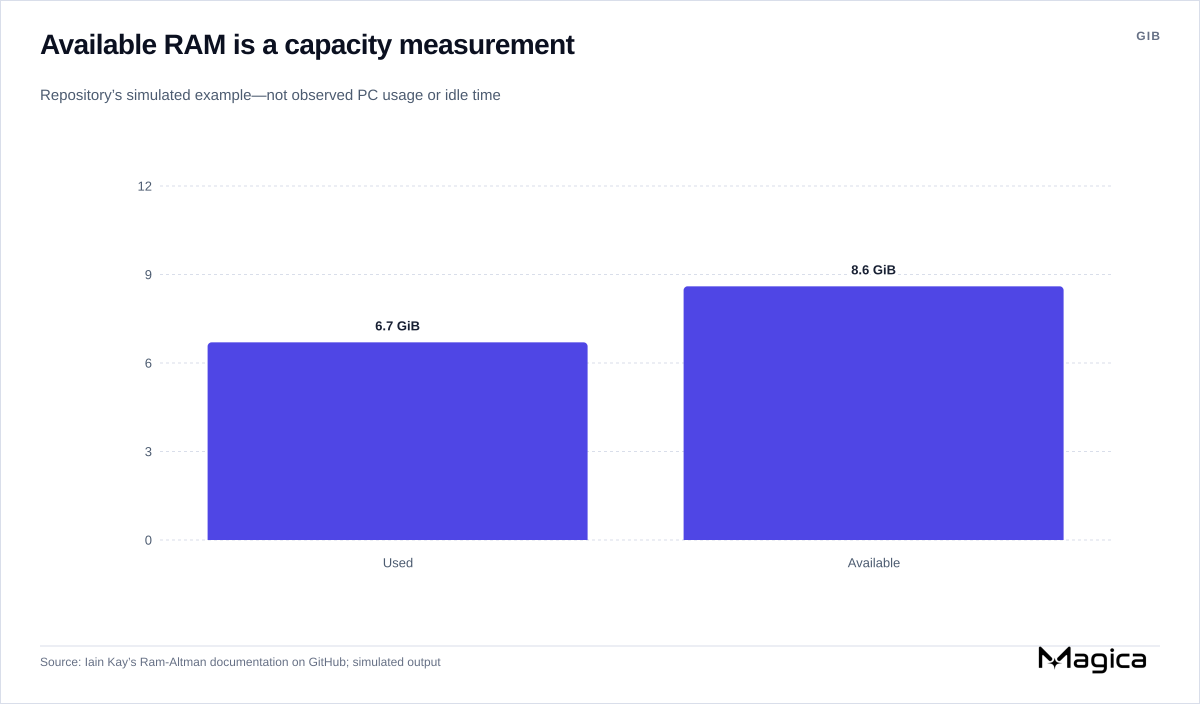
The repository’s simulated example measures memory capacity, not idle time. Available RAM includes reclaimable cache. Graphic: Magica; source: Iain Kay’s project documentation. Source: GitHub.
The technical distinction matters more than the punchline. Ram-Altman calculates used memory by subtracting Linux's MemAvailable estimate from MemTotal. Available memory includes both free RAM and cache the kernel can reclaim for applications without swapping.
That means memory counted as available may already be doing useful work as a page cache. The repository explicitly acknowledges this. On kernels older than 3.14, which lack MemAvailable, the script estimates availability from free memory and reclaimable cache.
The script also logs samples to CSV, allowing a user to examine their own memory use. But the documentation concedes that the share of memory occupied is different from the share of time it is used. Its simulated example is a demonstration, not a survey of PC owners. Neither that example nor an individual user’s log establishes whether Altman’s 5% estimate is representative, or whether running an AI model locally is more economical than using a remote service.
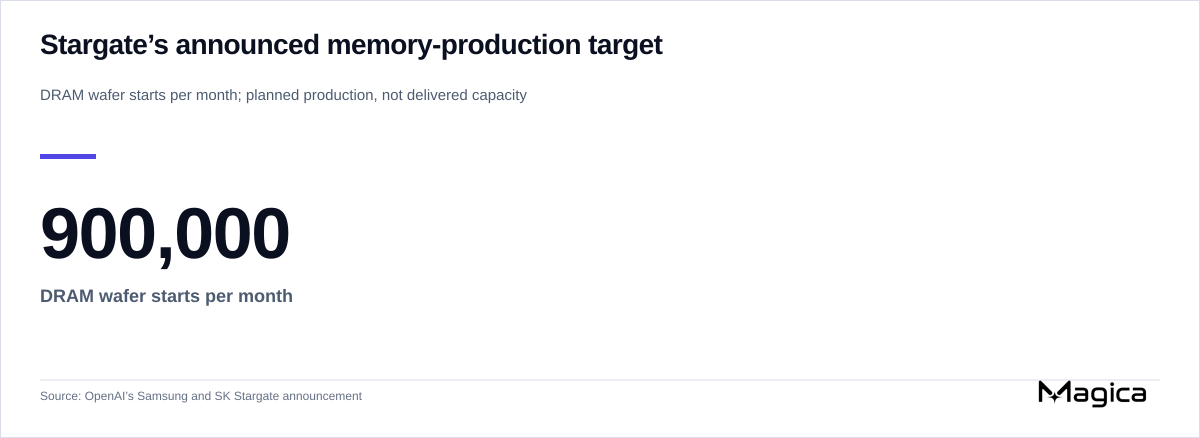
OpenAI’s company-reported target for Samsung Electronics and SK hynix was 900,000 DRAM wafer starts per month, not delivered capacity. Graphic: Magica; source: OpenAI. Source: OpenAI.
OpenAI has a direct commercial stake in memory availability. In its October 1, 2025 announcement, the company said memory manufacturers Samsung Electronics and SK hynix planned to scale advanced-memory production through Stargate, OpenAI’s AI infrastructure initiative, targeting 900,000 DRAM wafer starts per month. It also announced agreements to explore additional data-center capacity in Korea.
That figure is a company-announced production target, not evidence of delivered capacity, a quantity of finished RAM modules, or a measure of memory taken off consumer shelves. The announcement said further details would follow as plans progressed; it did not establish a consumer-price effect.
Resolving the allocation argument requires evidence of actual output, the supply reaching different buyers, and comparable utilization and costs for local and centralized AI. Ram-Altman provides none of those comparisons. Its own FAQ says it does not help with the shortage: the memory accounting is serious; the correspondence is parody.
Meta is expanding an existing system that places suspected teenagers into Instagram’s protective settings despite adult birthdays. Its global rollout follows legal settlements, but the announcement provides no numerical accuracy results.
Oppenheimer upgraded AMD to Outperform with a $600 target as it forecasts 135% data-center growth in 2027. The bullish call faces tests in supply, customer infrastructure and cash generation.
Statnett has paused new data center grid reservations pending technical safety rules, while the government plans licensing for existing and future facilities. The proposals would determine both connection requirements and which computing uses receive priority.
Google’s TPU 8tx targets confidential AI workloads, while TPU 8i Max combines two chips for larger contexts. Both reuse existing silicon, putting the competitive test on system design, software and delivered cost.
Reported app code points to a paid Galaxy AI tier with higher usage limits and new features. Samsung says core tools will stay free, while prices, allowances and a commercial launch remain unconfirmed.
Citi cut US equities and technology to neutral and upgraded Europe outside the UK, citing lower exposure to AI turbulence and benefits from falling oil prices while retaining a positive market outlook.
ByteDance is rolling out Seedream 5.5 with a 100-edit demonstration, native transparent output and a lower reported editing price. Its predecessor and Google already offered parts of that workflow; production reliability remains unproven.
DeepSeek says its open-source agent framework reached 1.54 million daily active users through its official API. Its model-agnostic framework is gaining plugins, but DeepSeek’s own terms caution against treating it as ready for production.
Animoca Brands co-founder Yat Siu will become CEO on December 1 while remaining executive chairman. His AI agent strategy comes alongside a target to clear overdue financial reporting during 2027, with no relisting date announced.

Amazon’s Fauna Robotics hiring spans manipulation, companionship and cloud operations. Sprout brings a developer platform and research customers, but Amazon has yet to disclose a household product, price or launch date.
Linux creator Linus Torvalds says eBPF fixes may now be arriving faster than new reports, offering a limited sign of relief from AI-driven maintenance work. Most other kernel areas probably have not reached that point, and the release note supplies no counts to establish a wider turnaround.
Dialpad and Ada plan to combine a communications network with customer-service AI agents. Reported terms suggest a sharp reset from Ada’s 2021 valuation, while the product test is whether the merger improves on automation and human handoffs Dialpad already advertised.
Data-centre developers are turning to second-hand turbines, refurbished machines and aeroderivative generators to accelerate power supplies. Lower equipment prices and shorter waits come with maintenance risks, scarce inventory and permitting obstacles.
Nvidia plans to back three Korean AI startups spanning enterprise software, language models and robotics. Its investment amounts remain undisclosed, limiting what the announcement reveals about the financing it will provide.
Independent directors and outside counsel will investigate reports involving Nvidia’s founder and CEO, who has admitted infidelity. The board says it has no reason to believe national security or company secrets were compromised.
Apple reportedly wants Siri to pursue goals without prompts at every step. A possible 2027 debut is a reporter’s assessment, while Apple experiments with its iOS 28 development process after earlier Siri delays.
Apple led Nvidia by roughly $615 billion in market value at the November 5 close. Nvidia’s rapid sales growth contrasts with financing and construction risks for AI infrastructure, while Apple faces rising costs and uses Nvidia chips in its own cloud.
Councils, transport officials and MPs’ staff report more demanding AI-assisted correspondence. Official records show pressure alongside successful appeals, while regulators seek to protect access and contain excessive submissions.
Anthropic has reportedly taken over commitments for Caterpillar generators ordered by OnePWR, gaining access to scarce equipment and installation capabilities as it seeks greater control over data-center power.