Editorial Team
6 min read
DeepSeek says its open-source agent framework reached 1.54 million daily active users through its official API. Its model-agnostic framework is gaining plugins, but DeepSeek’s own terms caution against treating it as ready for production.
DeepSeek, the Hangzhou-based AI model developer, says its open-source Harness agent framework reached 1.54 million daily active users on its official application programming interface. Its first disclosed user figures show rapid growth from late September, according to a November 6 report of the company’s figures.
Harness supplies software that helps language models manage and execute tasks. A model generates responses; a harness provides the surrounding infrastructure an agent needs to act on a user’s behalf. Adoption therefore extends DeepSeek’s reach into the software through which people use models, alongside its foundation-model business.
Founded in 2023, DeepSeek had released open language models, including V3 and the reasoning model R1, before its move into agent infrastructure. A July 2025 Congressional Research Service brief described hedge fund High-Flyer as reportedly its sole funder. The usage disclosure supplies no revenue or profitability figure for Harness.
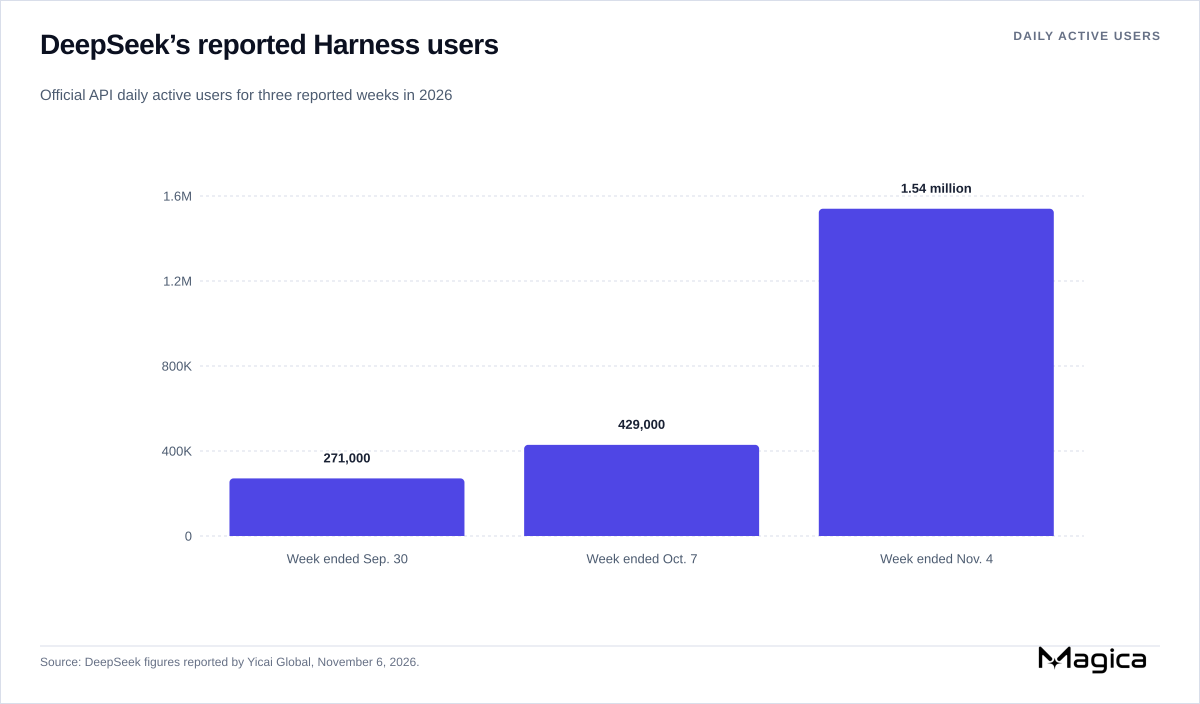
Company-reported daily active Harness users through DeepSeek’s official API. The report does not specify whether these are weekly averages or another measure of daily activity. Chart: Magica. Source: Yicai Global.
DeepSeek’s reported figures rose substantially over five weeks:
| Week ended, 2026 | Daily active users through the official API |
|---|---|
| September 30 | 271,000 |
| October 7 | 429,000 |
| November 4 | 1.54 million |
The latest figure is about 5.7 times the September figure, calculated by dividing 1.54 million by 271,000. These are company-reported DAU figures for the stated weeks. The report does not specify whether each is a weekly average or another measure of daily activity, explain how users are counted, or establish how many are retained or paying customers.
Harness launched on August 13, 2026, entering developer preview under the MIT open-source license alongside an updated official release of V4-Pro, DeepSeek’s flagship model focused on agent workloads.
DeepSeek also says users were consuming around 92 trillion tokens a day through its official API as of November 4, according to a separate account of its figures. That measures model traffic, rather than completed tasks. The reports do not explain the token-counting methodology or provide a billing mix from which to calculate revenue.
The launch report described Harness as built on Cordis, a framework of composable plugins. Developers can replace models, tools, sessions, sandboxes, filesystems and orchestration. Its coding mode can inspect repositories, edit files, run shell commands, search, plan and delegate to subagents.
Those functions already existed in Anthropic’s Claude Code and OpenAI’s Codex, established coding-agent products. The launch comparison identified broader hosted background-agent and GitHub workflows in those products that were not documented as finished DeepSeek-managed offerings. That is a launch-time comparison, not a current feature audit.
Modularity does not make extensibility unique to DeepSeek: the same report described skills, hooks and other extension mechanisms in rivals. DeepSeek also said in that report that V4-Pro was optimized for integration with Codex. Developers can choose DeepSeek’s model without choosing its harness, just as Harness users can choose another provider’s model.
DeepSeek says third-party plugins have reached about 35,000, and about 60 percent of users have created or installed at least one. It is preparing a support program for plugin authors, according to the November 6 report. The figures indicate participation beyond the framework’s basic functions, although the report does not measure how often individual plugins are used or how many remain maintained.
Its terms, last updated September 20, identify Hangzhou DeepSeek Artificial Intelligence Co., Ltd. as owner and operator. They allow users to choose default DeepSeek models or configure an external model API. In the latter case, DeepSeek supplies the interface and supporting tools while another provider supplies the model service.
For default models, the terms require advance payment into a DeepSeek Open Platform account, providing a route from agent use to model spending. With custom models, users bear the external provider’s charges; the terms warn that continuous calls can produce unexpectedly high bills.
That separates winning users for the framework from winning their model spending. The official-API figures do not establish the scale or economics of every deployment of the open-source framework.
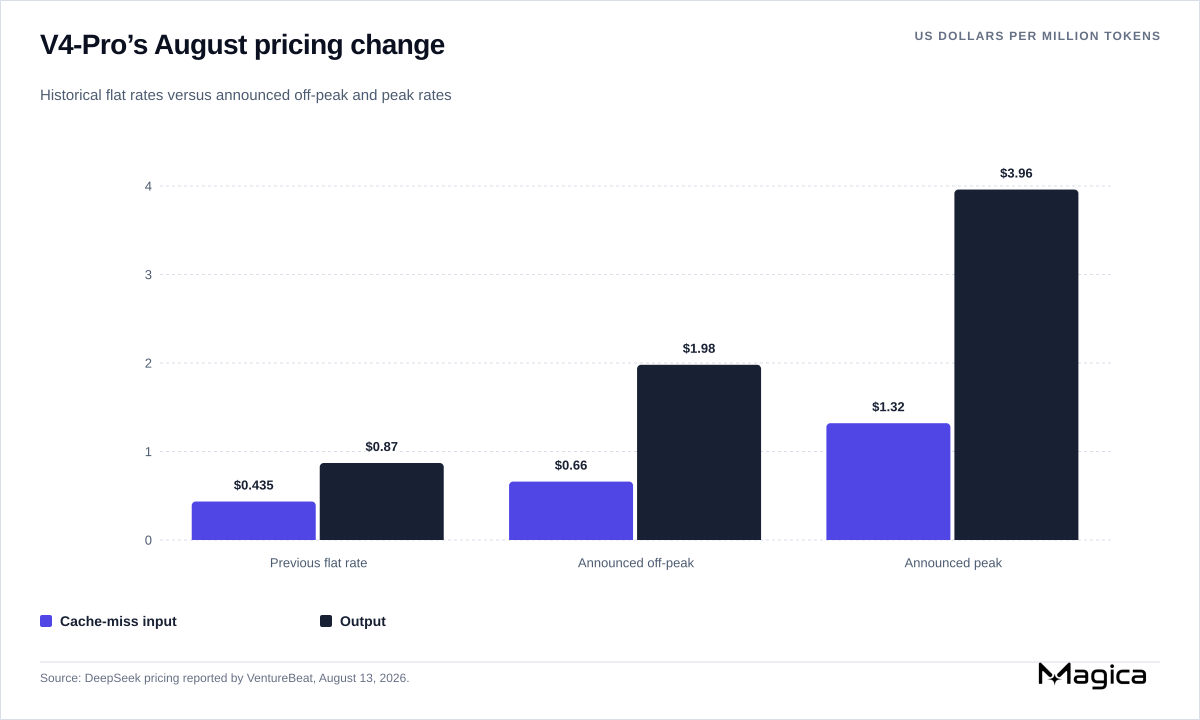
Company-reported V4-Pro prices at Harness’s August launch, with peak and off-peak rates scheduled for August 16, 2026. These are historical announced prices, not verified November rates or costs per completed task. Chart: Magica. Source: VentureBeat.
The August launch report documented a shift from flat API prices to peak and off-peak rates scheduled for August 16. For V4-Pro, it listed cache-miss input at $0.66 per million tokens off-peak and $1.32 at peak, and output at $1.98 and $3.96 respectively. Those exceeded the then-existing flat prices of $0.435 for input and $0.87 for output. These are historical announced prices, not a verified November rate card or a measure of cost per completed task.
An open-source framework does not remove inference costs. The economics depend on the model, timing and mix of cached input, uncached input and generated output, as well as how much work the agent completes.
DeepSeek’s own terms supply a material qualification to the adoption figures: Harness remains in continuous testing and must not be regarded as fully secure or ready for production environments. It can execute code and access permitted files, credentials and networks. The company warns that erroneous output, malicious input or untrusted plugins can cause damage or data leaks, and that sandboxes and approval controls do not guarantee isolation.
In an October 31 technical article described in the November 6 report, DeepSeek’s Harness team argued for agents that retain context across sessions and advance multiple complex tasks without interfering with one another. The team said mainstream designs still fell short at multitasking and team collaboration. It calls its proposed architecture a “super-agent.” This is a design proposition, rather than evidence in the usage figures that the problem has been solved.
The challenge predates this disclosure. In a November 2025 engineering article, Claude developer Anthropic described an initializer agent and a coding agent that left artifacts for subsequent sessions. It also reported that context compaction alone was insufficient to produce a production-quality web application from a high-level prompt. Anthropic said structured handoffs and browser-based testing improved results, while noting that its demonstration was optimized for full-stack web development and that the best arrangement of general-purpose and specialist agents remained unresolved. Carrying work across sessions is an existing competitive problem, rather than a capability unique to Harness.
The next useful evidence would connect adoption to outcomes: retained users, paid consumption, maintained plugins and independently measured completion of long-running tasks, with failure rates, human intervention and total model costs disclosed. DeepSeek’s figures show growing activity around its framework. They do not yet show how reliably that activity becomes finished work, or how much business DeepSeek captures from it.
NextDC is prioritising community support and contracted customers after Melbourne power delays forced a spending retreat. The risks extend to customer rights and access to debt, even as rivals take a 9.9% stake.

Meta is expanding an existing system that places suspected teenagers into Instagram’s protective settings despite adult birthdays. Its global rollout follows legal settlements, but the announcement provides no numerical accuracy results.
Developer Iain Kay’s Linux script turns available RAM into parody emails after Sam Altman’s remarks about local AI. Its own documentation preserves Altman’s clarification—and explains why its measurements cannot test his utilization claim.
Oppenheimer upgraded AMD to Outperform with a $600 target as it forecasts 135% data-center growth in 2027. The bullish call faces tests in supply, customer infrastructure and cash generation.
Statnett has paused new data center grid reservations pending technical safety rules, while the government plans licensing for existing and future facilities. The proposals would determine both connection requirements and which computing uses receive priority.
Google’s TPU 8tx targets confidential AI workloads, while TPU 8i Max combines two chips for larger contexts. Both reuse existing silicon, putting the competitive test on system design, software and delivered cost.
Reported app code points to a paid Galaxy AI tier with higher usage limits and new features. Samsung says core tools will stay free, while prices, allowances and a commercial launch remain unconfirmed.
Citi cut US equities and technology to neutral and upgraded Europe outside the UK, citing lower exposure to AI turbulence and benefits from falling oil prices while retaining a positive market outlook.
ByteDance is rolling out Seedream 5.5 with a 100-edit demonstration, native transparent output and a lower reported editing price. Its predecessor and Google already offered parts of that workflow; production reliability remains unproven.
Animoca Brands co-founder Yat Siu will become CEO on December 1 while remaining executive chairman. His AI agent strategy comes alongside a target to clear overdue financial reporting during 2027, with no relisting date announced.

Amazon’s Fauna Robotics hiring spans manipulation, companionship and cloud operations. Sprout brings a developer platform and research customers, but Amazon has yet to disclose a household product, price or launch date.
Linux creator Linus Torvalds says eBPF fixes may now be arriving faster than new reports, offering a limited sign of relief from AI-driven maintenance work. Most other kernel areas probably have not reached that point, and the release note supplies no counts to establish a wider turnaround.
Dialpad and Ada plan to combine a communications network with customer-service AI agents. Reported terms suggest a sharp reset from Ada’s 2021 valuation, while the product test is whether the merger improves on automation and human handoffs Dialpad already advertised.
Data-centre developers are turning to second-hand turbines, refurbished machines and aeroderivative generators to accelerate power supplies. Lower equipment prices and shorter waits come with maintenance risks, scarce inventory and permitting obstacles.
Nvidia plans to back three Korean AI startups spanning enterprise software, language models and robotics. Its investment amounts remain undisclosed, limiting what the announcement reveals about the financing it will provide.
Independent directors and outside counsel will investigate reports involving Nvidia’s founder and CEO, who has admitted infidelity. The board says it has no reason to believe national security or company secrets were compromised.
Apple reportedly wants Siri to pursue goals without prompts at every step. A possible 2027 debut is a reporter’s assessment, while Apple experiments with its iOS 28 development process after earlier Siri delays.
Apple led Nvidia by roughly $615 billion in market value at the November 5 close. Nvidia’s rapid sales growth contrasts with financing and construction risks for AI infrastructure, while Apple faces rising costs and uses Nvidia chips in its own cloud.
Councils, transport officials and MPs’ staff report more demanding AI-assisted correspondence. Official records show pressure alongside successful appeals, while regulators seek to protect access and contain excessive submissions.
Anthropic has reportedly taken over commitments for Caterpillar generators ordered by OnePWR, gaining access to scarce equipment and installation capabilities as it seeks greater control over data-center power.