Editorial Team
7 min read
Continental Strategy reported $740,000 from Anthropic over six quarters as the AI developer expanded its outside lobbying roster into national-security offices. The disclosures show spending and listed offices, but do not establish meetings or policy outcomes.
Continental Strategy, a government-relations firm led in Washington by Alberto Martinez, former Senate chief of staff to Secretary of State Marco Rubio, reported $740,000 in lobbying income from AI developer Anthropic across six quarters ending September 2026, according to an analysis of federal disclosures. Its April–June 2026 report listed the National Security Council among the offices lobbied.
The account is part of a broader expansion: the analysis counted eight paid outside lobbying firms working for Anthropic in the third quarter of 2026, compared with two a year earlier. Their reported quarterly income rose from $150,000 to $910,000, about sixfold. Continental and Ballard Partners were the only outside firms in the analysis whose reports listed the council.
That matters because Anthropic already serves the market those offices help shape. In a June 2025 announcement, the company said Claude Gov, a custom set of its Claude AI models for U.S. national-security customers, was already deployed in classified government environments. The disclosures do not establish that lobbying secured those deployments or changed government policy.
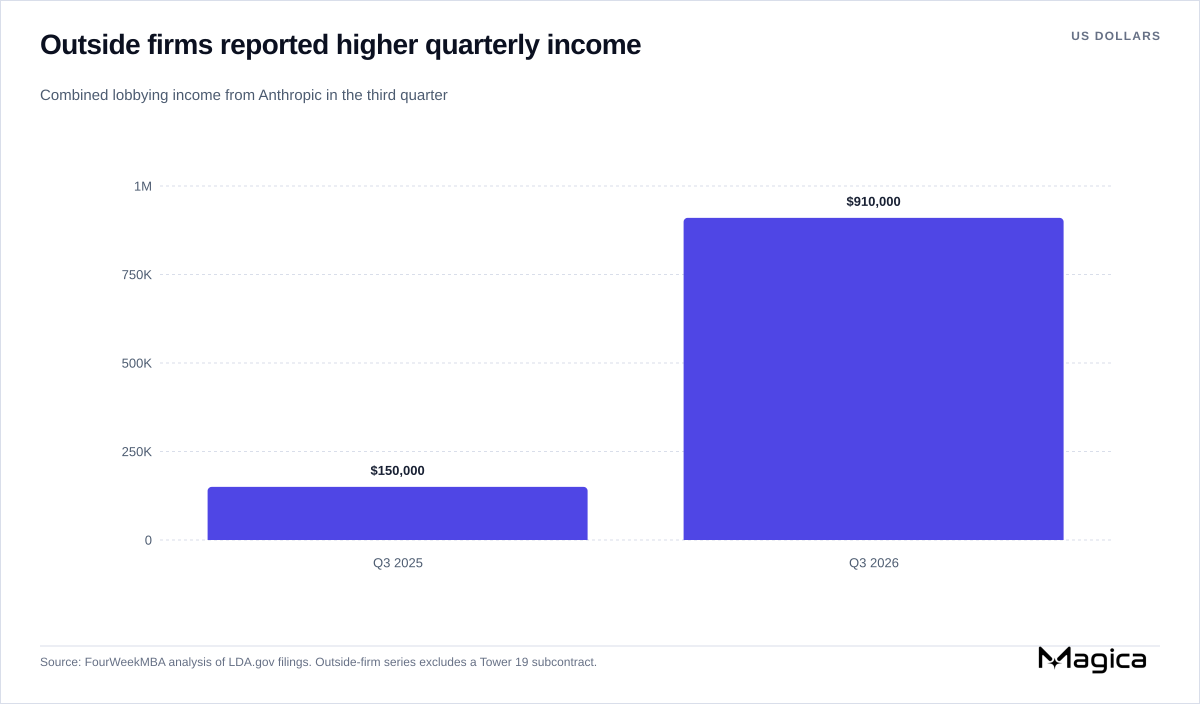
Outside firms’ combined reported income from Anthropic in the two third quarters. The series excludes a Tower 19 subcontract. Chart: Magica, based on FourWeekMBA’s analysis of LDA.gov filings. Source: FourWeekMBA.
Martinez became Continental’s Washington managing partner in November 2024, according to a report on the firm’s appointment announcement. He had spent a decade working for Rubio and then seven years as a founding executive at public-affairs firm Targeted Victory. Continental said he would lead its strategic growth in Washington. The available reporting does not explain why Anthropic chose the firm.
Rubio’s relevance extends beyond his former aide. President Donald Trump assigned him the national security adviser role on an interim basis in May 2025 while he remained secretary of state. Under the White House’s January 2025 council organization memorandum, the National Security Council coordinates executive departments’ development and implementation of national-security policy. The national security adviser sets its agenda at the president’s direction. An office listing nevertheless does not establish contact with Rubio himself.
The disclosure analysis says Continental registered Anthropic as a client in a filing posted May 7, 2025, specifying “AI development and national security.” Martinez appears on every subsequent quarterly report it examined, alongside lobbyist Paul Calkins.
Continental founder Carlos Trujillo, a former U.S. ambassador to the Organization of American States who launched the firm in 2022, joined the account’s reported lobbying team in the first quarter of 2026. Lobbyist Caroline Farr appears in the third quarter, with a listed covered position of senior adviser at Treasury, according to the analysis. Those disclosures identify experience elsewhere in government as well as the Rubio connection; they do not match particular lobbyists to particular contacts.
Continental also had another administration link: the November 2024 appointment report described Katie Wiles as directing its Jacksonville and Washington offices and identified her as the daughter of Susie Wiles. A separate report on the lobbying identifies Susie Wiles as White House chief of staff and a former employee of Ballard Partners.
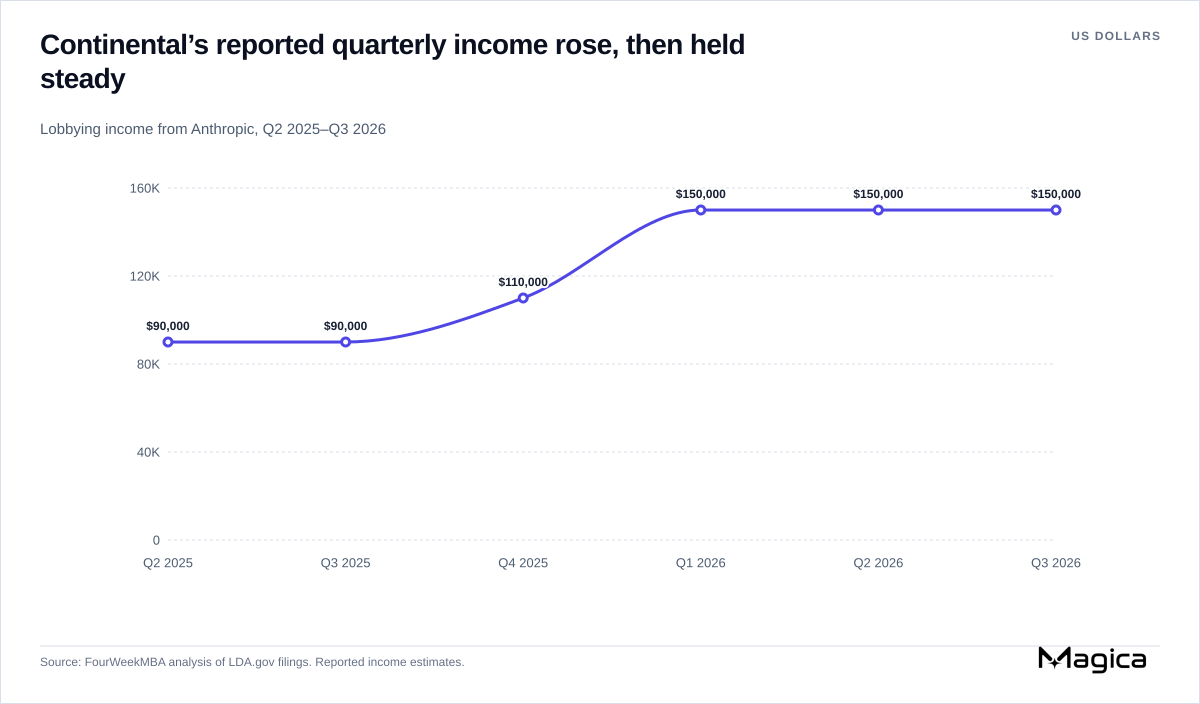
Continental’s reported quarterly lobbying income from Anthropic. These are income estimates rather than an exact cash-payment ledger. Chart: Magica, based on FourWeekMBA’s analysis of LDA.gov filings. Source: FourWeekMBA.
The six-quarter analysis gives the following Continental figures:
| Reporting quarter | Reported lobbying income from Anthropic |
|---|---|
| Q2 2025 | $90,000 |
| Q3 2025 | $90,000 |
| Q4 2025 | $110,000 |
| Q1 2026 | $150,000 |
| Q2 2026 | $150,000 |
| Q3 2026 | $150,000 |
| Total | $740,000 |
The quarterly amount rose by $60,000, or about 67%, from Q2 2025 to Q1 2026, then remained at $150,000 through September. These are sums of reported estimates, not an exact cash-payment ledger: congressional Lobbying Disclosure Act guidance says firms report income earned or accrued even if clients pay later, with amounts of $5,000 or more estimated in good faith and rounded to the nearest $10,000.
The offices varied. Continental’s April–June 2026 report listed Commerce, Defense, the House, the Senate, Treasury and the National Security Council. Its July–September report listed Commerce, the Executive Office of the President, State and Treasury. The full $740,000 cannot be assigned specifically to council lobbying.
The amounts and office lists here rely on the published disclosure analysis and were not independently verified against the underlying filings for this article.
Ballard Partners, another outside lobbying firm retained by Anthropic, reported $890,000 for the first three quarters of 2026, according to the same analysis: $130,000 in Q1 and $380,000 in each of Q2 and Q3. That exceeded Continental’s six-quarter total despite covering a shorter period.
The analysis dates Ballard’s registration filing to April 10, 2026. That filing date should not be treated as the start of its work: the account also identifies first-quarter income. Congressional guidance allows registration after the obligation arises, generally within 45 days; the available evidence does not establish Ballard’s precise engagement date.
Ballard’s first two quarterly reports described procurement advocacy; its third described advocacy on U.S. AI policy. Its April–June report listed the council, and its July–September report retained the council and added Defense and the Office of the Director of National Intelligence. The analysis identifies Ballard lobbyist Micah Ketchel on all three reports, with a listed prior role as special assistant to the president and senior adviser to the national security adviser in 2025. Amaryllis Fox Kennedy joined the reported lobbying team in Q3, with a listed prior role as deputy director of national intelligence in 2025–2026.
Together, Continental and Ballard accounted for $1.63 million, or about 54%, of the $3.01 million reported by eight paid outside firms from January 2025 through September 2026. That denominator excludes a Tower 19 subcontract through Aquia Group. It measures the two firms’ share of that outside-firm series, rather than Anthropic’s total lobbying spending.
The analysis found no council, Defense, State or intelligence-director office listings in paid outside firms’ 2025 reports; Continental and Ballard’s 2026 reports collectively listed all four.
Anthropic’s own reported lobbying expenses also grew: the analysis gives $1.01 million for Q3 2025 and $2.11 million for Q3 2026, roughly doubling. It gives $3.13 million for all of 2025 and $5.64 million for January–September 2026. The separate lobbying report cites $8.11 million for “2026 so far” without reconciling its scope. That figure cannot be treated as interchangeable with the analysis’s expense total.
Nor should the company’s expenses simply be added to outside firms’ income. Congressional guidance says an organization’s lobbying expense calculation includes retained lobbying firms’ costs, so adding the series risks double-counting.
Anthropic said Claude Gov was developed from government customer feedback for applications including strategic planning, operational support, intelligence analysis and threat assessment. It also claimed improved handling of classified material and fewer refusals when engaging with classified information.
The defense dispute makes acceptable-use policy a concrete business issue. In a February 27, 2026 statement, Anthropic said negotiations with defense officials had reached an impasse over its requested exceptions for mass domestic surveillance of Americans and fully autonomous weapons. It said Pete Hegseth, the cabinet official leading the defense department, had directed that Anthropic be designated a supply-chain risk. This is the company’s account of that dispute at that date; it does not establish the purpose or result of a later lobbying contact.
The October–December disclosures, due January 20, can show whether reported income and office listings change. Answering whether the spending altered procurement or acceptable-use decisions requires evidence of specific requests, contacts and resulting government actions. The disclosure analysis provides none of those outcomes, and says its authors did not contact Anthropic, Continental or Ballard. The open question is what these firms achieved for the company, beyond the activity and income reported.
SemiAnalysis reports that Amazon’s Trainium3 delivers up to 2.28 times the tokens per modeled dollar of Nvidia’s GB300 NVL72 in an AgentX preview. The result expands public evidence for custom AI chips, but validation, model matching and customer pricing still determine its practical value.
Microsoft says Chinese and North Korean hacking groups have adopted ARTEX, an AI penetration-testing framework that coordinates existing tools. Its spread across models and software forks complicates efforts to contain abuse through a single provider.
Neuralink says its LINK pivotal study is recruiting people with severe paralysis from ALS to assess digital device control, daily independence and long-term safety. Earlier participant gains and technical setbacks frame the test; the implant remains investigational.
India’s IT secretary says Sarvam’s commercial hosting of foreign AI models does not conflict with its publicly supported domestic model development. Eligibility for proposed inference support remains unresolved.
Manufacturing partners have reportedly told buyers that Nvidia will not permit server orders to ship to Malaysia, Singapore, Thailand and Indonesia as they assess new US export controls. The uncertainty is already reaching cloud-project financing.
Trustly’s existing owners are funding new AI payment products after job cuts. New quarterly results show rising payment volumes and revenue, but weaker earnings than a year earlier.
The Pentagon denies reports that officials weighed production powers to pressure Nvidia to restore Jensen Huang. Nvidia confirms senior government input, but its board’s foreign-intelligence investigation remains open.
Perplexity says users are choosing Google's new model over rival offerings, with daily token volume doubling in three days. The 120-billion figure is cumulative, and the early demand leaves retention and task economics unresolved.
Kioxia says a proof of concept paired Nvidia software with about 1.1 PB of raw SSD capacity to expand the datasets GPUs can access. The demonstration establishes a capacity proposition, while workload performance and deployment economics remain undisclosed.
Google’s November 25 update adds Familiar Face alerts and remote siren controls to two Walmart Onn outdoor cameras. The expansion makes inexpensive Nest alternatives more capable, while the value depends on subscription access and reliable video playback.
OpenAI is testing a combined Chat and Work experience with a small group of Pro subscribers. A shared allowance arriving more broadly in December will put advanced conversations and delegated tasks on the same budget, but the size of any resulting loss of access remains unknown.
Sellers are seeking buyers for thousands of Nvidia B300 chips, while Asian data centers try to replace Chinese customers affected by U.S. controls. Rental prices have fallen, but short contracts remain scarce and operators face demanding financing terms.
Lenders are delaying or reassessing financing for Asian data centers serving Chinese technology firms as new US licensing rules put chip purchases and customers’ access to computing capacity in doubt.
Meta employees describe cuts to moderation teams and difficulty correcting mistakes as AI enforcement expands. Meta claims better accuracy, while account restrictions and an EU investigation put the effectiveness of appeals under scrutiny.
Dario Amodei rejects handing political authority to AI while defending task automation. An independent assessment finds faster progress at Anthropic, largely through AI assistance, but leaves important evidence outside public view.
OpenAI is piloting Private Inference with selected business customers. The feature targets provider access during processing, but model coverage, costs and evidence of its protections remain key questions.
Executives at rival AI developers are challenging a view reported among some Anthropic employees that people should delegate authority to superior machines. Anthropic defends human oversight, while the dispute exposes a harder question about who retains power when AI makes better decisions.
Officials told congressional staff there was no evidence China directed Alice Huang’s affair with Nvidia founder Jensen Huang. Reports of later information sharing, excluded intelligence and scrutiny of her former company complicate the security assessment.
Updates incorporating Sam Corcos’s requests appeared in his AI-built strategy game during a FinCEN cyber disruption. The Treasury CIO says computers develop it autonomously; the record does not establish time diverted from official duties or who pays the project’s costs.
SpaceX won conditional authorization for its Starmind orbital data centers, with deployment deadlines through 2040. The FCC left higher-altitude debris plans unresolved and did not judge whether the computing business will work.