Editorial Team
9 min read
SemiAnalysis reports that Amazon’s Trainium3 delivers up to 2.28 times the tokens per modeled dollar of Nvidia’s GB300 NVL72 in an AgentX preview. The result expands public evidence for custom AI chips, but validation, model matching and customer pricing still determine its practical value.
Amazon’s Trainium3 custom AI accelerator has posted a reported cost advantage in a public test of serving AI agents, giving buyers another comparison with Nvidia’s GPU systems. The result is provisional: it measures tokens generated per modeled dollar under particular serving conditions, leaving validation and commercial pricing to determine the savings a customer could obtain.
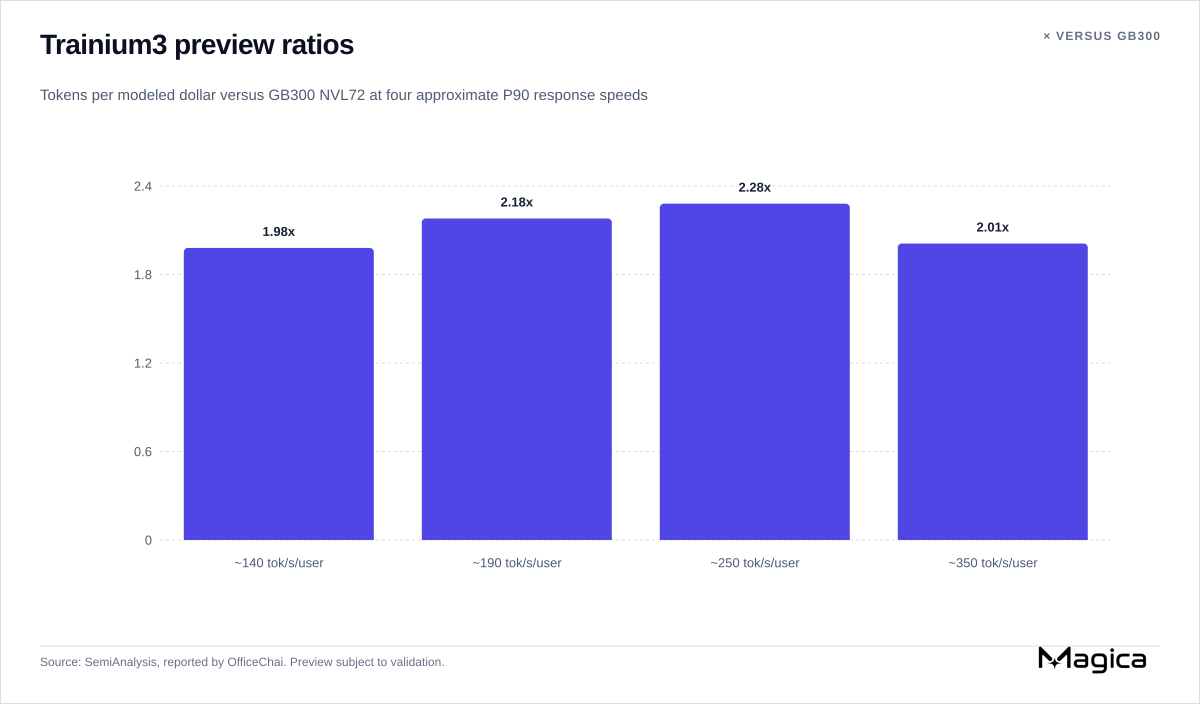
SemiAnalysis's reported AgentX preview ratios for the GLM-5.2/GLM-5.3 FP4 workload at four approximate P90 interactivity points. These compare tokens per modeled ownership-cost dollar; validation remains ongoing. Source: 7 Months After Jensen Huang Said TPU And Trainium Would Never Show Up On InferenceMAX, Both Are Beating NVIDIA On It.
SemiAnalysis, the semiconductor research firm that developed the InferenceMAX benchmarking project and its successors InferenceX and AgentX, announced on November 25 that Amazon had submitted its first Trainium3 UltraServer results to its agentic inference benchmark. The firm claimed 2.28x better performance per dollar than Nvidia’s GB300 NVL72 and B300 and AMD’s MI355.
Trainium3 is the custom AI accelerator offered by Amazon Web Services, Amazon’s cloud computing business, through its Elastic Compute Cloud service. It supports both model training and inference—the process of running a model to generate answers. This result concerns inference. Nvidia and AMD supply competing graphics processing units, or GPUs, used for AI computing.
The detailed comparison with GB300 varies by the response speed required for each user. A report describing SemiAnalysis’s results gives these approximate points:
| P90 interactivity, in tokens per second per user | Trainium3 tokens per modeled dollar relative to GB300 |
|---|---|
| 140 | 1.98x |
| 190 | 2.18x |
| 250 | 2.28x |
| 350 | 2.01x |
The report describes P90 interactivity as reflecting token delivery for the slowest 10% of users. These are points on a cost-versus-response-speed curve, rather than four measurements of raw chip speed. The report says Trainium3’s curve extends beyond 450 tokens per second per user, farther than the Nvidia and AMD systems tested. It also says SemiAnalysis labels the results an official preview that may change during validation.
The same account identifies the workload as AI developer Z.ai’s 744-billion-parameter model, labeled GLM-5.2/GLM-5.3, running with the vLLM model-serving software and FP4 numerical precision. That combined version label does not establish an unambiguous model match across systems. The headline ratio should therefore remain a reported preview, rather than a settled comparison of interchangeable deployments.
AgentX addresses repeated, lengthy interactions: many conversation turns, growing context, reuse of earlier text and bursts of short-lived sub-agents. As an account of the benchmark explains, tokens are units of text processed by a model. Tokens per dollar measures throughput against a cost assumption; it does not mean Trainium3 answers every request 2.28 times faster.
SemiAnalysis credits Amazon’s result to wide expert parallelism, which distributes a model’s expert components across chips. That makes server connections and serving software part of the result. The technique is not exclusive to Amazon: SemiAnalysis’s October 2025 methodology already described Nvidia submissions using wide expert parallelism on the earlier DeepSeek R1 model.
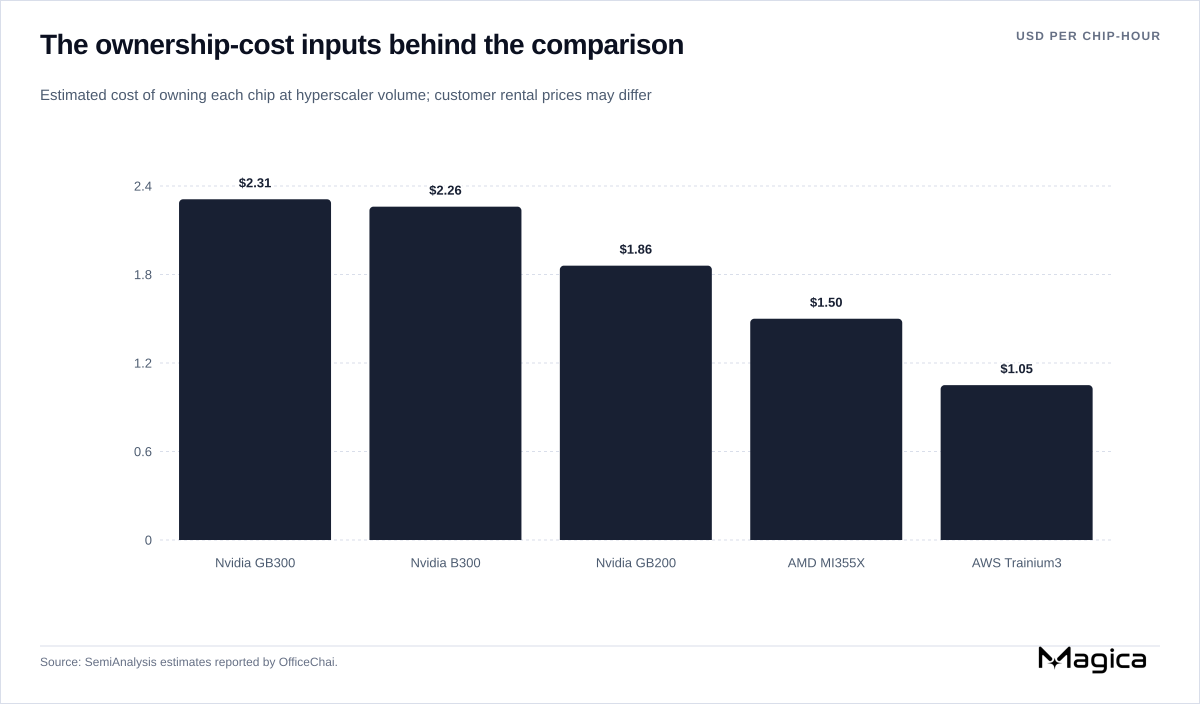
SemiAnalysis's estimated ownership costs at hyperscaler volume. These are cost inputs, not customer cloud prices or measurements of system throughput. Source: 7 Months After Jensen Huang Said TPU And Trainium Would Never Show Up On InferenceMAX, Both Are Beating NVIDIA On It.
The report gives the following SemiAnalysis estimates for owning chips at hyperscaler volume:
| Accelerator | Estimated cost per chip-hour |
|---|---|
| Nvidia GB300 | $2.31 |
| Nvidia B300 | $2.26 |
| Nvidia GB200 | $1.86 |
| AMD MI355X | $1.50 |
| AWS Trainium3 | $1.05 |
On those inputs, a GB300 chip-hour costs 2.2 times a Trainium3 chip-hour: $2.31 divided by $1.05. That is a comparison of the cost inputs, not a reconstruction of system throughput. It shows why acquisition and operating assumptions matter so much to the tokens-per-dollar ranking.
SemiAnalysis’s original InferenceMAX methodology distinguished hyperscalers owning hardware, other large owners and customers renting GPUs under contracts. Its published October 2025 ownership analysis assumed a four-year economic life. Those historical assumptions explain the framework; they do not establish every input behind the November 2026 AgentX preview.
The methodology also explains the trade-off that a single ratio can hide. Serving more requests together generally increases total throughput while slowing token delivery to each user. Demanding faster individual responses can raise cost per token. Buyers need a comparison at the speed their application requires, using their own prices.
For AWS, a lower underlying cost could support lower customer prices or higher margins. The benchmark does not establish how that benefit would be divided. Nor does it price the engineering work needed to move an application between serving systems.
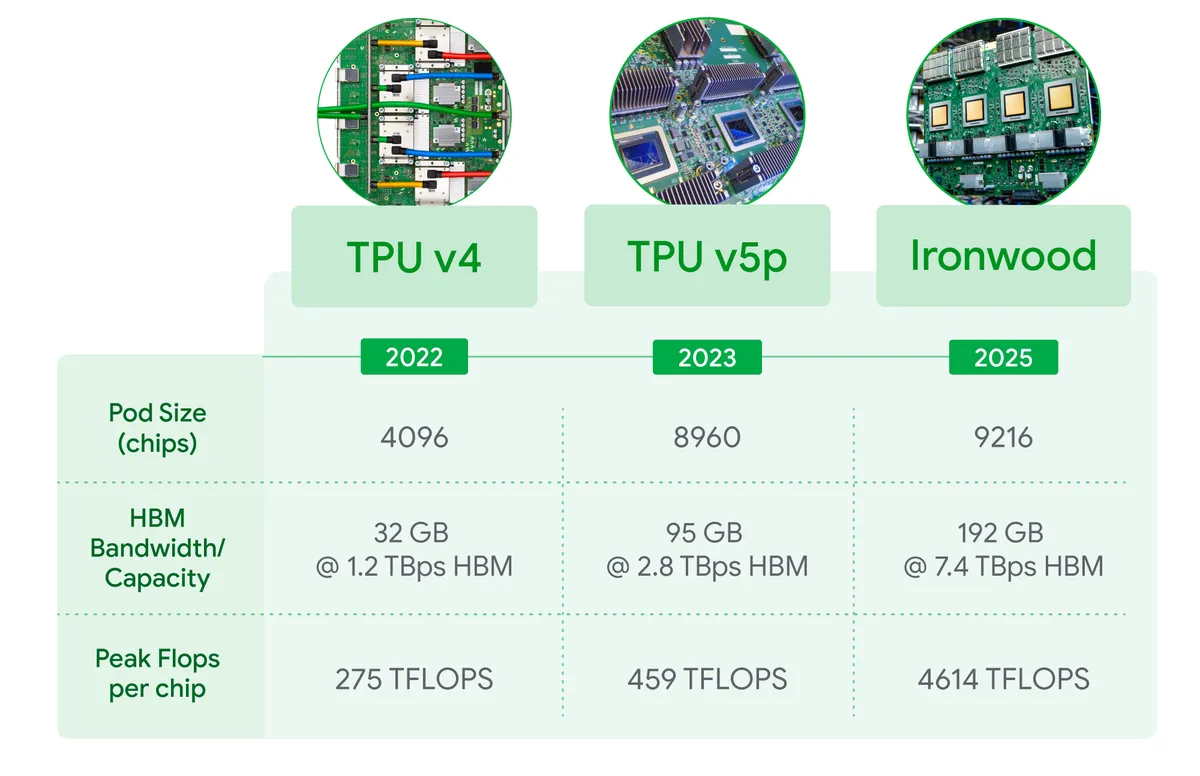
Google's company-reported TPU specifications. FP8 peak compute is emulated for v4 and v5p and native for Ironwood. These specifications do not describe the AgentX test configuration. Source: Google: Ironwood TPU introduction.
The benchmark submission follows an existing product launch. AWS announced general availability of Trn3 UltraServers on December 2, 2025. It said they could connect up to 144 Trainium3 chips, each with 144 GB of high-bandwidth memory, and that NeuronSwitch-v1 doubled interchip bandwidth relative to Trn2 UltraServers.
AWS’s launch claims of up to 4.4x higher performance and 4x better performance per watt were comparisons with Trn2 UltraServers. They cannot be substituted for the AgentX comparison with Nvidia. AWS also said its Neuron software development kit offered native PyTorch integration without changes to model code, while exposing deeper controls for performance engineers. That claim addresses part of the adoption burden; it does not measure the work required for a particular customer’s deployment.
Google offers a separate custom-chip alternative. Its Tensor Processing Unit, or TPU, is another custom AI accelerator. Google introduced seventh-generation Ironwood in April 2025. Google called Ironwood its first TPU designed specifically for inference. It said TPUs had powered its own demanding training and serving workloads for more than a decade and also enabled cloud customers to run those workloads.
Google’s announcement described 192 GB of memory per chip and configurations of 256 or 9,216 chips. At the larger scale, it specified liquid cooling and nearly 10 megawatts of power. Those are product design specifications, not the configuration or measured energy use of the AgentX submission. They illustrate why memory, networking, cooling and available electricity belong alongside price in a deployment decision.
The report places the submissions against an April podcast challenge from Jensen Huang, Nvidia’s founder and chief executive, who questioned whether TPU and Trainium would appear on InferenceMAX to demonstrate their inference costs. Their participation answers the question of public comparison; it does not establish a universal ranking.
Google’s earlier results are another limit on the novelty of Amazon’s submission. The report attributes to SemiAnalysis up to 50% better performance per dollar for Ironwood against Blackwell Ultra, and a 56% advantage over GB200 on AI developer Moonshot’s Kimi K3 model after software optimization. It also says TPUv7’s first AgentX submission beat GB300 NVL72 across most of its curve. Those are separate workloads and configurations, not replications of Trainium3’s GLM result.
The project’s own history argues against treating any ranking as permanent. In October 2025, SemiAnalysis said it planned TPU and Trainium backends and warned that rapidly improving software makes fixed-date benchmarks stale. Its original suite found both AMD and Nvidia advantages depending on model, serving engine and response speed. For example, on its GPT-OSS 120B FP4 summarization test, AMD’s MI355X running vLLM could beat Nvidia’s B200 running the TensorRT-LLM serving engine below 225 tokens per second per user; above that level, B200 was cheaper per token. That older result illustrates the trade-off, rather than establishing a current ranking.
The original methodology also disclosed hardware access and optimization help from AMD and Nvidia, alongside compute support from cloud providers. SemiAnalysis operates the benchmark, but vendors contribute to the systems and configurations being tested. Its 2025 suite deliberately avoided prefix caching; AgentX’s reported emphasis on context reuse is a different workload, so the older methods should not be assumed to describe every detail of the new test.
Production use supplies another kind of evidence. The current report relays SemiAnalysis’s statement that Anthropic, the developer of Claude AI models, uses Trainium at large scale for production inference and other workloads. It also describes Anthropic’s commitment to up to a million Google TPUs and addition of AMD as a supplier. Nvidia’s CUDA software ecosystem remains a source of switching friction, the report notes.
Anthropic is also a financially and technically involved customer. In its November 2024 partnership announcement, Anthropic said a further $4 billion from Amazon would bring Amazon’s investment to $8 billion while keeping it a minority investor. It named AWS its primary cloud and training partner and described joint work with AWS’s Annapurna Labs on Trainium kernels and the Neuron software stack. That dated announcement establishes a stake in Trainium’s success and a role in optimizing it; it is not a current investment total or independent validation of AgentX.
The next decisive evidence is a validated submission with a clear model version, numerical precision, serving configuration and response-speed requirement. Buyers then need to apply actual contract prices and test their own request patterns, including context reuse and bursts of concurrent work.
They also need output-quality checks, time to first token, sustained response speed, migration effort and power requirements. SemiAnalysis’s original methodology distinguished estimated provisioned power from measured energy consumption; the 2.28x cost ratio supplies neither a measured energy saving nor a complete deployment budget. A purchasing case rests on how the validated system performs within those customer constraints.
Microsoft says Chinese and North Korean hacking groups have adopted ARTEX, an AI penetration-testing framework that coordinates existing tools. Its spread across models and software forks complicates efforts to contain abuse through a single provider.
Neuralink says its LINK pivotal study is recruiting people with severe paralysis from ALS to assess digital device control, daily independence and long-term safety. Earlier participant gains and technical setbacks frame the test; the implant remains investigational.
India’s IT secretary says Sarvam’s commercial hosting of foreign AI models does not conflict with its publicly supported domestic model development. Eligibility for proposed inference support remains unresolved.
Manufacturing partners have reportedly told buyers that Nvidia will not permit server orders to ship to Malaysia, Singapore, Thailand and Indonesia as they assess new US export controls. The uncertainty is already reaching cloud-project financing.
Trustly’s existing owners are funding new AI payment products after job cuts. New quarterly results show rising payment volumes and revenue, but weaker earnings than a year earlier.
The Pentagon denies reports that officials weighed production powers to pressure Nvidia to restore Jensen Huang. Nvidia confirms senior government input, but its board’s foreign-intelligence investigation remains open.
Perplexity says users are choosing Google's new model over rival offerings, with daily token volume doubling in three days. The 120-billion figure is cumulative, and the early demand leaves retention and task economics unresolved.
Kioxia says a proof of concept paired Nvidia software with about 1.1 PB of raw SSD capacity to expand the datasets GPUs can access. The demonstration establishes a capacity proposition, while workload performance and deployment economics remain undisclosed.
Google’s November 25 update adds Familiar Face alerts and remote siren controls to two Walmart Onn outdoor cameras. The expansion makes inexpensive Nest alternatives more capable, while the value depends on subscription access and reliable video playback.
OpenAI is testing a combined Chat and Work experience with a small group of Pro subscribers. A shared allowance arriving more broadly in December will put advanced conversations and delegated tasks on the same budget, but the size of any resulting loss of access remains unknown.
Sellers are seeking buyers for thousands of Nvidia B300 chips, while Asian data centers try to replace Chinese customers affected by U.S. controls. Rental prices have fallen, but short contracts remain scarce and operators face demanding financing terms.
Lenders are delaying or reassessing financing for Asian data centers serving Chinese technology firms as new US licensing rules put chip purchases and customers’ access to computing capacity in doubt.
Meta employees describe cuts to moderation teams and difficulty correcting mistakes as AI enforcement expands. Meta claims better accuracy, while account restrictions and an EU investigation put the effectiveness of appeals under scrutiny.
Dario Amodei rejects handing political authority to AI while defending task automation. An independent assessment finds faster progress at Anthropic, largely through AI assistance, but leaves important evidence outside public view.
OpenAI is piloting Private Inference with selected business customers. The feature targets provider access during processing, but model coverage, costs and evidence of its protections remain key questions.
Executives at rival AI developers are challenging a view reported among some Anthropic employees that people should delegate authority to superior machines. Anthropic defends human oversight, while the dispute exposes a harder question about who retains power when AI makes better decisions.
Officials told congressional staff there was no evidence China directed Alice Huang’s affair with Nvidia founder Jensen Huang. Reports of later information sharing, excluded intelligence and scrutiny of her former company complicate the security assessment.
Updates incorporating Sam Corcos’s requests appeared in his AI-built strategy game during a FinCEN cyber disruption. The Treasury CIO says computers develop it autonomously; the record does not establish time diverted from official duties or who pays the project’s costs.
SpaceX won conditional authorization for its Starmind orbital data centers, with deployment deadlines through 2040. The FCC left higher-altitude debris plans unresolved and did not judge whether the computing business will work.
NVIDIA has released Nemotron-Labs-Image-30B-A3B for non-commercial research and evaluation. The broader creation framework awaits legal clearance, and its best GenEval and GenEval2 results use GPT-6 assistance rather than the downloadable generator alone.