Editorial Team
8 min read
India’s IT secretary says Sarvam’s commercial hosting of foreign AI models does not conflict with its publicly supported domestic model development. Eligibility for proposed inference support remains unresolved.
India’s government has defended Sarvam AI, a Bengaluru-based developer of Indian-language AI models, over its commercial hosting of Chinese-developed systems. The defence allows room for a domestic-model developer to run a foreign-model business, but leaves the terms of future public support unresolved.
Sarvam’s launch illustration for Token Factory, its platform for serving its own and foreign open-weight models from India. Illustration: Sarvam AI. Source: Sarvam Token Factory announcement.
S. Krishnan, secretary of India’s Ministry of Electronics and Information Technology and a former Tamil Nadu industries and finance secretary, said on November 25 that the government saw no contradiction between Sarvam’s indigenous model work and its commercial services. His appointment to the ministry was announced in 2023.
His defence rested on a stated evidentiary basis: what Sarvam had told the government and users’ experience. He said the ministry saw no misuse of IndiaAI Mission support and argued that AI companies need ways to earn revenue, according to the account of his remarks. The assurance does not establish an independent audit of the service’s funding.
Sarvam co-founder Pratyush Kumar previously helped found AI4Bharat, a research initiative building open-source Indian-language AI. Fellow co-founder Vivek Raghavan worked on digital public infrastructure, including Aadhaar. Those backgrounds are described in the company’s December 2023 funding announcement.
In that announcement, Sarvam said it was raising $41 million in Series A financing led by Lightspeed, with Peak XV Partners and Khosla Ventures participating. Its stated plan already combined model research with an enterprise platform for creating and deploying AI applications. Private venture financing and public compute support are distinct parts of that history; the 2023 announcement does not establish how Token Factory is financed today.
The public stake is substantial. The IndiaAI Mission was approved in March 2024 with a five-year outlay of Rs 10,371.92 crore. That is the overall budget of the government’s AI ecosystem programme, not an award to Sarvam. An August 2026 government statement said 20 indigenous foundation-model proposals had been identified for support from 506 applications, with intellectual property retained by applicants. It listed Sarvam’s 30-billion- and 105-billion-parameter models among outputs already launched. It also listed launched models from other developers. Parameters are learned model values; their number alone does not establish capability.
Sarvam launched Token Factory on November 16 to serve its own models and foreign open-weight models from GPU clusters in India. Inference means running a trained model to produce responses; it is distinct from training the model itself. The platform lets businesses and developers use models without buying and operating the underlying computing infrastructure.
Open weights allow a provider to run the model itself, rather than obtain every response from its developer’s servers. The criticism centred on the prominence of Chinese offerings. A report on the dispute described social-media objections to Chinese offerings, including DeepSeek, Kimi and GLM, alongside Sarvam’s own 105B. The company’s launch announcement also lists Google’s Gemma.
Kumar says Token Factory uses only privately procured graphics processing units, or GPUs. He also said Sarvam’s access to government-subsidised GPUs ended in March 2026, according to the report carrying his explanation.
His account of the earlier support is specific: around 20 startups received a 40% discount on computing costs, Sarvam used that support to train its proprietary 105B model from scratch, and the subsidy went to GPU cloud providers rather than directly to Sarvam. Those are the co-founder’s descriptions of the arrangement, reported in his earlier explanation. Payment to providers does not remove the economic benefit to Sarvam: the company’s account is that it paid less for computing.
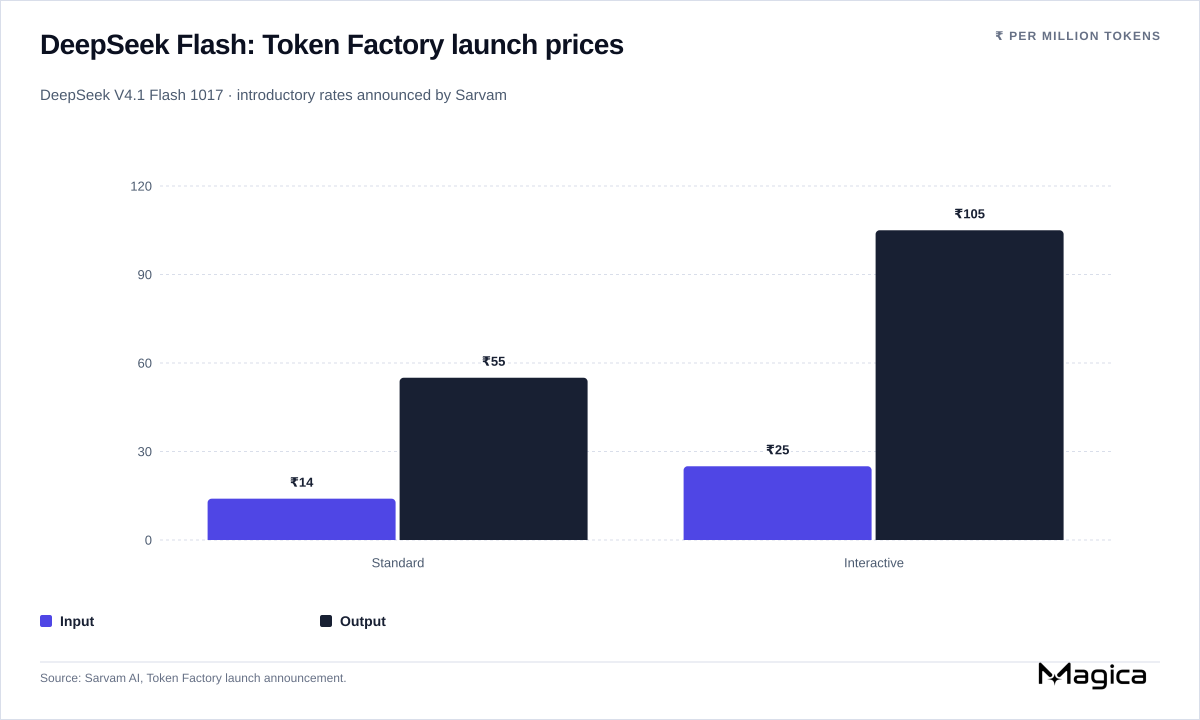
Company-reported introductory prices for DeepSeek V4.1 Flash 1017 on Sarvam’s Standard and Interactive endpoints. Customer prices do not establish operating costs or profitability. Graphic: Magica. Source: Sarvam Token Factory announcement.
Token Factory competes in an established market. Together AI, Fireworks AI and DeepInfra also provide inference services; OpenRouter connects developers to multiple providers through one interface. Sarvam’s opportunity therefore depends on how effectively it operates the models, rather than exclusive access to their weights.
Sarvam’s launch announcement lists introductory prices for its DeepSeek V4.1 Flash Standard endpoint of Rs 14 per million input tokens and Rs 55 per million output tokens. Its faster Interactive endpoint costs Rs 25 and Rs 105 respectively. Tokens are units of model input and output. These are customer prices, not evidence of operating cost or profitability.
Sarvam’s own performance comparisons show why claims need a defined workload. The following figures measure the wait for the first response token, not the speed of the entire answer or its quality:
| Model and prompt length | Sarvam Token Factory | Together | Fireworks | DeepInfra |
|---|---|---|---|---|
| GLM 5.3, 1,000 tokens | 0.68 seconds | 0.82 seconds | 0.84 seconds | 2.17 seconds |
| GLM 5.3, 10,000 tokens | 1.19 seconds | 1.19 seconds | 1.57 seconds | 2.18 seconds |
| DeepSeek V4.1 Flash, 1,000 tokens | 0.51 seconds | 0.61 seconds | 1.01 seconds | 1.08 seconds |
| DeepSeek V4.1 Flash, 10,000 tokens | 0.90 seconds | 0.71 seconds | 1.55 seconds | 1.75 seconds |
These are company-reported medians over 72 hours, sending one request at a time from AWS Mumbai using a recreation of Artificial Analysis’s method. Sarvam says it used each provider’s fastest tier and its own Standard endpoint for DeepSeek. Its GLM measurement was on November 6; the others were November 3–5. Together tied Sarvam on the longer GLM prompt and beat it on the longer DeepSeek prompt. The results support a competitive offering under those conditions, not a universal speed lead.
The announcement describes engineering beyond making model weights available: separating prompt processing from response generation, reusing cached context and changing how requests are assigned to GPUs. Sarvam says that, across seven days of production counters from October 30 to November 6, its additional cache raised the share of DeepSeek V4.1 Flash prompt tokens served from cache from 91.4% to 95.7%. That halves the uncached share, from 8.6% to 4.3%; it does not show a halving of total computing costs.
Sarvam says it also offers deployments on customers’ premises. Its commercial proposition combines model choice, local operation and inference engineering, while relying on work from model developers and open-source infrastructure teams.
Krishnan said Sarvam had informed the government of its multi-model platform plans and that other startups had approached it with similar offerings. He also said government users already employed open-source and open-weight models, arguing that domestic operation keeps data in the country, according to the account of his comments.
That explains the ministry’s data-residency rationale; it does not make the underlying models Indian-developed.
The hardware has a separate dependency. The government’s August statement acknowledged that India’s compute ecosystem uses globally sourced GPUs through approved providers. Krishnan said the mission had access to multiple chip platforms, including TPUs and AMD chips, and did not expect US chip restrictions to have a significant impact on India. That is his assessment of supply risk, rather than a guarantee of future access.
Sarvam’s domestic-model programme is continuing. The company says in the account of its plans that an improved 105B version strengthens reasoning, tool use and Indian-language capabilities, and it plans additional vision, speech and edge models. Sarvam also says it is working with partners to bring more advanced computing infrastructure into India for larger models. Krishnan said in his account of the supported work that the government was also backing work towards a trillion-parameter model. His favourable description of feedback from startups using Sarvam’s services supplied no published comparative capability benchmark.
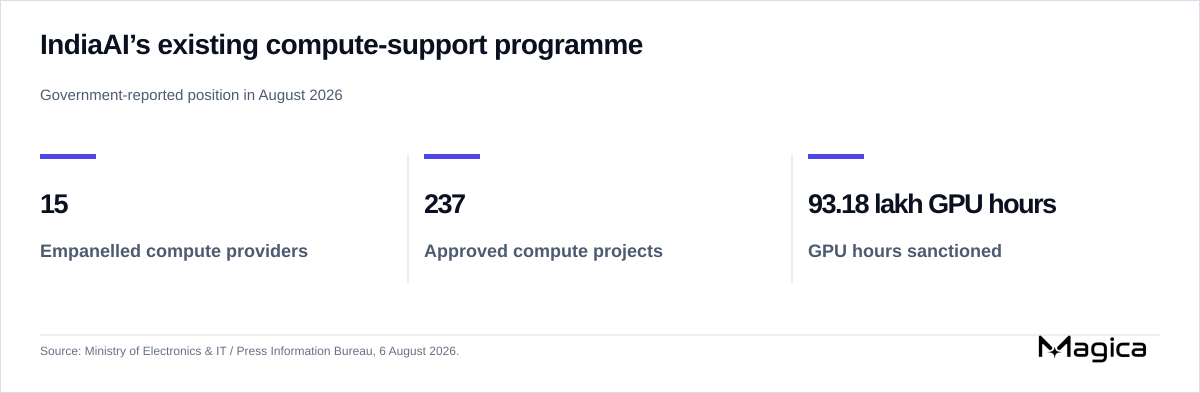
IndiaAI compute support reported by the government in August 2026. Sanctioned hours represent authorised support across approved projects, not actual consumption or an allocation solely to Sarvam. Graphic: Magica. Source: Press Information Bureau.
Krishnan said in his remarks on the next phase that the government was working on support for inference after initially providing training access. Startups would not need to reapply, but a scheme still had to be worked out. He said more than 200 companies had expressed interest in the next phase, through registrations or preparations to apply. That measures interest, rather than approved beneficiaries.
The existing programme already supports a broader computing market. As of its August statement, the government reported 15 empanelled compute providers and 93.18 lakh GPU hours sanctioned across 237 approved projects. Sanctioned hours measure authorised support, not actual consumption, and those projects are a different population from the 20 foundation-model proposals.
The unresolved question is which inference workloads the new scheme would cover. Krishnan’s remarks do not establish whether serving foreign models would qualify, or how eligible workloads would be separated from other commercial activity. Those terms are needed to judge whether future subsidies advance domestic model development, domestic hosting capacity, or both.
SemiAnalysis reports that Amazon’s Trainium3 delivers up to 2.28 times the tokens per modeled dollar of Nvidia’s GB300 NVL72 in an AgentX preview. The result expands public evidence for custom AI chips, but validation, model matching and customer pricing still determine its practical value.
Microsoft says Chinese and North Korean hacking groups have adopted ARTEX, an AI penetration-testing framework that coordinates existing tools. Its spread across models and software forks complicates efforts to contain abuse through a single provider.
Neuralink says its LINK pivotal study is recruiting people with severe paralysis from ALS to assess digital device control, daily independence and long-term safety. Earlier participant gains and technical setbacks frame the test; the implant remains investigational.
Manufacturing partners have reportedly told buyers that Nvidia will not permit server orders to ship to Malaysia, Singapore, Thailand and Indonesia as they assess new US export controls. The uncertainty is already reaching cloud-project financing.
Trustly’s existing owners are funding new AI payment products after job cuts. New quarterly results show rising payment volumes and revenue, but weaker earnings than a year earlier.
The Pentagon denies reports that officials weighed production powers to pressure Nvidia to restore Jensen Huang. Nvidia confirms senior government input, but its board’s foreign-intelligence investigation remains open.
Perplexity says users are choosing Google's new model over rival offerings, with daily token volume doubling in three days. The 120-billion figure is cumulative, and the early demand leaves retention and task economics unresolved.
Kioxia says a proof of concept paired Nvidia software with about 1.1 PB of raw SSD capacity to expand the datasets GPUs can access. The demonstration establishes a capacity proposition, while workload performance and deployment economics remain undisclosed.
Google’s November 25 update adds Familiar Face alerts and remote siren controls to two Walmart Onn outdoor cameras. The expansion makes inexpensive Nest alternatives more capable, while the value depends on subscription access and reliable video playback.
OpenAI is testing a combined Chat and Work experience with a small group of Pro subscribers. A shared allowance arriving more broadly in December will put advanced conversations and delegated tasks on the same budget, but the size of any resulting loss of access remains unknown.
Sellers are seeking buyers for thousands of Nvidia B300 chips, while Asian data centers try to replace Chinese customers affected by U.S. controls. Rental prices have fallen, but short contracts remain scarce and operators face demanding financing terms.
Lenders are delaying or reassessing financing for Asian data centers serving Chinese technology firms as new US licensing rules put chip purchases and customers’ access to computing capacity in doubt.
Meta employees describe cuts to moderation teams and difficulty correcting mistakes as AI enforcement expands. Meta claims better accuracy, while account restrictions and an EU investigation put the effectiveness of appeals under scrutiny.
Dario Amodei rejects handing political authority to AI while defending task automation. An independent assessment finds faster progress at Anthropic, largely through AI assistance, but leaves important evidence outside public view.
OpenAI is piloting Private Inference with selected business customers. The feature targets provider access during processing, but model coverage, costs and evidence of its protections remain key questions.
Executives at rival AI developers are challenging a view reported among some Anthropic employees that people should delegate authority to superior machines. Anthropic defends human oversight, while the dispute exposes a harder question about who retains power when AI makes better decisions.
Officials told congressional staff there was no evidence China directed Alice Huang’s affair with Nvidia founder Jensen Huang. Reports of later information sharing, excluded intelligence and scrutiny of her former company complicate the security assessment.
Updates incorporating Sam Corcos’s requests appeared in his AI-built strategy game during a FinCEN cyber disruption. The Treasury CIO says computers develop it autonomously; the record does not establish time diverted from official duties or who pays the project’s costs.
SpaceX won conditional authorization for its Starmind orbital data centers, with deployment deadlines through 2040. The FCC left higher-altitude debris plans unresolved and did not judge whether the computing business will work.
NVIDIA has released Nemotron-Labs-Image-30B-A3B for non-commercial research and evaluation. The broader creation framework awaits legal clearance, and its best GenEval and GenEval2 results use GPT-6 assistance rather than the downloadable generator alone.