Editorial Team
7 min read
Neuralink says its LINK pivotal study is recruiting people with severe paralysis from ALS to assess digital device control, daily independence and long-term safety. Earlier participant gains and technical setbacks frame the test; the implant remains investigational.
Neuralink, a developer of implanted brain-computer interfaces (BCIs) that turn brain activity into computer commands, says the U.S. Food and Drug Administration has authorized its LINK Pivotal Study. The company says the study will test safety and effectiveness in people with severe paralysis caused by amyotrophic lateral sclerosis, or ALS, and enrollment is open.
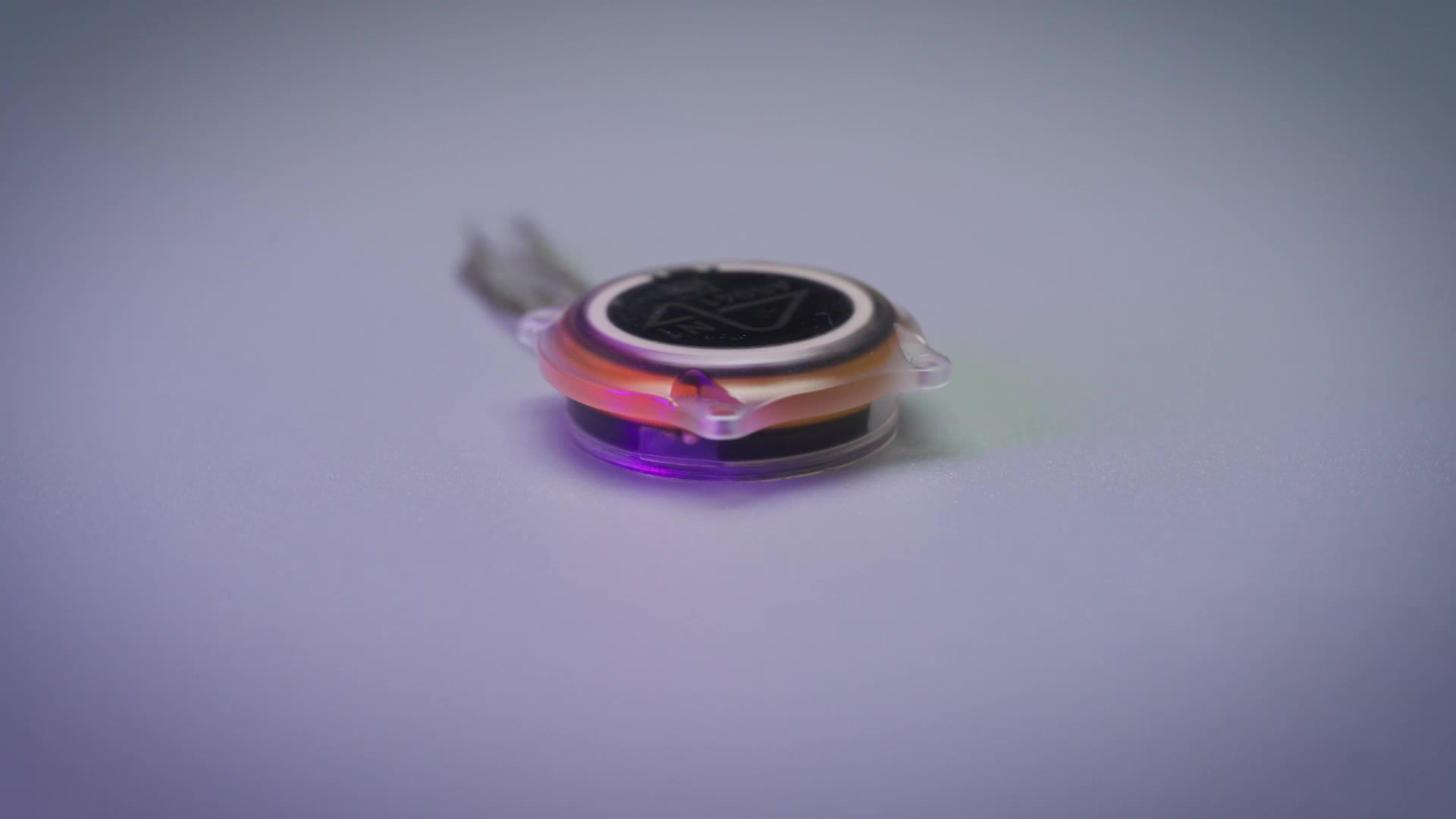
Neuralink’s implant, pictured in its LINK study announcement. The device remains investigational. Image: Neuralink. Source: Neuralink.
The development advances Neuralink beyond its earlier feasibility studies toward testing whether digital device control improves everyday independence, while assessing long-term safety and reliability across multiple clinical sites. ALS is a progressive neurodegenerative disorder that damages nerve cells controlling voluntary movement, making alternative ways to communicate consequential for people losing physical control.
Neuralink already has experience with this population. The company previously disclosed that its first participant with ALS, Bradford Smith, could communicate using brain signals alone, as described in reporting on the new authorization. That individual experience helps explain the application; it does not establish how reliably the system will benefit a broader ALS population.
The FDA, the U.S. medical-device regulator, has guidance covering feasibility and pivotal studies of implanted BCIs. Its separate pivotal study design guidance addresses clinical evidence intended to support submissions for permission to market medical devices. This is a step toward building that evidence, with no guarantee of commercial approval.
Neuralink's own trial information says its N1 implant has not been approved for general use and is used in research under an Investigational Device Exemption. Permission to conduct LINK does not authorize commercial marketing.
The company calls LINK the first pivotal trial for an implantable BCI in the United States. The scope of that claim matters: implanted BCIs have been tested before. Neuralink says more than 30 people have received its implant through early feasibility studies in the U.S., Canada and UK, according to reporting on its announcement. That is a company-reported participant count across earlier studies, rather than a LINK enrollment figure or success rate.
Neuralink's investigational Telepathy product combines the N1 implant, seated in the skull, with fine electrode threads placed in the motor cortex by its R1 surgical robot. Software translates activity associated with imagined hand movement into cursor navigation and mouse clicks. This provides another means of operating a computer; Neuralink says it does not cure paralysis or restore bodily movement, feeling or speech.
Its general device-control trial page says participants receive a MacBook laptop, through which they can also control other devices. The implant communicates and charges wirelessly. Learning to use it can take from a day to a few weeks, and maintaining cursor control may require up to a few hours of calibration each week. The company puts battery life at approximately four hours per charge, with continued use possible while charging.
Those requirements are part of the practical test. Performance varies among participants, and experimental wheelchair or robotic-arm controls are not available to everyone. Neuralink says its studies compare tasks performed with the N1 system against participants' existing assistive technologies, including eye-tracking, switches and voice control. Those tools provide a relevant baseline for judging added benefit.
An earlier participant's experience shows why the comparison can involve more than cursor speed. In its PRIME progress update, Neuralink described how Noland Arbaugh, its first PRIME participant and a person with paralysis from a spinal cord injury, previously used a mouth-held tablet stylus that a caregiver had to position. The company said the stylus required him to sit upright, while the implant let him operate his laptop lying in bed. PRIME is the company's early study of implant and surgical-robot safety and initial device-control functionality.
Neuralink reported one week in which Arbaugh used the system for 69 hours: 35 hours of structured research sessions and 34 hours of personal use. That split documents substantial use outside research sessions in one participant; it is neither an ALS outcome nor a typical-use estimate for future recipients.
The same update disclosed a technical setback. Threads retracted from Arbaugh's brain after surgery, reducing the number of effective electrodes and cursor-control performance. Neuralink said changes to signal recording, translation into cursor movement and the user interface subsequently lifted performance above his initial level. Both the reported benefit and the need for adaptation matter when assessing sustained function.
Neuralink lists surgical risks including bleeding, infection and seizures, along with device failure, risks from later removal, and privacy and security risks. Its general eligibility information calls for a reliable caregiver. The system collects brain signals, health information and usage data; Neuralink says coded study data can be accessed by its team, study staff, safety monitors and regulators when required.
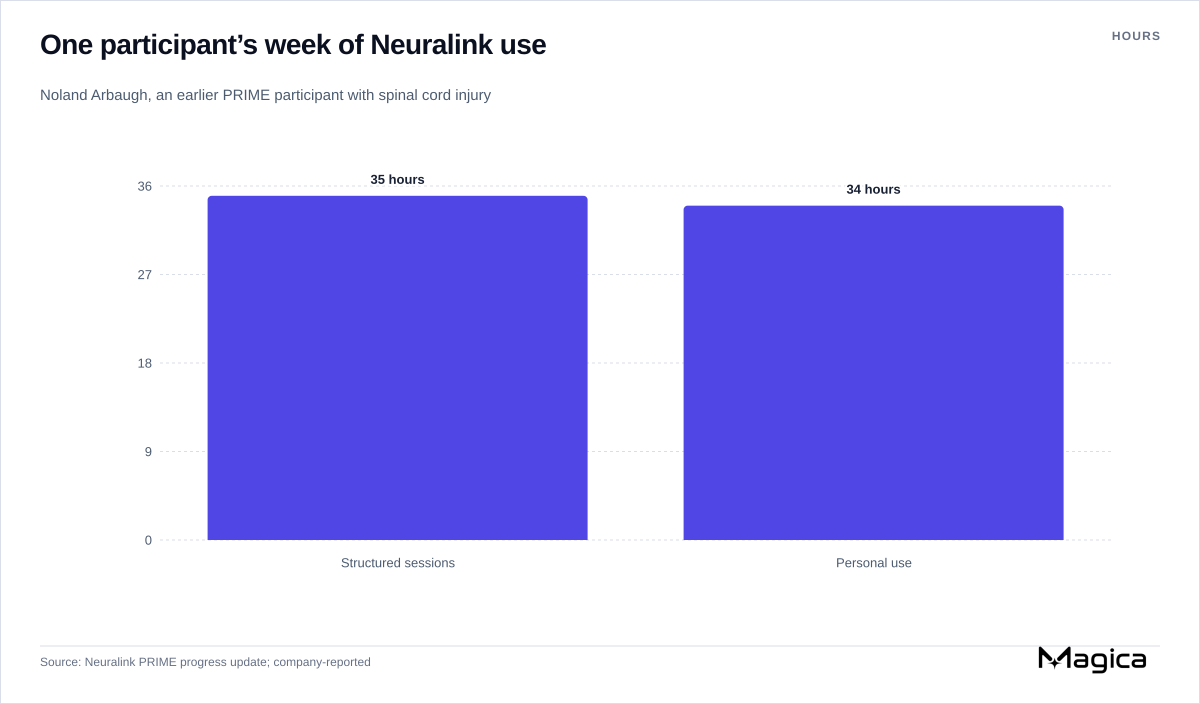
Company-reported use by Noland Arbaugh totaled 69 hours during one week. This single PRIME participant’s experience is neither an ALS outcome nor a typical-use estimate. Source: Neuralink PRIME progress update.
Synchron, another developer of implanted BCIs for people with paralysis, reported results from its COMMAND study in September 2024. In a company statement reproduced by Neurofounders, it said six participants with severe chronic paralysis of both upper limbs received implants and all met the primary safety endpoint: no device-related serious adverse events resulting in death or permanently increased disability during the year after implantation.
Synchron also reported that motor-intent signals could be captured and converted into digital actions, allowing participants to perform digital tasks. Its Stentrode implant reaches a blood vessel on the surface of the brain's motor cortex through the jugular vein, offering a different implantation route from Neuralink's threads placed into the brain.
Those company-reported results establish a competing approach and earlier clinical experience. A six-person study with a specified one-year safety endpoint does not establish superiority over Neuralink, nor can it be compared directly with Neuralink's cumulative participant count.
Neuralink's $650 million Series E financing announcement identified investors including Founders Fund and Sequoia Capital. The company said the money would expand patient access and help develop future devices. It described a broader program spanning device control, vision and speech applications, rather than an ALS pivotal-study budget.
The distinction matters for access. Neuralink's general trial information says the device, surgery and study-related visits are provided without charge, with travel and lodging supported. These research arrangements do not establish a future commercial price or reimbursement model. Participants also face time commitments for visits and training, alongside caregiver support needs.
The company did not disclose target enrollment, anticipated study duration or participating clinical sites in its LINK announcement, according to reporting on the study. Its broader Telepathy page describes roughly 24 months of participation and follow-up; that general description does not establish a LINK-specific timetable. The pivotal listing is for adults with ALS, while the early feasibility program also covers spinal cord injury and brain stem stroke.
A disclosed protocol would clarify how LINK defines functional improvement, what comparisons it uses and how long safety and reliability will be measured. Results would then need to show how consistently participants gain useful independence, what adverse events occur, and how much calibration and support sustained use requires. Those are the findings patients and clinicians need to weigh an implanted interface against the tools already available to them.
SemiAnalysis reports that Amazon’s Trainium3 delivers up to 2.28 times the tokens per modeled dollar of Nvidia’s GB300 NVL72 in an AgentX preview. The result expands public evidence for custom AI chips, but validation, model matching and customer pricing still determine its practical value.
Microsoft says Chinese and North Korean hacking groups have adopted ARTEX, an AI penetration-testing framework that coordinates existing tools. Its spread across models and software forks complicates efforts to contain abuse through a single provider.
India’s IT secretary says Sarvam’s commercial hosting of foreign AI models does not conflict with its publicly supported domestic model development. Eligibility for proposed inference support remains unresolved.
Manufacturing partners have reportedly told buyers that Nvidia will not permit server orders to ship to Malaysia, Singapore, Thailand and Indonesia as they assess new US export controls. The uncertainty is already reaching cloud-project financing.
Trustly’s existing owners are funding new AI payment products after job cuts. New quarterly results show rising payment volumes and revenue, but weaker earnings than a year earlier.
The Pentagon denies reports that officials weighed production powers to pressure Nvidia to restore Jensen Huang. Nvidia confirms senior government input, but its board’s foreign-intelligence investigation remains open.
Perplexity says users are choosing Google's new model over rival offerings, with daily token volume doubling in three days. The 120-billion figure is cumulative, and the early demand leaves retention and task economics unresolved.
Kioxia says a proof of concept paired Nvidia software with about 1.1 PB of raw SSD capacity to expand the datasets GPUs can access. The demonstration establishes a capacity proposition, while workload performance and deployment economics remain undisclosed.
Google’s November 25 update adds Familiar Face alerts and remote siren controls to two Walmart Onn outdoor cameras. The expansion makes inexpensive Nest alternatives more capable, while the value depends on subscription access and reliable video playback.
OpenAI is testing a combined Chat and Work experience with a small group of Pro subscribers. A shared allowance arriving more broadly in December will put advanced conversations and delegated tasks on the same budget, but the size of any resulting loss of access remains unknown.
Sellers are seeking buyers for thousands of Nvidia B300 chips, while Asian data centers try to replace Chinese customers affected by U.S. controls. Rental prices have fallen, but short contracts remain scarce and operators face demanding financing terms.
Lenders are delaying or reassessing financing for Asian data centers serving Chinese technology firms as new US licensing rules put chip purchases and customers’ access to computing capacity in doubt.
Meta employees describe cuts to moderation teams and difficulty correcting mistakes as AI enforcement expands. Meta claims better accuracy, while account restrictions and an EU investigation put the effectiveness of appeals under scrutiny.
Dario Amodei rejects handing political authority to AI while defending task automation. An independent assessment finds faster progress at Anthropic, largely through AI assistance, but leaves important evidence outside public view.
OpenAI is piloting Private Inference with selected business customers. The feature targets provider access during processing, but model coverage, costs and evidence of its protections remain key questions.
Executives at rival AI developers are challenging a view reported among some Anthropic employees that people should delegate authority to superior machines. Anthropic defends human oversight, while the dispute exposes a harder question about who retains power when AI makes better decisions.
Officials told congressional staff there was no evidence China directed Alice Huang’s affair with Nvidia founder Jensen Huang. Reports of later information sharing, excluded intelligence and scrutiny of her former company complicate the security assessment.
Updates incorporating Sam Corcos’s requests appeared in his AI-built strategy game during a FinCEN cyber disruption. The Treasury CIO says computers develop it autonomously; the record does not establish time diverted from official duties or who pays the project’s costs.
SpaceX won conditional authorization for its Starmind orbital data centers, with deployment deadlines through 2040. The FCC left higher-altitude debris plans unresolved and did not judge whether the computing business will work.
NVIDIA has released Nemotron-Labs-Image-30B-A3B for non-commercial research and evaluation. The broader creation framework awaits legal clearance, and its best GenEval and GenEval2 results use GPT-6 assistance rather than the downloadable generator alone.