Editorial Team
8 min read
Humanity’s First Exam tests repeated correctness across 544 elementary text and image prompts. Leading models perform strongly on individual answers but lose ground when every retry and variation must succeed. Visual errors dominate the remaining mistakes, though the deliberately adversarial test cannot estimate everyday failure rates.
Google DeepMind, Google’s AI research unit formed in 2023 from DeepMind and Google Research’s Brain team, launched Humanity’s First Exam on November 24, 2026, to test whether models can repeatedly answer elementary text and image questions correctly. The 544-prompt benchmark makes small changes to related tasks, then penalizes inconsistency across both variants and repeated attempts, according to the launch announcement.
The accompanying Google DeepMind study’s five highest-ranked models scored roughly 96%–98% on single-answer accuracy but averaged 85.8% on its stricter family consistency metric. For someone choosing a model for automated work, the distinction is consequential: high average accuracy can conceal failures when related tasks must all succeed. HFE isolates that problem, though it does not establish how a tool-equipped assistant will perform in a real workflow.
DeepMind is also seeking new questions through December 15 on Kaggle, the data science and competition platform that joined Google Cloud in 2017. Google supplies the benchmark, hosting platform and primary answer judge while competing through its Gemini models against OpenAI’s GPT and Anthropic’s Claude models.

A public task in Google’s company-reported HFE benchmark asks for the third letter’s color in each word of the neon slogan. Image: Google. Source: Google.
The Google DeepMind technical report describes 136 families of four prompts: one seed and three variants that preserve the underlying skill while changing names, clause order or visual details. Answers can change between variants. The 20 capabilities include object counting, color identification, basic arithmetic, spatial tracking, formatting constraints and rejecting false premises.
One public task asks for the colors of the third letter of each word in a neon sign. Another public example asks which bowl contains exactly five oranges, when none does. The latter requires rejecting the question’s premise rather than naming a color.
Researchers generated six independent responses per prompt, without a system prompt or external tools. From those six observations, the main metric, “family pass⁴,” estimates the probability that four draws without replacement for each of four related prompts all succeed—16 correct answers together. It averages those estimates across the 136 families.
That scoring rule is deliberately unforgiving. A prompt answered correctly five times out of six contributes only one-third on prompt-level pass⁴, because just five of the 15 possible four-response subsets contain no error. A family’s score multiplies the four prompt-level results. It is therefore neither individual-answer accuracy nor simply a count of families with observed mistakes.
The contrasting “family pass@4” asks whether at least one of the 16 answers succeeds anywhere in the family. The study’s top five models scored 100% on that easier measure. It does not mean every variant was solved, and the gap from family pass⁴ partly reflects the much greater number of successes the stricter metric requires.
Repeated-trial evaluation predates HFE. The 2024 tau-bench study introduced passᵏ for agents conversing with simulated users while using tools and following policies. Its retail experiments found success on all eight trials below 25%, using older models and different tasks; that number cannot be compared directly with HFE. HFE combines repeated sampling with controlled variants across elementary text and image tasks.
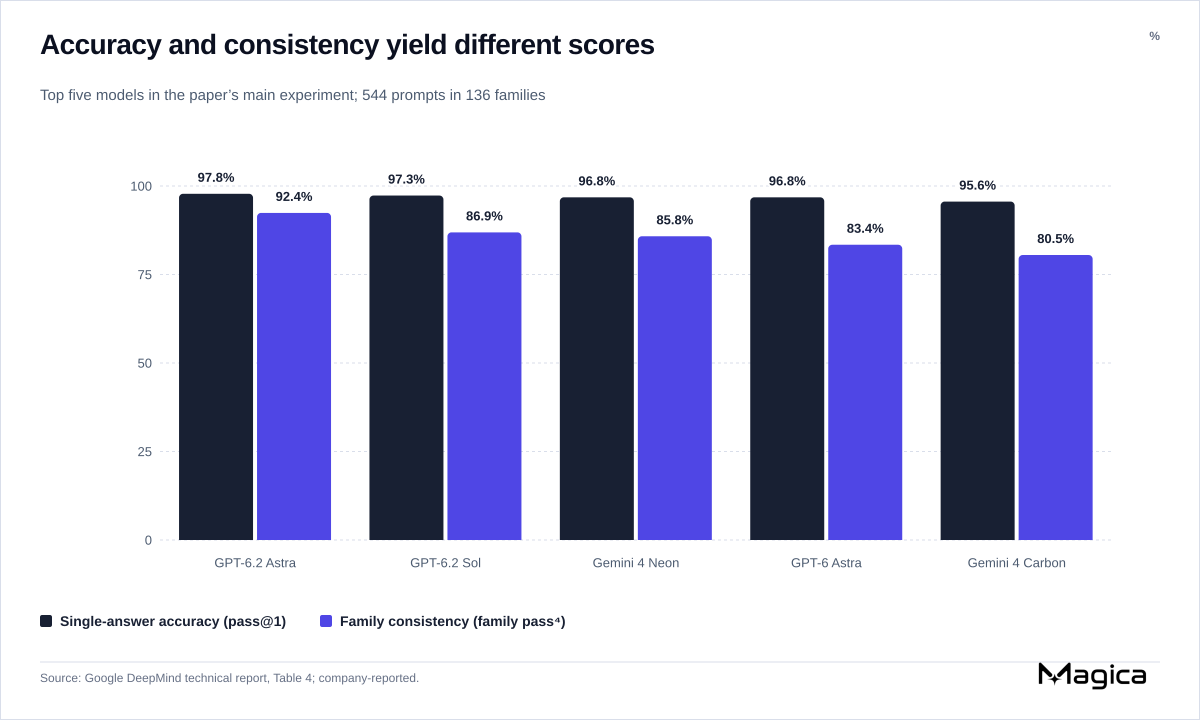
Company-reported single-answer accuracy and family pass⁴ for the paper’s top five models. The metrics require different kinds of success; these are paper results, separate from Kaggle’s run. Confidence intervals are omitted. Chart: Magica; data: Google DeepMind. Source: Google DeepMind technical report.
Google says frontier models have made significant progress on HFE over six months. The paper also shows that the test is not uniformly difficult: its top nine models reached 83%–97% family pass⁴ on text-only families, compared with 64%–89% on multimodal families.
The launch leaderboard, marked updated November 23, puts OpenAI’s GPT-6.2 Astra first. Its leading results differ from the paper’s main experiment:
| Model | Paper: family pass⁴ | Kaggle: family pass⁴ | Kaggle’s reported 95% confidence half-width |
|---|---|---|---|
| GPT-6.2 Astra | 92.4% | 90.7% | ±4.7 percentage points |
| GPT-6.2 Sol | 86.9% | 87.5% | ±5.1 percentage points |
| Gemini 4 Neon | 85.8% | 85.6% | ±5.7 percentage points |
The paper’s figures here are from Table 4, covering 18 models; Kaggle evaluates a different 16-model cohort. Both GPT models use xhigh reasoning effort in these runs, while Gemini 4 Neon uses xhigh in the paper and high on Kaggle. The leaderboard also changes response handling and sampling, including resizing some large images for Anthropic’s API. These are separate experiments, and overlapping confidence ranges limit what small rank differences establish.
A flagship label does not guarantee the best result. Within Google’s lineup, the paper’s balanced-tier Gemini 4 Neon scored 85.8%, ahead of flagship Gemini 4 Carbon at 80.5%. Within Anthropic’s lineup, Claude Sonnet 5.5 outscored Claude Opus 5.5; refusals contributed to Opus’s lower result. Provider restrictions and output limits count as failures even when no wrong answer is produced.
The benchmark’s creator has a direct stake in these comparisons. Its development of Gemini gives Google DeepMind relevant technical experience while making the evaluation a test of its own products as well as competitors’.
The paper’s failure analysis covers 5,823 failed responses across 58,752 responses from its 18-model main evaluation. Wrong answers accounted for 95% of failures; refusals, output limits and rare evaluation errors accounted for the rest.
Its failure analysis attributes approximately 73% of 5,552 wrong-answer responses to visual perception, including 31% involving position, direction or paths and 23% involving object counting. The dataset itself contains 316 text-and-image prompts and 228 text-only prompts, so the result comes from a benchmark with substantial visual coverage.
These are approximate classifications. A Claude Fable 5.2 judge examined one failed response per prompt–model pair, then researchers weighted that diagnosis by the pair’s number of wrong responses. Labels were manually spot-checked rather than fully validated by human annotators. A second judge produced a similar visual-error share.
Additional reasoning helped unevenly. Raising Gemini 4 Carbon from low to high reasoning effort improved family pass⁴ by 42.4 percentage points on Math & Algorithmic tasks, versus 3.1 points on Vision. Its average reported thought-token count rose from 29 to 6,616 per response. That is evidence of a computation tradeoff within one model, not a dollar-cost or latency comparison; the paper cautions that providers’ token accounting is not directly comparable.
Nor is inconsistency always widespread across a family. Among the top 12 models, 61%–85% of families with any failed response had just one problematic prompt, while the other three prompts were answered correctly on all six attempts. Small surface changes can expose a narrow weakness that an aggregate accuracy score obscures.
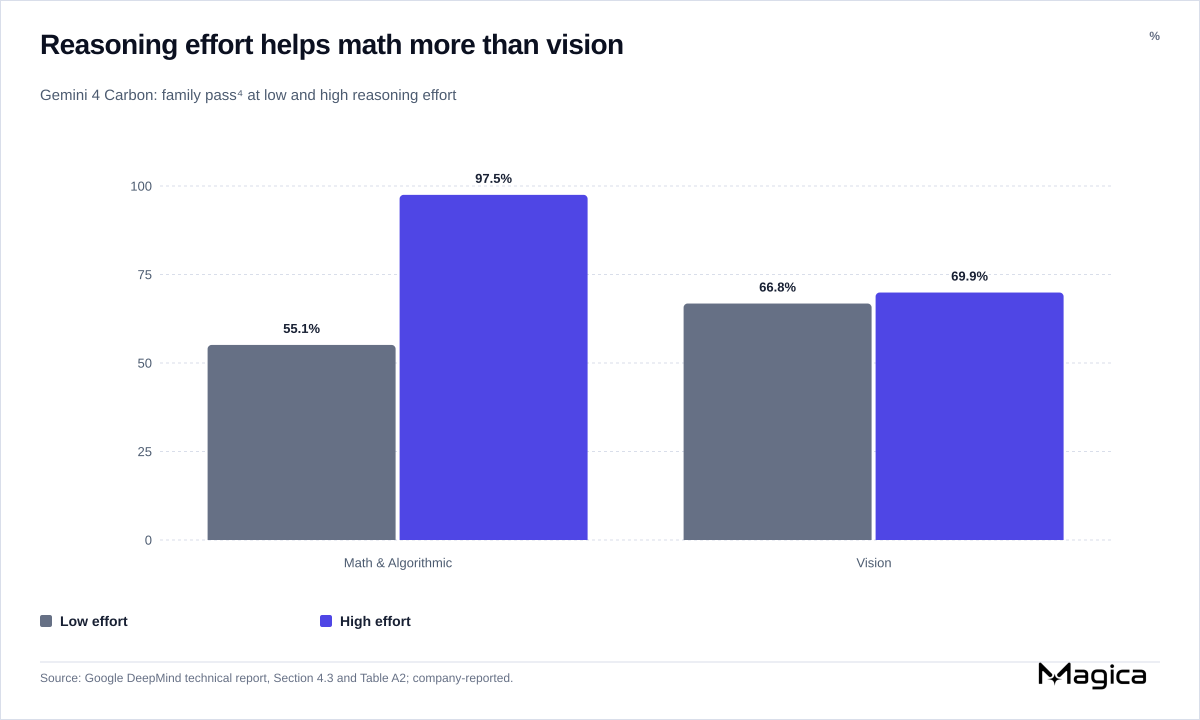
Company-reported family pass⁴ for Gemini 4 Carbon at low and high reasoning effort. Math & Algorithmic scores rise more than Vision scores. Chart: Magica; data: Google DeepMind. Source: Google DeepMind technical report.
HFE was built to find failures. Seeds authored in May and June 2026 had to trigger an error on a calibration panel, and variants were also screened for model mistakes. Quality checks then removed difficult-for-humans or ambiguous material. Sixteen of the 18 models in the main evaluation were released after collection ended, which limits—but does not erase—the selection caveat.
The human baseline is also narrower than the model test. Each retained seed had to be solved by at least three of four independent raters. Their single-attempt accuracy on the final seeds was 90.8%; they were not tested repeatedly on all sibling variants, so that figure cannot be compared directly with model family pass⁴.
Most multimodal tasks use Gemini-generated images, alongside diagrams, screenshots and photographs. Synthetic artifacts and residual ambiguity remain possible. A deterministic Gemini 3.1 Pro model grades final answers; a cross-provider audit flagged about 3% of wrong-answer verdicts, roughly 0.3% of all responses, as potentially defensible. That audit checks rejected answers rather than proving the whole grading system free of bias.
Only 112 prompts are public under CC-BY-4.0; 432 remain private to reduce contamination. The three-week community competition offers a share of $50,000 in swag and research-paper citation for approved contributions, according to Kaggle. Fresh submissions could keep the test useful as models improve, but they will need the same human-solvability and ambiguity checks.
For deployment decisions, the missing evidence is whether gains survive tool use, multistep workflows and the costs of repeated or longer responses. Those workflows are future work in the paper. HFE gives buyers a controlled test of consistency to examine alongside task-specific evaluations; it does not yet settle which system can do their work most reliably or economically.
SemiAnalysis reports that Amazon’s Trainium3 delivers up to 2.28 times the tokens per modeled dollar of Nvidia’s GB300 NVL72 in an AgentX preview. The result expands public evidence for custom AI chips, but validation, model matching and customer pricing still determine its practical value.
Microsoft says Chinese and North Korean hacking groups have adopted ARTEX, an AI penetration-testing framework that coordinates existing tools. Its spread across models and software forks complicates efforts to contain abuse through a single provider.
Neuralink says its LINK pivotal study is recruiting people with severe paralysis from ALS to assess digital device control, daily independence and long-term safety. Earlier participant gains and technical setbacks frame the test; the implant remains investigational.
India’s IT secretary says Sarvam’s commercial hosting of foreign AI models does not conflict with its publicly supported domestic model development. Eligibility for proposed inference support remains unresolved.
Manufacturing partners have reportedly told buyers that Nvidia will not permit server orders to ship to Malaysia, Singapore, Thailand and Indonesia as they assess new US export controls. The uncertainty is already reaching cloud-project financing.
Trustly’s existing owners are funding new AI payment products after job cuts. New quarterly results show rising payment volumes and revenue, but weaker earnings than a year earlier.
The Pentagon denies reports that officials weighed production powers to pressure Nvidia to restore Jensen Huang. Nvidia confirms senior government input, but its board’s foreign-intelligence investigation remains open.
Perplexity says users are choosing Google's new model over rival offerings, with daily token volume doubling in three days. The 120-billion figure is cumulative, and the early demand leaves retention and task economics unresolved.
Kioxia says a proof of concept paired Nvidia software with about 1.1 PB of raw SSD capacity to expand the datasets GPUs can access. The demonstration establishes a capacity proposition, while workload performance and deployment economics remain undisclosed.
Google’s November 25 update adds Familiar Face alerts and remote siren controls to two Walmart Onn outdoor cameras. The expansion makes inexpensive Nest alternatives more capable, while the value depends on subscription access and reliable video playback.
OpenAI is testing a combined Chat and Work experience with a small group of Pro subscribers. A shared allowance arriving more broadly in December will put advanced conversations and delegated tasks on the same budget, but the size of any resulting loss of access remains unknown.
Sellers are seeking buyers for thousands of Nvidia B300 chips, while Asian data centers try to replace Chinese customers affected by U.S. controls. Rental prices have fallen, but short contracts remain scarce and operators face demanding financing terms.
Lenders are delaying or reassessing financing for Asian data centers serving Chinese technology firms as new US licensing rules put chip purchases and customers’ access to computing capacity in doubt.
Meta employees describe cuts to moderation teams and difficulty correcting mistakes as AI enforcement expands. Meta claims better accuracy, while account restrictions and an EU investigation put the effectiveness of appeals under scrutiny.
Dario Amodei rejects handing political authority to AI while defending task automation. An independent assessment finds faster progress at Anthropic, largely through AI assistance, but leaves important evidence outside public view.
OpenAI is piloting Private Inference with selected business customers. The feature targets provider access during processing, but model coverage, costs and evidence of its protections remain key questions.
Executives at rival AI developers are challenging a view reported among some Anthropic employees that people should delegate authority to superior machines. Anthropic defends human oversight, while the dispute exposes a harder question about who retains power when AI makes better decisions.
Officials told congressional staff there was no evidence China directed Alice Huang’s affair with Nvidia founder Jensen Huang. Reports of later information sharing, excluded intelligence and scrutiny of her former company complicate the security assessment.
Updates incorporating Sam Corcos’s requests appeared in his AI-built strategy game during a FinCEN cyber disruption. The Treasury CIO says computers develop it autonomously; the record does not establish time diverted from official duties or who pays the project’s costs.
SpaceX won conditional authorization for its Starmind orbital data centers, with deployment deadlines through 2040. The FCC left higher-altitude debris plans unresolved and did not judge whether the computing business will work.