Editorial Team
5 min read
OpenCode has added the anonymous Omen Alpha to its $10-a-month Go subscription. Its model-specific price and usage row is unusually detailed, but the documentation does not identify the model’s developer or publish an Omen-specific evaluation, leaving the apparent Zhipu AI connection as informed speculation.
zhipu path has prompted speculation about Zhipu AI, but neither OpenCode nor Zhipu has confirmed who built the model.OpenCode, a coding-agent service whose Go subscription aggregates selected open coding models, has added Omen Alpha to that paid catalog without naming the model’s developer. The offer is concrete enough to test: OpenCode’s price table gives Omen Alpha a $100 monthly-usage entry and token rates, while the service documents an OpenAI-compatible endpoint. What it does not provide is a model card, a provider name or an Omen-specific benchmark.
That makes this less a conventional model launch than a paid, bounded trial inside a coding workflow. The absence matters because a token price and context claim cannot establish how a model behaves on a repository, who operates it, or what support and data practices apply beyond OpenCode’s own service policy.
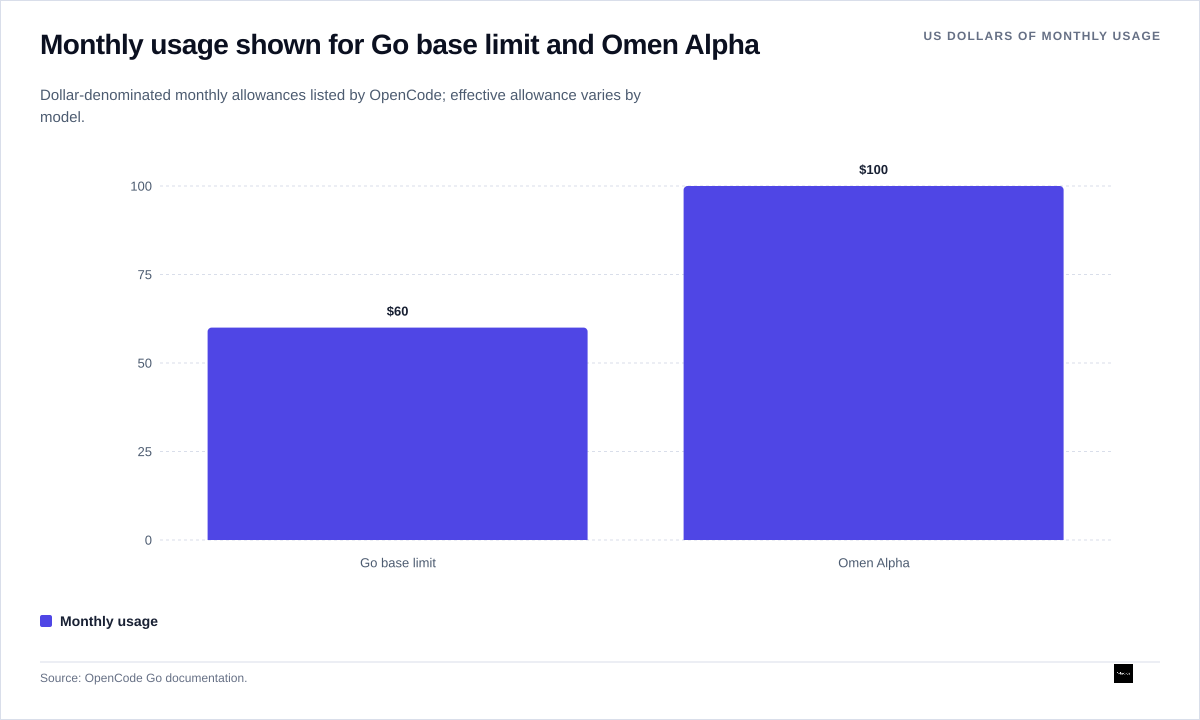
OpenCode lists a $60 base monthly limit and a $100 Omen Alpha monthly-usage entry; effective allowance varies by model. Source: OpenCode.
OpenCode’s Go documentation says the subscription costs $10 a month and is optional for users of the broader coding tool. Its published base limits are $12 of usage per rolling five hours, $30 per week and $60 per month; it also says effective allowance varies by model. The Omen Alpha table row separately lists $100 under monthly usage.
That distinction changes how the headline number should be read. OpenCode says it aims to provide six times the subscription price for most models through bulk discounts and reserved GPU capacity, while some models have different multipliers when it cannot negotiate or host them more cheaply. The $100 row describes Omen Alpha’s listed allowance; it is not evidence that every Go model gets that amount or that a subscriber receives a fixed number of coding jobs.
For Omen Alpha, the same table lists reference prices of $0.20 per million input tokens, $0.66 per million output tokens and $0.04 per million cached reads. Its request-count estimates assume 300 input tokens, 40,000 cached tokens and 100 output tokens per request, yielding 11,600 requests per five-hour window, 29,000 weekly and 57,900 monthly. OpenCode explicitly labels those as estimates whose actual request count depends on model and use.
Jensen Huang’s return as Nvidia CEO leaves December congressional questioning intact. Lawmakers want evidence behind the board’s security assurance and answers about chip exports and the administration’s involvement.
A repository change titled “add Omen Alpha” also inserts the model into the limits graph at 11,600 requests per five hours. That is evidence of a deployed service entry, not a measurement of model quality or capacity.

Anomaly’s public OpenCode repository change adds Omen Alpha with req: 11600 to its limits graph. Source: GitHub.
Omen Alpha is not the lowest-priced input option in the Go table. The same documentation lists input prices of $0.10 for the two Muse Spark Contributor entries, $0.14 for MiMo-V2.5, and $0.15 for both GLM-5.3-Flash and Qwen3.8 Flash. Those are not like-for-like cost rankings: output, cached-read and cached-write prices vary, as do the model-specific usage allowances and the request patterns used in OpenCode’s estimates.
Nor does the list show that Omen is better at coding than those named alternatives. OpenCode says its general Go process includes testing a select group of open models, working with providers on serving them, and benchmarking model/provider combinations before recommending them. But the Omen entry has no named provider and no published Omen-specific evaluation. The service-level claim therefore cannot fill the model-level evidence gap.
For teams deciding whether to try it, the practical comparison is a controlled one: run the same non-sensitive coding tasks through Omen Alpha and known Go models, then judge cost, latency and results in that workflow. OpenCode’s privacy table lists Omen Alpha as not used for model training and with zero days of data retention, but that is a statement of the service policy, not a substitute for a disclosure from an unidentified model developer.
The public clue points toward Zhipu AI, the Chinese AI company also known as Z.ai. A report on the launch says an OpenCode data path placed Omen under zhipu; it also says Z.ai later identified the earlier anonymous Ox Alpha as GLM-5.3-Flash. That history explains why developers are treating the path as meaningful rather than random, but the report says it is not confirmation.
A separate account similarly reported Omen Alpha’s September 4 appearance in Go and the zhipu path, while describing community speculation that it could be a new GLM or Omni-branch model. It also relayed third-party claims of a 500,000-token context window, text-and-image input, reasoning support and a 128,000-token maximum output. None of those characteristics identifies the developer, and OpenCode’s Go documentation does not itself make those claims.
The strongest counterweight to the mystery narrative is that OpenCode has not asked users to rely on a hunch alone: it has made the service entry, token-price assumptions and rolling request estimates public. But those disclosures redistribute, rather than solve, the risk. They make an inexpensive trial legible while leaving provenance and independently reproducible quality unverified.
The next consequential evidence is a direct identification from the developer or OpenCode, followed by a model card and reproducible coding evaluations against the named alternatives in Go. Those materials would let users distinguish an anonymous label from a supported model with known capabilities and operating commitments. Until then, Omen Alpha is a transparently priced experiment inside OpenCode Go—not a fully documented production dependency.
The Commerce Department added Singapore-based Megaspeed to its Entity List, imposing a licensing barrier on supplies to a longstanding Nvidia customer while allegations of chip diversion remain unresolved.
Google is rolling out optional Wallet access in Search’s AI Mode, with Drive and Gemini connections to follow. The expansion brings existing personal-finance capabilities into Search, while data-use permissions extend beyond the read-only limit on financial actions.
Anthropic has launched Claude Ship for GitHub repositories, combining code review with new agents that fix problems and apply approval policies. Teams retain control through repository rules, while automation adds token costs and can allow changes to merge without human review.
Google’s patent application describes generating videos from viewing habits, demographics and device context, with optional replicas of the viewer and inserted ads. Existing video tools show parts of the idea are already available; a commercial service and its economics remain unproven.
Google’s Gemini API can slice documents, spreadsheets and recordings on its servers and bill for selected content sent to the model. The controls reduce local preparation work, but upload limits, model defaults and the cost of finding relevant material qualify the savings.
OpenAI's OpenWorks pilot offers free AI assistance to eligible small businesses in 20 U.S. communities, pairing paid local partners with a three-month ChatGPT Business trial. It builds on earlier training efforts, but its total budget is undisclosed and typical business returns are unproven.
Nothing plans to unveil Ear (note) on December 8, pairing call-recording earbuds with a case that captures meetings for AI transcription. Existing recording products, uncertain service costs and unresolved privacy details narrow the novelty of the pitch.
Anthropic’s Enterprise Frontier Safeguards beta lets eligible businesses use its most capable Claude models while keeping encrypted safety records in their own cloud accounts. Automated monitoring remains; customers pay cloud costs and review flagged cases.
Hakeem Jeffries promised an investigation after Nvidia reinstated Jensen Huang following Donald Trump’s intervention. Reports that directors excluded interim CEO Colette Kress sharpen questions about the reversal and its national security assurances.
The European Commission has confirmed a leak affecting users of its public learning platform, while the number affected, the wider exposure of staff data and responsibility for the attack remain unresolved.
Maintainers defend continued distribution of the AI penetration-testing framework after its creator withdrew it. Investigations document data theft and cheap automation, but also failed payouts, blocked attacks and safeguards that vary by version.
China Telecom's AI arm has released the 285-billion-parameter Xing4.1-Preview under Apache 2.0, extending its TeleChat model lineage and domestic-compute strategy. Its million-token context and quantized variants widen deployment choices, but mixed benchmarks and incomplete cost disclosures leave its low-cost pitch unproven.
Applied Digital signed an 18-year lease for 150 MW with an unnamed investment-grade hyperscaler. Higher pricing strengthens its contracted revenue book, but financing, power arrangements and construction still stand between the agreement and delivery.
Sarvam Dictate combines speech recognition and text editing for English and 22 Indian languages at ₹0.50 per audio minute. Its company-run benchmarks show fewer character edits than rival APIs, but the advantage varies by language and recording length.
Arm CEO Rene Haas will become SoftBank Group vice chairman on December 1, building on existing roles at its controlling shareholder as Arm expands beyond processor licensing into its own chips. The extension follows a reported Nvidia recruitment approach, but Nvidia has since reinstated co-founder Jensen Huang as CEO.
Trump claimed personal credit for Jensen Huang’s reinstatement after Nvidia received government security assurances. The reversal leaves questions about export controls, presidential influence and Trump’s financial stake unresolved.
Sierra’s $1.75 billion Series F follows reported annual recurring revenue above $400 million. Competitors already offer outcome pricing and agents that act on customer accounts, making reliability and delivery costs central to its $30 billion valuation.
The states allege that Grok and X enabled nonconsensual sexualized images while misleading consumers about safeguards. Their consumer-protection cases seek financial penalties and court orders against SpaceX and its subsidiaries.
Founded in May, Marlowe has raised $277 million at a company-reported $1.15 billion valuation to build inference infrastructure using AMD and Etched chips. Its first deployments will test whether engineering across hardware and software can deliver its promised efficiency gains.