Editorial Team
8 min read
Perplexity's Orchestrator API combines model access, billing and same-model provider failover. It enters a market where rival OpenRouter already routes around provider failures, while Perplexity's automatic model selection remains in preview.
Perplexity, the company behind an AI answer engine that searches the web and supplies cited answers, launched its Orchestrator API on November 17, 2026. The service opens its model-serving infrastructure to developers, combining access to 45 catalog models with billing and retries across providers, according to the launch report and Perplexity's announcement.
The commercial offer is to consolidate the accounts, contracts and operational work involved in using several model suppliers. Perplexity adds no platform fee on top of credits. But provider failover already exists at rival OpenRouter, and delegating model choice to Perplexity remains a preview feature whose financial effect depends on which model answers.
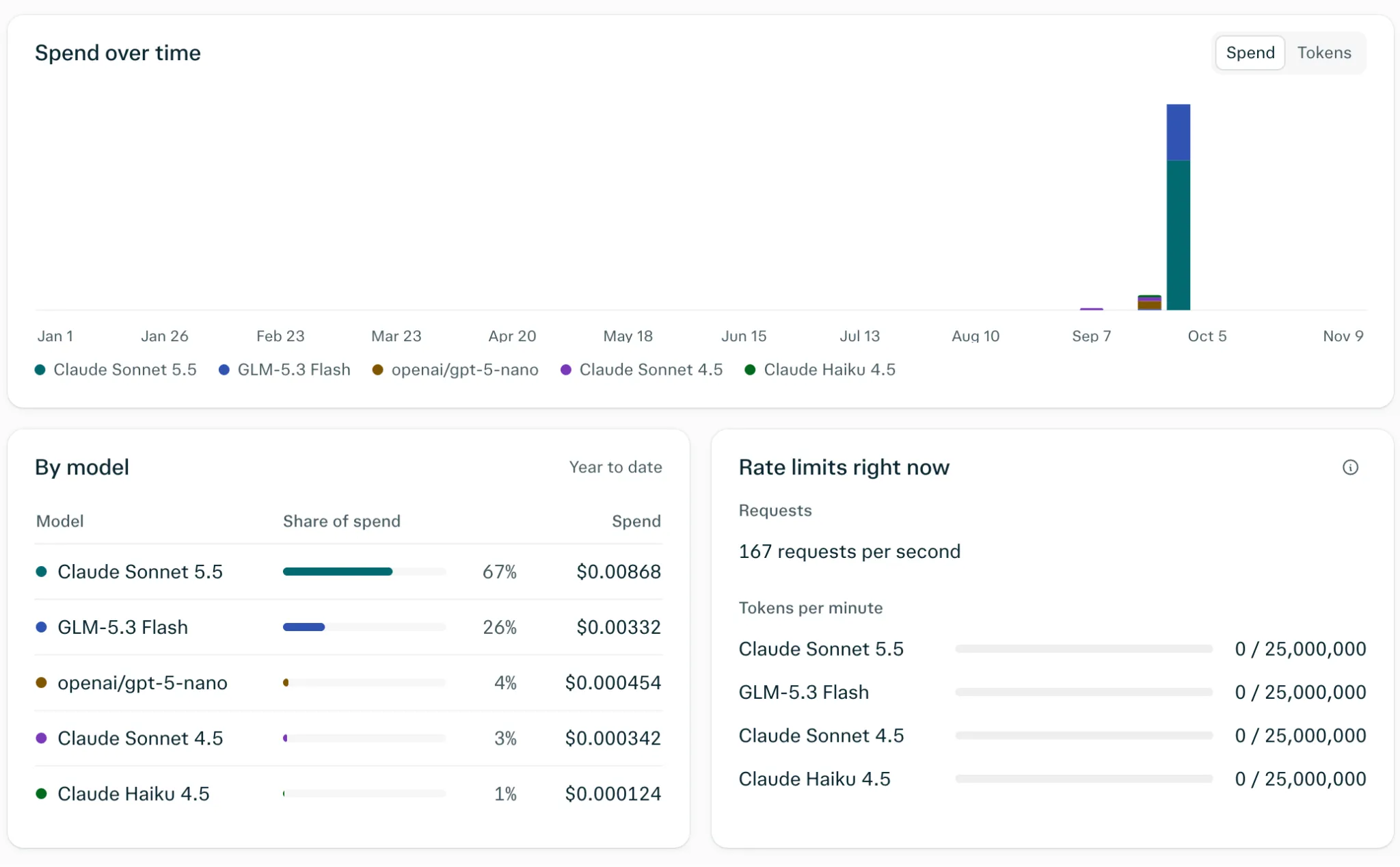
Perplexity’s API Console displays model-level spending and rate limits. The account figures shown do not measure Orchestrator adoption. Source: Perplexity.
Perplexity introduced Enterprise Pro, its first business offering for workplace research, in 2024. Its enterprise announcement describes the web-browsing answer engine. Orchestrator serves a different need: developers supply their own prompts and tools to models. Perplexity's separate Agent API supplies web-grounded answers with built-in citations, its documentation explains.
Perplexity says the internal model layer behind Orchestrator routes hundreds of millions of requests across at least 85 models and more than a dozen providers. That establishes the company's claimed operating experience; it does not measure adoption of the new external API. The public catalog has 45 entries, a distinction also made in a count of its model tables.
The catalog spans Anthropic, OpenAI, Google and xAI models alongside open-weight models from Z.AI, DeepSeek and Moonshot AI. Perplexity says it serves open-weight models itself or through inference partners. Developers can reuse OpenAI or Anthropic software development kits by changing their key, base URL and model identifier. Every catalog model accepts the OpenAI Chat Completions, OpenAI Responses and Anthropic Messages request formats, though supported features vary by model.
Access depends on usage tier. Google, xAI and open-weight models are available at every tier; OpenAI and Anthropic require at least Tier 1. Claude Opus 5, Opus 5.5 and Fable require Tier 2. Organizations with zero data retention enabled cannot call Fable, according to the catalog's access rules.
Provider routing chooses the deployment that runs a selected model. Perplexity says Orchestrator distributes traffic according to observed health and capacity, retrying another deployment after provider errors, rate limits or timeouts. That can move a Claude request from Anthropic to Amazon's AWS Bedrock service without changing the model. Customers do not select the deployment.
Perplexity's documentation, as described in the launch report, limits that protection: malformed requests and prompts exceeding a model's context window return errors without a deployment retry. A request that produces no output is not billed; a stream interrupted after output starts is billed for tokens already delivered.
In its technical account, Perplexity says Claude and GPT requests through its system succeeded more often than requests to any individual provider it measured from October 4 through November 2, 2026. It counted failures when deployments were exhausted or the serving layer returned an error, excluding client errors such as invalid requests and client rate-limit violations. The comparison is company-reported and does not establish superiority over another router.
Its speed observations also have a narrower meaning than a product guarantee. Anthropic and AWS Bedrock each led Claude Opus 5.5 output speed on 15 of those 30 days. Azure's median GPT-5.6 Sol output speed after the first token was 27% higher than OpenAI's. Perplexity says adaptive routing that responds to changing model speed is still in development.
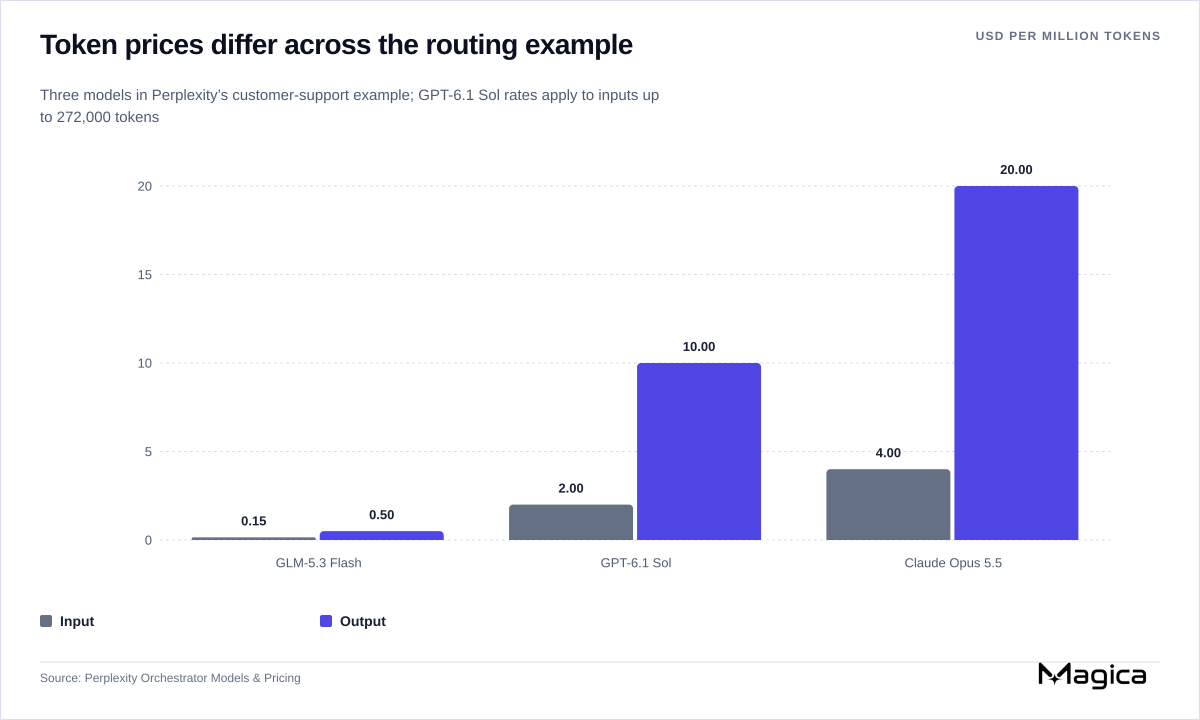
Perplexity’s published token prices for its three support-routing example models. GPT-6.1 Sol rates shown apply to inputs up to 272,000 tokens; prices do not establish equivalent task performance. Source: Perplexity Documentation.
In the separate automatic-routing preview, a Perplexity decision model matches conversation text to task descriptions supplied by the developer. It does not see model names; developers decide which model goes with each route. The default model answers when nothing matches or the decision model fails or times out. Perplexity's documentation also specifies fallback to the default for conversations containing images, audio, video or files, according to the launch report.
Routing can choose a different model on each turn. Because Orchestrator is stateless, the application must resend the conversation history. Each model has its own prompt cache: a model returning later in a conversation can reuse its earlier cached prefix, but must process intervening replies as new input. Perplexity says it tries to retain the same deployment to preserve caching. Switching models therefore does not give every model a shared warm cache.
The launch also previews Auto effort, which adjusts a supported model's reasoning effort under a developer-defined policy without requiring a model switch.
Perplexity bills the answering model's published token rates regardless of provider, drawing on prepaid API credits. Provider failover leaves those rates unchanged; model selection can move spending substantially. Its illustrative customer-support profile uses these catalog prices:
| Model and suggested support task | Input per million tokens | Output per million tokens |
|---|---|---|
| Z.AI GLM-5.3 Flash: routine questions | $0.15 | $0.50 |
| OpenAI GPT-6.1 Sol: technical issues | $2.00 | $10.00 |
| Anthropic Claude Opus 5.5: billing disputes | $4.00 | $20.00 |
Rates are in US dollars; GPT-6.1 Sol's listed rates apply to inputs up to 272,000 tokens per request. Across multiple requests below the relevant context limits, one million uncached input tokens plus 100,000 output tokens would cost $0.20, $3 or $6 respectively, before any cache-write premiums. That calculation holds token counts fixed; it does not establish equivalent answers or task performance. Cache reads have separate rates, some models charge extra for cache writes, and reasoning tokens are billed at output rates.
Perplexity's benchmark account illustrates a reason to route for capability even when it costs more. The company tested Anthropic's Claude Code coding agent on an adjusted 63-task subset of Terminal-Bench 4.1. Two configurations kept Anthropic's Claude Fable 5.2 as the default, sending cybersecurity, biology and post-refusal work to OpenAI's GPT-6 Astra or GPT-6.1 Sol. Perplexity cited Anthropic's warning that Fable's safeguards can block benign cybersecurity and life-sciences work.
Both routed setups completed 41 tasks, compared with 38 for Fable alone, at higher estimated cost per task. These were model substitutions to work around refusals, a different mechanism from retrying a failed provider. The small, selected comparison supports that particular trade-off; it is not evidence of general savings. Perplexity also included standalone Codex runs with the OpenAI models; its chart labels one Astra result an assumed pass.
OpenRouter, an intermediary connecting developers to model-serving providers, already retries failed requests with another provider. Its October 28 routing update describes a system that weighs actual price, latency, throughput and errors, moves traffic away from troubled endpoints, and preserves provider affinity for prompt caching. Developers can instead specify provider order or choose a price-based sort.
The rival's evidence carries its own qualifications. OpenRouter reported a week-long switchback experiment across more than 24 million requests to a sample of open-source models, alternating old and new routing in three-hour blocks and discarding an hour after each change. It reported 16.9% lower median time to first token and 6% higher cost per request. The share of requests encountering at least one capacity rejection fell from 7.1% to 3.8%. Those results compare its own algorithms, not OpenRouter with Perplexity, but show that balancing speed, reliability and price is already a competitive service.
Fees differ. OpenRouter's fee notice, updated in June 2026, lists 5.5% on non-crypto credit purchases, with a $0.80 minimum, and 5% on crypto purchases with no minimum. Perplexity's lack of an additional platform fee is a concrete difference. It does not establish the lowest total application cost without comparing model rates, caching and actual usage.
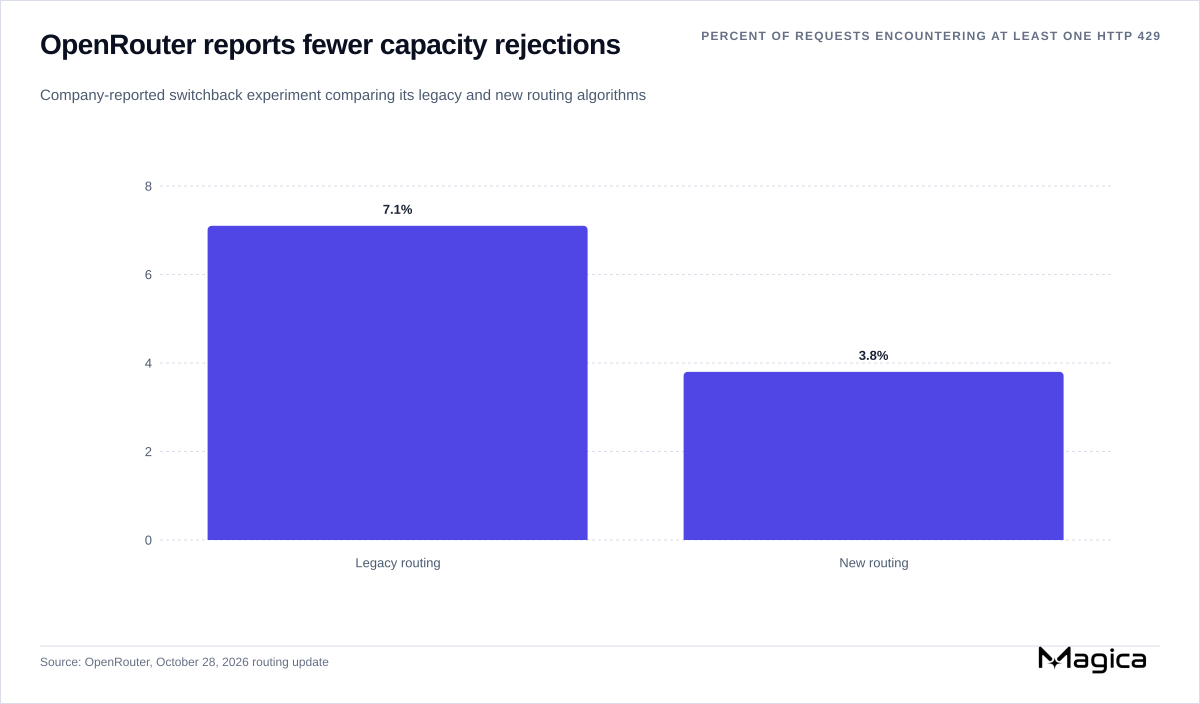
Company-reported OpenRouter results from a week-long experiment on a sample of open-source models. The comparison tests its own routing algorithms, not OpenRouter against Perplexity. Source: OpenRouter.
Perplexity offers usage reporting by model, project, key and date, plus model allowlists and spending caps. Consolidation gives buyers one vendor while handing that vendor deployment selection and prepaid spending. For large or committed workloads, the company invites discussions about volume pricing and capacity, so the public token table is not the only purchasing decision.
The launch materials disclose no customer count or request volume specific to the external Orchestrator API, and no date for automatic model routing to leave preview. The next evidence developers need is a comparison on their own workload: completed tasks, time to first and last token, behavior during outages, cache reuse and total spend. That would establish whether consolidating inference through Perplexity improves their operating results enough to justify moving the serving relationship.
Employee equity at Anthropic’s IPO price is reportedly worth $232 billion, while book rightsholders await a first settlement installment estimated at $2,203.56 per work. Vesting, shared copyrights and founder voting rights complicate the comparison.
Moore Threads is preparing a December 29 reveal for Lushan, a desktop GPU pitched at gaming and local AI inference. Its claimed memory record remains unquantified, and capacity alone will not establish performance or value.

Amazon is in advanced talks to buy Decart, whose software helps AI models run efficiently across chips. The reported deal could strengthen AWS’s Trainium business, with conditional payments and five-year founder commitments making execution central to its value.
The University of California is expanding ChatGPT and Codex access across 10 campuses, with extra charges for advanced models and an unresolved dispute over faculty authority.
Ray-Ban’s US store cuts the Gen 2 Wayfarer by 25% to $284.25. Buyers still face separate prescription-lens prices, a cheaper Gen 1 option and newer glasses outside Meta’s frame sale.
Ubisoft has made the team behind its Teammates experiment a dedicated subsidiary targeting AI characters with memory and outside game creators. Earlier playtests show both progress and limitations, while commercial plans remain undisclosed amid group cost cuts and refinancing.
Neuralink has shown a trial participant controlling GTA VI through intended movements. Earlier gaming use and company-reported trial results put the demonstration in context, while its reliability across users remains unmeasured in the reports.
SoftBank founder Masayoshi Son reportedly explored financing a $1 trillion acquisition of memory-chip maker SK hynix, but the company says the deal is no longer under active consideration. The target brings surging earnings, existing shareholders and customer commitments that complicate any simple equation between ownership and access to AI-memory supply.
Nvidia reported $115.8 billion in quarterly revenue, but its shares fell 14% Friday amid a wider technology selloff, a leadership transition and a reported accounting investigation. Strong cash generation offers a counterweight to concerns about the durability of AI spending.
The Nasdaq 100 fell 5.6% on November 20 and closed 19.8% below its record after an intraday bear-market breach. Nvidia’s revenue surge and Anthropic’s huge IPO did not halt the rout; infrastructure bills and resilience elsewhere in the market complicate the picture.
OpenAI reports sharply lower reasoning-extraction rates in internal GPT-6.2 tests and backs sanctions against illicit foreign distillation. Its own research and rival Anthropic’s experience show why protecting hidden reasoning leaves capability transfer and customer costs unresolved.
Alberta proposes 600-metre setbacks for large data centres and expanded utility oversight, but exemptions and rules still to be written will determine how much protection communities receive.
President Donald Trump backed Commerce Secretary Howard Lutnick as lawmakers scrutinize alleged delays in restricting a suspected route for AI chips to China. A new congressional inquiry also questions Nvidia’s influence on an existing investigation.

Amazon’s month-old Echo Time is $50 off for Black Friday. Its touchscreen, home hub and optional sleep-aware alarm cost $90 more than the reported Echo Spot price, while Alexa+ access and evidence of better waking remain key buying questions.
Merck will pair its experimental data with Isomorphic Labs’ AI to seek small-molecule cancer drug candidates. The deal follows Isomorphic’s $5 billion financing, but its payments, target and development timetable remain undisclosed.
Thinking Machines Lab released a roughly 20GB open-weights model that reuses its middle layers for reasoning. It brings the Inkling family to local hardware, with competitive coding results but workload-dependent costs and preliminary evidence on oversight.
Apple’s first HomePod mini update since 2020 adds Mac audio and four-speaker surround, but Siri AI remains unavailable, core home-hub features carry over, and reviews disagree on playback reliability.
Treasury Secretary Scott Bessent says an unnamed Anthropic founder will announce a large gift to children's investment accounts within weeks, but the amount, recipients and connection to existing philanthropic pledges remain undisclosed.
Google says air cooling will limit water use at its Visakhapatnam AI hub, but environmental proceedings and residents’ accounts raise broader questions about land, electricity, public incentives and the evidence behind promised benefits.
Nvidia slipped behind Alphabet to fourth in U.S. market value during November 20 trading. The reversal follows a steep selloff despite strong reported revenue growth, with a permanent CEO still to be chosen.