Editorial Team
8 min read
Redwood and Crusoe announced plans to expand their Nevada AI campus after reporting 99.2% microgrid availability. Crusoe separately cites grid backup for cloud reliability, while undisclosed project costs leave the used-battery business case unresolved.
Battery recycler Redwood Materials and AI infrastructure developer Crusoe announced an expansion of their solar-and-used-battery computing campus in Nevada after reporting 99.2% operational availability for its microgrid. The project gives retired electric-vehicle batteries another commercial use, while leaving open how cheaply—and independently of the grid—the arrangement can deliver dependable computing.
In its expansion announcement, Redwood said the result supported plans for 20 additional Crusoe Spark modular data centers, bringing computing capacity to nearly seven times its original level. The claim offers an operating result behind the pitch that used batteries can help developers get power faster. It does not yet establish the lifetime economics of doing so.
Crusoe’s March 24, 2026 announcement adds a qualification: it says the microgrid achieved 99.2% operational availability over seven months, while Crusoe Cloud maintains 99.9% availability using the grid as backup. The statement does not define the scope of the cloud figure or specify the Nevada campus’s use of grid backup. The two measures should not be treated as interchangeable, or as evidence of uninterrupted computing powered solely by solar and reused batteries.
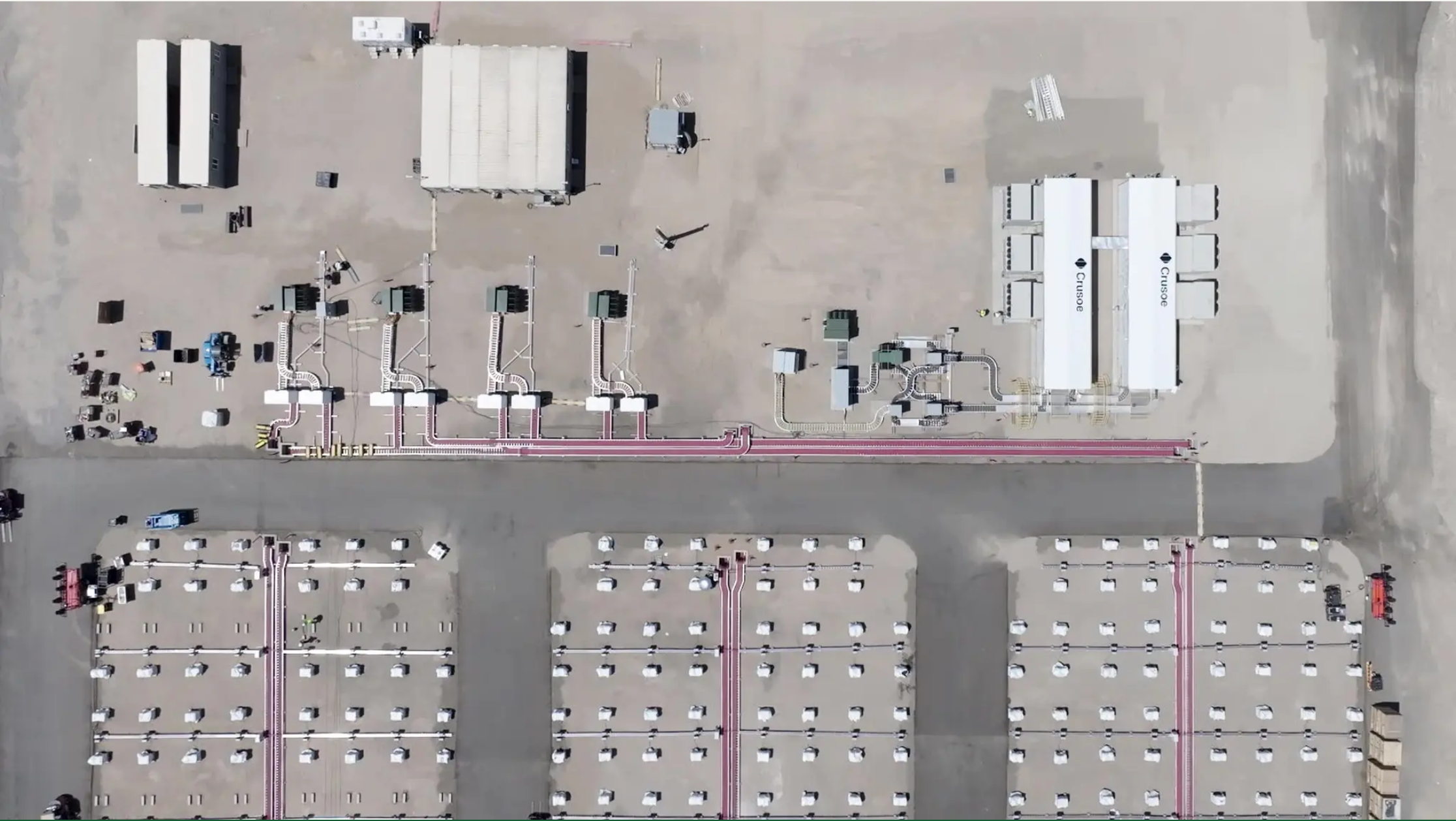
Battery packs and Crusoe Spark modular data centers at Redwood’s Nevada campus. Photo: Redwood Materials. Source: Redwood Materials.
Redwood founder and chief executive JB Straubel, Tesla’s co-founder and former longtime chief technology officer, established the company in 2017. His role at Redwood puts experience building EV battery systems behind a business handling what happens after those batteries leave vehicles.
A recent report following a visit to Redwood describes the scale of its original operation: about 70% of U.S. lithium-ion batteries destined for recycling reach its facilities, and it turned batteries into more than 60,000 metric tons of minerals in 2025. Those are figures reported in the account, rather than a measurement of how much reusable storage Redwood can sell.
The original business collects batteries, recovers materials including lithium, nickel and cobalt, and returns materials to battery manufacturing. A report on the storage launch describes revenue at both ends: fees for recycling batteries and sales of recovered materials. Stationary storage adds an intermediate use before recycling.
That June 2025 report identified the Crusoe deployment as Redwood Energy’s first completed project. It also noted that the wider recycling industry had struggled to scale partly because too few used batteries were available. Redwood’s collection network gives it access to feedstock, but incoming recycling volumes alone do not establish how much second-life capacity is ready for customers.
Redwood says it receives more than 20 gigawatt-hours of batteries annually, and that many recovered EV packs retain more than half their usable capacity. Under its Redwood Energy platform, it tests packs, sends suitable ones into storage systems, and ultimately recycles them. Stationary applications can accommodate slower discharge and reduced capacity that no longer meet vehicle requirements, the company says.
That makes access to discarded batteries only part of the proposition. Redwood also supplies diagnostics, controls that combine different manufacturers' packs and chemistries, and the eventual recycling route. The commercial question is whether that integrated operation saves more than testing, maintenance and replacement cost.
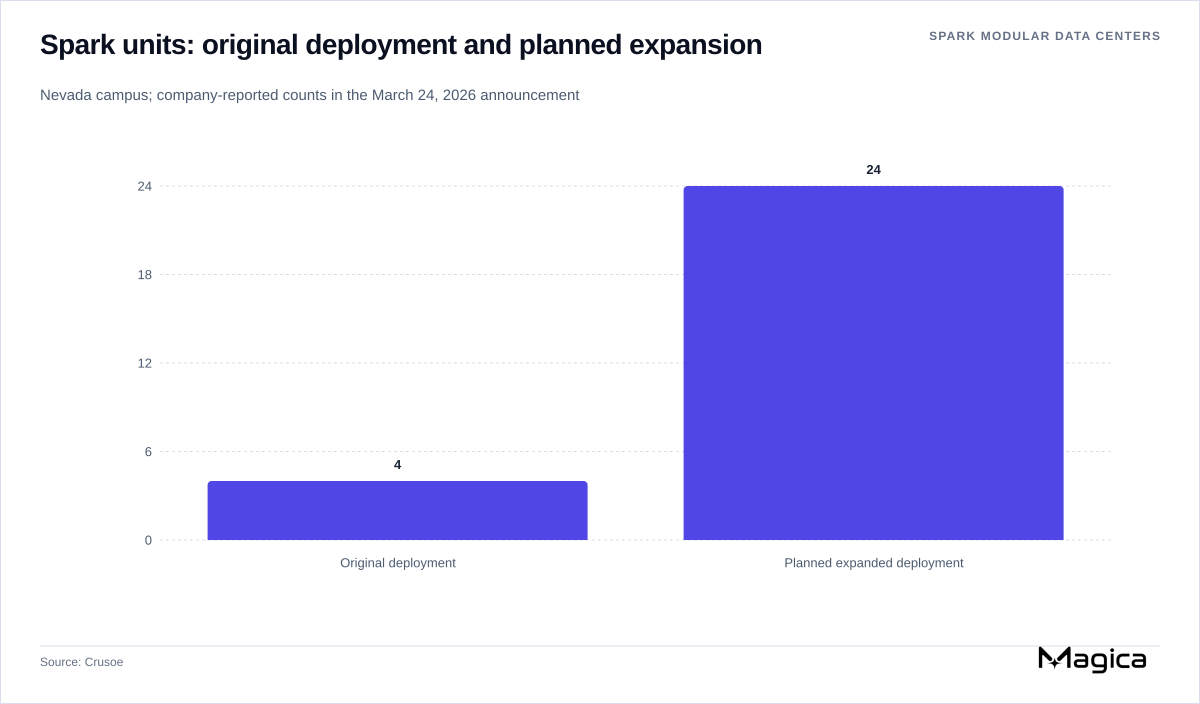
Company-reported counts show four original Spark units and 24 planned in total. Unit counts do not measure computing capacity; launch reporting described two units. Source: Crusoe.
The microgrid on Redwood's Nevada campus combines solar with 63 megawatt-hours of used-battery storage. Redwood describes it as a 12-megawatt microgrid built in just under four months. Those power and storage ratings describe the energy infrastructure; they should not be read as the data center's electricity demand.
The June 2025 launch report described a one-megawatt computing demonstration with two Spark units, a 20-acre solar array and roughly another 10 acres of battery packs. Spark units contain power equipment, cooling and GPU racks. The partners’ subsequent expansion accounts describe four units in the original deployment before the planned addition of 20. The sources do not reconcile that difference in unit counts. Nor do they provide the hardware breakdown explaining why six times as many units would deliver nearly seven times the computing capacity.
Crusoe’s participation matters because it has experience deploying modular computing facilities in remote oil fields as well as developing its large data center campus in Abilene, Texas, according to its launch announcement. Its Spark product applies that deployment experience to portable AI infrastructure.
The launch report described Crusoe’s earlier focus on fossil-gas generation with carbon capture and sequestration, and a planned 300-megawatt gas plant for backup at Abilene. Nevada tests another power option; it does not establish that solar and reused batteries can replace Crusoe’s other power arrangements.
Redwood attributes the microgrid’s performance to its Pack Manager technology. The reported availability is evidence of operation, but the announcements lack detailed outage accounting showing how microgrid performance maps to uninterrupted customer computing.
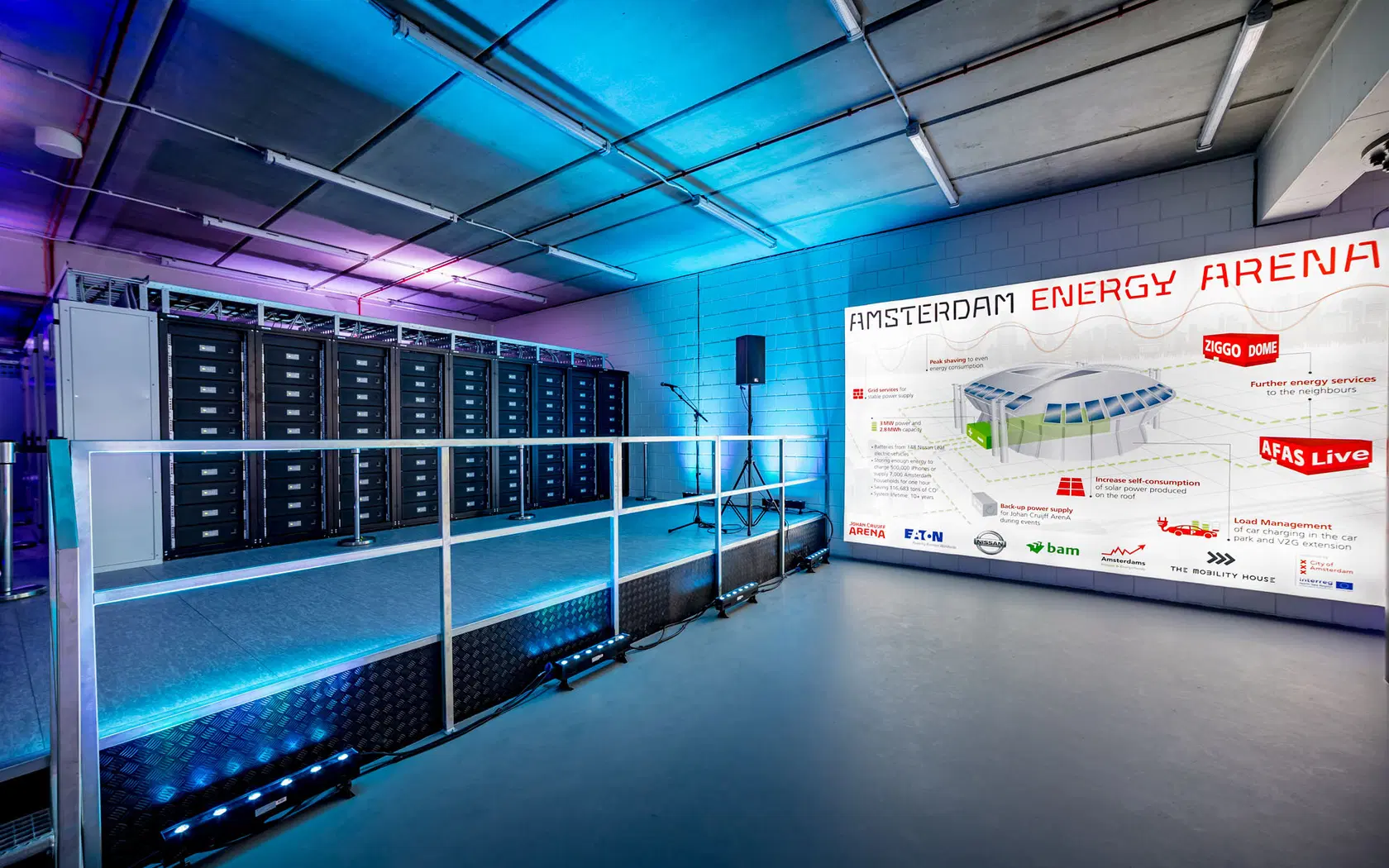
Johan Cruijff ArenA’s storage installation combined second-life and new EV batteries in 2018. Photo: Johan Cruijff ArenA. Source: Johan Cruijff ArenA.
Reusing vehicle batteries for stationary power predates Redwood Energy. Amsterdam’s Johan Cruijff ArenA stadium opened a three-megawatt storage system using both second-life and new EV batteries in June 2018 to provide backup and help balance electricity demand. Redwood’s case rests on its supply network, integration and deployment economics rather than inventing the second-life concept.
The price of the alternative is also moving. Research provider BloombergNEF’s December 2025 battery-price survey put stationary-storage battery pack prices at $70 per kilowatt-hour, down 45% from 2024. It attributed downward price pressure to manufacturing overcapacity, competition and the shift toward cheaper lithium iron phosphate batteries.
That is a global pack-price benchmark, not an installed-system cost or a quote for a U.S. project. Regional costs matter too: the survey found North American pack prices across applications averaged 44% above China’s. That broader regional comparison is not specific to stationary storage, but cautions against treating the cheapest global packs as a local installed price.
Redwood declined to disclose specific costs for the Nevada project in the launch reporting. It said its system cost substantially less than a new lithium-ion installation including batteries, software, power electronics and infrastructure, and offered a way around import duties. Without the underlying figures, those claims cannot support a like-for-like public comparison.
The same report identified the difficult part of second-life storage: evaluating old batteries and predicting their performance can be expensive. Redwood said it sells fixed-capacity systems, monitors pack health and replaces degraded packs as necessary. It also said the converters connecting the packs last 15 years or more. Customers therefore need to evaluate the maintained system’s cost and obligations, rather than just the acquisition price of used batteries.
The land requirement also limits the addressable customer. The launch reporting described Redwood's approach as best suited to new data center builds with room for the equipment. A campus demonstration does not settle the economics for a constrained site.
In January 2026, Redwood announced the final close of a $425 million Series E, up from a previously announced $350 million. Google joined as a new investor alongside existing backers Capricorn and Goldman Sachs Alternatives. Redwood said the money would accelerate energy storage and strengthen its recycling and critical minerals business. The financing supports both operations; it does not establish the Nevada storage project’s profitability.
The launch report said Redwood had stepped away in late 2024 from a conditional $2 billion Department of Energy loan commitment for its Nevada battery-materials campus, opting for private financing. Redwood cited financial strength after raising $2 billion and generating around $200 million in revenue. Those historical figures describe the parent company’s position, rather than the capital cost or profitability of Redwood Energy.
At launch, Redwood said it had more than one gigawatt-hour of reusable batteries in its deployment pipeline, expected another five gigawatt-hours in the following year and was designing projects above 100 megawatts. These were pipeline figures and plans, not completed installations. Its subsequent announcement described projects ranging from hundreds of megawatt-hours to multiple gigawatt-hours across several partners.
The Crusoe expansion is a more concrete test: more computing on an operating campus. Crusoe’s expansion announcement describes the expanded work as 20 megawatts and says computing will grow on the same energy infrastructure. It does not reconcile that figure with the existing microgrid’s 12-megawatt rating or fully explain the expanded site’s solar, storage and backup requirements. Installed and operating costs and pack replacement rates also remain undisclosed.
Those measurements would let customers judge whether Redwood’s recycling network produces a durable cost advantage. A clearly defined account of microgrid outages, grid assistance and computing availability at the larger load would show how much dependable service the batteries actually enable.
Supertake's seed round and former Coinbase AI leaders back a service that turns market opinions into portfolios. Brokerage constraints, unaudited returns and an undefined revenue-sharing model complicate its ambition to reward the best ideas.
South Korean stocks rebounded as Nvidia co-founder Jensen Huang returned as CEO, lifting Samsung Electronics and SK hynix. The rally recovered only part of recent losses, with a board investigation and doubts about AI investment still unresolved.
AWS has released five open-weight decision models that read shared context in both directions and return probabilities rather than generated text. Its results suggest better handling of pivotal details, but deployment savings and confidence scores still need testing on real workloads.
OpenAI is bringing a conversational version of GPT-6.2 Sol to four paid ChatGPT tiers ahead of a reported December 23 retirement of two older models. Its tests show better image understanding and web search, but uneven progress on factuality and instruction steering.
Jensen Huang’s return as Nvidia CEO leaves December congressional questioning intact. Lawmakers want evidence behind the board’s security assurance and answers about chip exports and the administration’s involvement.
The Commerce Department added Singapore-based Megaspeed to its Entity List, imposing a licensing barrier on supplies to a longstanding Nvidia customer while allegations of chip diversion remain unresolved.
Google is rolling out optional Wallet access in Search’s AI Mode, with Drive and Gemini connections to follow. The expansion brings existing personal-finance capabilities into Search, while data-use permissions extend beyond the read-only limit on financial actions.
Anthropic has launched Claude Ship for GitHub repositories, combining code review with new agents that fix problems and apply approval policies. Teams retain control through repository rules, while automation adds token costs and can allow changes to merge without human review.
Google’s patent application describes generating videos from viewing habits, demographics and device context, with optional replicas of the viewer and inserted ads. Existing video tools show parts of the idea are already available; a commercial service and its economics remain unproven.
Google’s Gemini API can slice documents, spreadsheets and recordings on its servers and bill for selected content sent to the model. The controls reduce local preparation work, but upload limits, model defaults and the cost of finding relevant material qualify the savings.
OpenAI's OpenWorks pilot offers free AI assistance to eligible small businesses in 20 U.S. communities, pairing paid local partners with a three-month ChatGPT Business trial. It builds on earlier training efforts, but its total budget is undisclosed and typical business returns are unproven.
Nothing plans to unveil Ear (note) on December 8, pairing call-recording earbuds with a case that captures meetings for AI transcription. Existing recording products, uncertain service costs and unresolved privacy details narrow the novelty of the pitch.
Anthropic’s Enterprise Frontier Safeguards beta lets eligible businesses use its most capable Claude models while keeping encrypted safety records in their own cloud accounts. Automated monitoring remains; customers pay cloud costs and review flagged cases.
Hakeem Jeffries promised an investigation after Nvidia reinstated Jensen Huang following Donald Trump’s intervention. Reports that directors excluded interim CEO Colette Kress sharpen questions about the reversal and its national security assurances.
The European Commission has confirmed a leak affecting users of its public learning platform, while the number affected, the wider exposure of staff data and responsibility for the attack remain unresolved.
Maintainers defend continued distribution of the AI penetration-testing framework after its creator withdrew it. Investigations document data theft and cheap automation, but also failed payouts, blocked attacks and safeguards that vary by version.
China Telecom's AI arm has released the 285-billion-parameter Xing4.1-Preview under Apache 2.0, extending its TeleChat model lineage and domestic-compute strategy. Its million-token context and quantized variants widen deployment choices, but mixed benchmarks and incomplete cost disclosures leave its low-cost pitch unproven.
Applied Digital signed an 18-year lease for 150 MW with an unnamed investment-grade hyperscaler. Higher pricing strengthens its contracted revenue book, but financing, power arrangements and construction still stand between the agreement and delivery.
Sarvam Dictate combines speech recognition and text editing for English and 22 Indian languages at ₹0.50 per audio minute. Its company-run benchmarks show fewer character edits than rival APIs, but the advantage varies by language and recording length.
Arm CEO Rene Haas will become SoftBank Group vice chairman on December 1, building on existing roles at its controlling shareholder as Arm expands beyond processor licensing into its own chips. The extension follows a reported Nvidia recruitment approach, but Nvidia has since reinstated co-founder Jensen Huang as CEO.