Editorial Team
6 min read
Supertake's seed round and former Coinbase AI leaders back a service that turns market opinions into portfolios. Brokerage constraints, unaudited returns and an undefined revenue-sharing model complicate its ambition to reward the best ideas.
Supertake, an investing startup that turns users’ market opinions into AI-generated portfolios, has raised $20 million in seed funding while its beta remains behind a waitlist. It wants people to build audiences around investment ideas that others can follow and fund—a broader ambition than generating stock picks from a prompt.
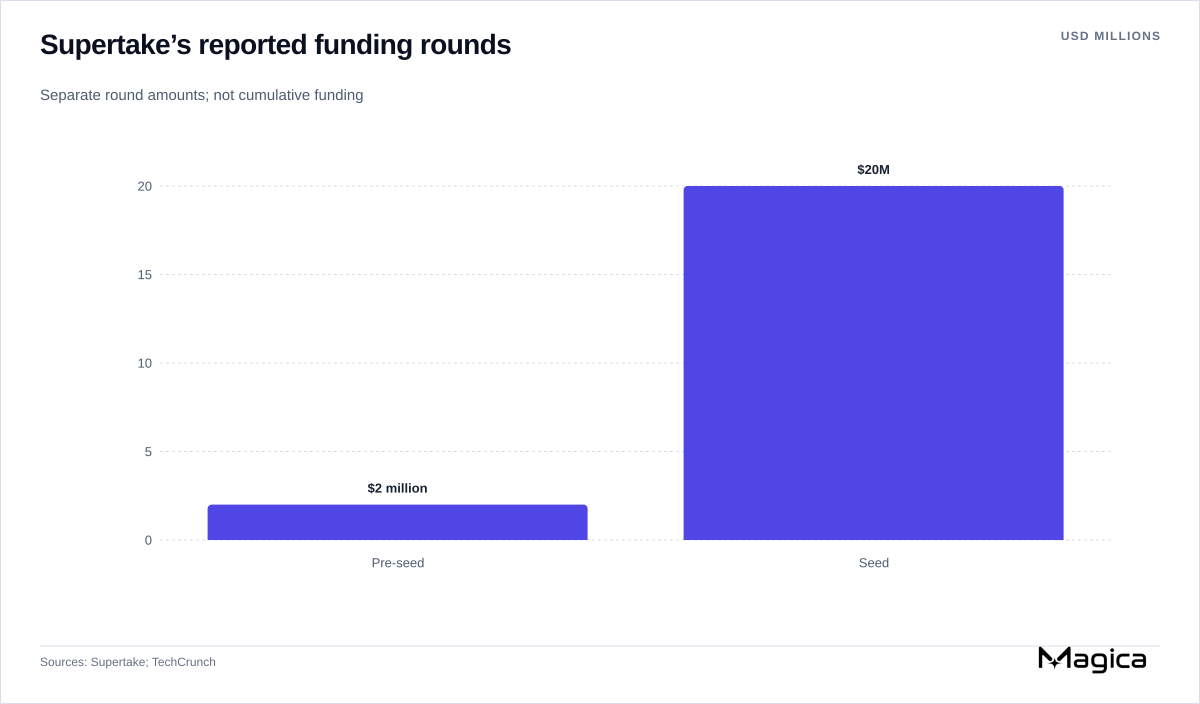
Supertake’s company-reported $20M seed round follows an earlier $2 million pre-seed round reported by TechCrunch. Graphic: Magica. Source: TechCrunch.
Supertake confirmed the seed round, led by venture firm Adjacent with backing from Union Square Ventures, Coinbase Ventures and angel investors. It follows a $2 million pre-seed round, according to the funding report.
Murr and Peterson will run Supertake day to day. Founder and executive chairman Michael Mignano, who previously co-founded and led the podcasting platform Anchor, said the two led AI product and engineering at the cryptocurrency trading platform Coinbase, including launches such as Coinbase Advisor, Coinbase for Agents and agentic wallets, according to the funding report. That is relevant product and engineering experience for connecting AI agents to financial accounts; it is not an investment-performance record.
Mignano, also a partner at venture firm Union Square Ventures, incubated Supertake there. Spotify acquired Anchor in 2019, and he later led its podcasting business. His subsequent AI work includes investments in Suno and Granola as a Lightspeed venture partner and co-founding the AI education startup Oboe, according to the same report. He brings consumer-product and AI investing experience, while his current venture firm is both Supertake’s incubator and a participant in its financing.
The team says the money will expand engineering, design, growth marketing and other functions. Supertake’s recruitment page lists founding engineering and growth roles. In a report describing his November 23 announcement, Mignano said the product had been introduced a little over a month earlier and beta users were investing real money. The announcement supplied no user or asset totals, leaving the service’s adoption scale unclear.
Users describe a view about how the world will change, and Supertake’s AI works with them to translate it into an investable “take.” The company says it combines frontier models and tools with proprietary software that directs and limits their actions. According to the funding report, it currently works with trading platforms Coinbase and Robinhood and plans more brokerage connections.
Murr describes the product as a new version of the robo-adviser experience rather than a prediction market. The team’s current focus is medium- and longer-term holdings, although it wants eventually to support instruments including shorts and derivatives, as well as prediction-market transactions through partners. Those are ambitions, not a description of everything available today.
Natural-language strategy creation has precedent. Composer, a platform for building and executing trading strategies, describes an overlapping workflow in its ChatGPT tutorial: describe a strategy, backtest it, refine it through conversation and invest, with trades executed on a rebalancing schedule. Its example also turns a broad belief about AI’s growth into a basket of stocks. Composer cautions that generated tickers may need correction or may no longer trade publicly. A conversational interface alone therefore does not distinguish Supertake’s proposition.
Supertake’s additional pitch is social: users can discover and back other people’s ideas, with contributors building track records and audiences. The company wants eventually to reward successful contributors with a share of the value their takes create.
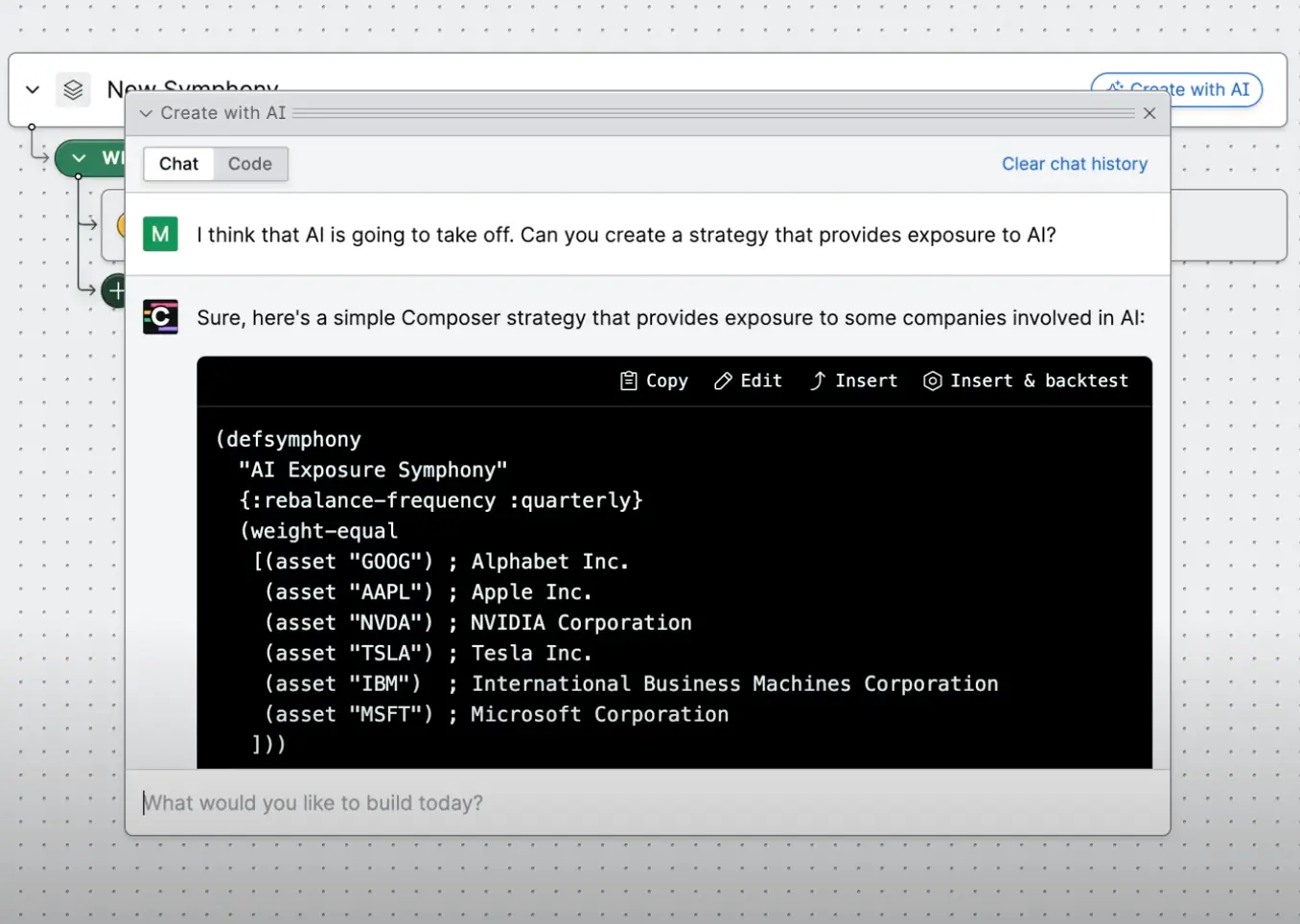
Composer’s tutorial shows its AI assistant translating a market belief into strategy code. Screenshot: Composer. Source: Composer.
Supertake’s terms, revised October 29, 2026, say real-money investing starts with approval for each trade instruction. Optional Autopilot can decide when to generate and transmit instructions within an approved strategy and settings without approval for every trade. Settings can cover trade size, holding weight and drift alerts; they start with defaults, and enabling Autopilot does not require a separately entered dollar cap.
Assets remain with the connected provider, which decides whether to accept an instruction and executes accepted trades. Supertake cannot change an instruction after transmission. Available assets and features depend on the provider, account and location—not simply on what the AI proposes.
The terms give a concrete example: a rejected cryptocurrency purchase can leave that allocation in cash while the other holdings are purchased. Supertake does not automatically substitute another asset or redistribute the allocation. A follower’s actual holdings and performance can consequently differ from the original idea’s.
In the funding report, the team also describes asset allow and deny lists, anomaly monitoring and restrictions preventing agents from seeing brokerage credentials. These constrain what agents can do; they do not establish whether a portfolio expresses a user’s belief well or earns a return.
Supertake’s public vision page displays percentage gains beside featured takes. Those figures are insufficient to establish investment skill: its terms say performance in published content is not verified or audited by Supertake and may reflect simulated Practice Mode results. The terms also say Supertake is not currently an investment adviser or broker-dealer and leaves suitability decisions to users.
The terms say Supertake does not review AI output before showing it to users, and warn that it can omit relevant assets or include unrelated ones. Practice Mode uses simulated funds without a brokerage connection; its results exclude live-trading effects such as execution, fees, taxes and liquidity constraints. These are material differences when comparing the ideas ranked on a leaderboard.
The featured strategies also complicate any assumption that a simple prompt produces a simple exposure. One displayed take combines Apple with a triple-levered inverse semiconductor fund, short-term Treasuries and cash. Its description acknowledges daily resets and decay if chip prices move sideways. That is a showcased strategy, not independently verified evidence of live holdings or returns.
The founders say they are investing their own money: Murr describes tens of thousands of dollars, Peterson thousands and Mignano hundreds of thousands, according to the funding report. Those disclosures indicate personal exposure but supply neither returns nor a comparable performance record across users.
To substantiate its proposed meritocracy, Supertake will need results that distinguish simulation from live execution and make time periods, costs, risk and benchmarks comparable. The funding announcement does not resolve whether its rankings can distinguish a good investment idea from a favorable stretch of markets.
The economics also remain unfinished. Supertake’s terms say it currently receives no subscription fee, commission or other direct or indirect compensation for its AI investment-idea and portfolio-intelligence features; third-party charges remain outside its control. Its vision page promises that contributors will share in the value their ideas create but does not specify how. The next consequential choices are how Supertake charges for the service, rewards contributors and demonstrates that the returns being ranked are returns followers can actually obtain.
South Korean stocks rebounded as Nvidia co-founder Jensen Huang returned as CEO, lifting Samsung Electronics and SK hynix. The rally recovered only part of recent losses, with a board investigation and doubts about AI investment still unresolved.
AWS has released five open-weight decision models that read shared context in both directions and return probabilities rather than generated text. Its results suggest better handling of pivotal details, but deployment savings and confidence scores still need testing on real workloads.
OpenAI is bringing a conversational version of GPT-6.2 Sol to four paid ChatGPT tiers ahead of a reported December 23 retirement of two older models. Its tests show better image understanding and web search, but uneven progress on factuality and instruction steering.
Redwood and Crusoe announced plans to expand their Nevada AI campus after reporting 99.2% microgrid availability. Crusoe separately cites grid backup for cloud reliability, while undisclosed project costs leave the used-battery business case unresolved.
Jensen Huang’s return as Nvidia CEO leaves December congressional questioning intact. Lawmakers want evidence behind the board’s security assurance and answers about chip exports and the administration’s involvement.
The Commerce Department added Singapore-based Megaspeed to its Entity List, imposing a licensing barrier on supplies to a longstanding Nvidia customer while allegations of chip diversion remain unresolved.
Google is rolling out optional Wallet access in Search’s AI Mode, with Drive and Gemini connections to follow. The expansion brings existing personal-finance capabilities into Search, while data-use permissions extend beyond the read-only limit on financial actions.
Anthropic has launched Claude Ship for GitHub repositories, combining code review with new agents that fix problems and apply approval policies. Teams retain control through repository rules, while automation adds token costs and can allow changes to merge without human review.
Google’s patent application describes generating videos from viewing habits, demographics and device context, with optional replicas of the viewer and inserted ads. Existing video tools show parts of the idea are already available; a commercial service and its economics remain unproven.
Google’s Gemini API can slice documents, spreadsheets and recordings on its servers and bill for selected content sent to the model. The controls reduce local preparation work, but upload limits, model defaults and the cost of finding relevant material qualify the savings.
OpenAI's OpenWorks pilot offers free AI assistance to eligible small businesses in 20 U.S. communities, pairing paid local partners with a three-month ChatGPT Business trial. It builds on earlier training efforts, but its total budget is undisclosed and typical business returns are unproven.
Nothing plans to unveil Ear (note) on December 8, pairing call-recording earbuds with a case that captures meetings for AI transcription. Existing recording products, uncertain service costs and unresolved privacy details narrow the novelty of the pitch.
Anthropic’s Enterprise Frontier Safeguards beta lets eligible businesses use its most capable Claude models while keeping encrypted safety records in their own cloud accounts. Automated monitoring remains; customers pay cloud costs and review flagged cases.
Hakeem Jeffries promised an investigation after Nvidia reinstated Jensen Huang following Donald Trump’s intervention. Reports that directors excluded interim CEO Colette Kress sharpen questions about the reversal and its national security assurances.
The European Commission has confirmed a leak affecting users of its public learning platform, while the number affected, the wider exposure of staff data and responsibility for the attack remain unresolved.
Maintainers defend continued distribution of the AI penetration-testing framework after its creator withdrew it. Investigations document data theft and cheap automation, but also failed payouts, blocked attacks and safeguards that vary by version.
China Telecom's AI arm has released the 285-billion-parameter Xing4.1-Preview under Apache 2.0, extending its TeleChat model lineage and domestic-compute strategy. Its million-token context and quantized variants widen deployment choices, but mixed benchmarks and incomplete cost disclosures leave its low-cost pitch unproven.
Applied Digital signed an 18-year lease for 150 MW with an unnamed investment-grade hyperscaler. Higher pricing strengthens its contracted revenue book, but financing, power arrangements and construction still stand between the agreement and delivery.
Sarvam Dictate combines speech recognition and text editing for English and 22 Indian languages at ₹0.50 per audio minute. Its company-run benchmarks show fewer character edits than rival APIs, but the advantage varies by language and recording length.
Arm CEO Rene Haas will become SoftBank Group vice chairman on December 1, building on existing roles at its controlling shareholder as Arm expands beyond processor licensing into its own chips. The extension follows a reported Nvidia recruitment approach, but Nvidia has since reinstated co-founder Jensen Huang as CEO.