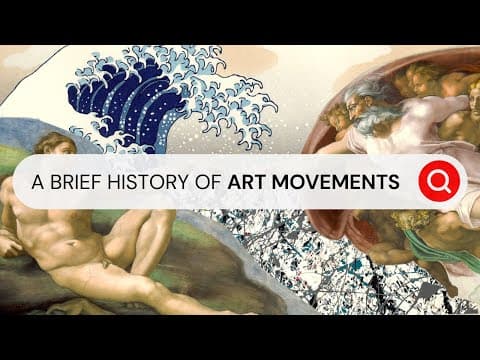
This blog post explores the evolution of art movements from prehistoric times to contemporary art, highlighting key periods, influential artists, and the societal changes that shaped artistic expression.
Art has been an intrinsic part of human existence for over 40,000 years, beginning with our Neanderthal ancestors who created some of the earliest visual representations. This need to create is as fundamental to humanity as the need for food, protection, and love. While many perceive art as something confined to museums, it is, in fact, a universal experience meant for everyone.
Before written language, early humans expressed themselves through cave paintings and rock engravings, often depicting scenes of survival such as hunting. One notable exception from this prehistoric period is the Venus of Willendorf, a small sculpture believed to represent a fertility goddess. This early art signifies the beginning of symbolic and abstract thought, laying the groundwork for future art movements.
As civilizations advanced in Mesopotamia, Egypt, Greece, Persia, China, and Rome, art evolved to reflect more complex societal structures. Art became a medium for enforcing religious and political ideologies, often featuring symbolic imagery and mythological narratives. A prime example is the Code of Hammurabi, a stone carving that illustrates laws and the authority of the king alongside divine imagery.
Following the fall of the Roman Empire, the Medieval period saw art become increasingly focused on religious themes. Artists aimed to convey spiritual messages rather than realism, using gold and jewels to attract followers to the church. This period set the stage for the Renaissance, a time of cultural rebirth in Italy from the 14th to the 17th century.
The Renaissance marked a significant shift as artists began to draw inspiration from classical antiquity. This era celebrated humanism, leading to advancements in portrait painting, sculpture, and architecture. The invention of the printing press further democratized art, increasing literacy and appreciation for cultural subjects.
Emerging from the Renaissance, the Baroque movement emphasized drama and emotion, exemplified by artists like Caravaggio and Gian Lorenzo Bernini. Following this, the Rococo period introduced a lighter, more playful aesthetic characterized by elaborate ornamentation and pastel colors.
The discovery of ancient Roman cities like Pompeii reignited interest in classical art, leading to the Neoclassical movement. This style focused on symmetry and clarity. In contrast, Romanticism celebrated individualism and the beauty of nature, often reflecting the emotional turmoil of the time.
The Realism movement emerged in response to Romanticism, depicting everyday life and the struggles of ordinary people. This was followed by Impressionism, where artists like Claude Monet and Edgar Degas broke from tradition by painting outdoors and capturing the effects of light and movement.
Post-Impressionism expanded on Impressionist techniques while emphasizing individual expression. Artists such as Vincent van Gogh and Paul Cézanne explored new styles, including Pointillism. Meanwhile, Expressionism emerged, focusing on emotional experiences and subjective interpretations of reality.
The late 19th and early 20th centuries saw the rise of various modern art movements. Art Nouveau embraced organic forms and decorative arts, while Cubism, founded by Pablo Picasso and Georges Braque, deconstructed subjects into abstract forms. Futurism celebrated modernity and technology, while Dada rejected traditional values in response to the horrors of World War I.
Surrealism, influenced by Freud's theories, explored the unconscious mind through dream-like imagery. In contrast, the Bauhaus school sought to integrate art into everyday life, emphasizing functionality and simplicity.
Post-World War II, Abstract Expressionism emerged as the first American art movement to gain international acclaim, characterized by spontaneous and expressive techniques. This was followed by Pop Art, which drew inspiration from popular culture and mass media, making art more accessible.
Minimalism stripped art down to its essentials, focusing on form and materiality. In contrast, contemporary art encompasses a wide range of styles and ideas, often addressing social issues and cultural dialogues.
The history of art is a rich tapestry that reflects societal changes and human experiences. While many renowned artists have shaped this narrative, it is crucial to recognize the diverse influences and cultures that have contributed to these movements. Understanding art history not only enriches our appreciation of art but also informs our perspectives on identity and community in today's world. As we continue to create and engage with art, we must strive for inclusivity and recognition of all voices in this ongoing journey.