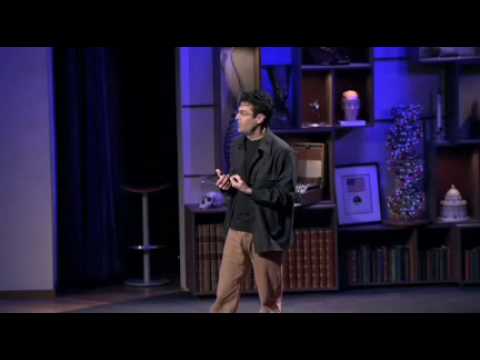
Chris Jordan's artistic work highlights unconscious collective behaviors through powerful visual representations of statistics, aiming to evoke emotional responses and inspire societal change.
Chris Jordan's work delves into the unconscious behaviors that permeate our society, behaviors that often go unnoticed yet have significant consequences. He explores how these actions, when multiplied across millions of individuals, can lead to catastrophic outcomes that no one intends.
Jordan begins by illustrating how personal behaviors can reflect broader societal issues. For instance, he describes scenarios where individuals act out of frustration or anxiety, leading to negative consequences not just for themselves but for those around them. When these behaviors are multiplied by the actions of 300 million people, the results can be devastating.
One of Jordan's notable pieces features a striking image that, from a distance, resembles a factory emitting pollution. Upon closer inspection, it reveals itself to be composed of one million plastic cups, representing the staggering number of cups used on airline flights in the United States every six hours. This artwork serves as a commentary on our consumption habits, highlighting that four million cups are discarded daily, with little to no recycling efforts in place.
Jordan also addresses the broader issue of paper cup consumption, noting that 40 million cups are used daily for hot beverages, primarily coffee. To visualize this, he created a piece that represents 410,000 cups, equivalent to just 15 minutes of cup consumption. He further illustrates the scale of this waste by comparing it to the height of a 42-story building, using the Statue of Liberty for reference.
Another significant theme in Jordan's work is the alarming rate of incarceration in the United States. He points out that America has the highest percentage of its population in prison globally, with 2.3 million Americans incarcerated as of 2005. To convey this statistic, he created an artwork featuring tiny prison uniforms, each the size of a nickel, requiring a massive canvas to display the sheer number of uniforms.
Jordan's exploration of addiction is equally poignant. He created a piece representing the annual death toll from cigarette smoking, which exceeds 400,000 Americans. This artwork is composed of cigarette boxes and, when viewed from a distance, forms a Van Gogh painting titled "Skull with Cigarette." He contrasts the public's reaction to the 9/11 tragedy, where 3,000 lives were lost, with the daily death toll from smoking, which goes largely unnoticed.
He also highlights the alarming statistic that 65,000 teenagers begin smoking each month in the U.S., using 65,000 cigarettes to represent this figure visually. Furthermore, he addresses the misuse of prescription drugs, creating an image from scanned Vicodin pills to represent the 213,000 emergency room visits each year due to prescription drug abuse.
Jordan's work also touches on societal pressures regarding body image, particularly the rise in breast augmentation surgeries. He notes that 384,000 American women underwent this procedure last year, often as a graduation gift. His artwork, made from 32,000 Barbie dolls, visually represents the number of breast augmentations performed monthly, emphasizing the trend among young women.
Throughout his presentation, Jordan expresses concern over a cultural anesthesia that seems to have taken hold in America. He believes that society has lost its sense of outrage and grief regarding pressing issues. He argues that as individuals strive to understand the interconnectedness of their actions and the consequences they have on a global scale, they often encounter overwhelming statistics that are difficult to comprehend.
Jordan's mission is to translate these daunting numbers into a visual language that resonates emotionally. He believes that if people can feel the weight of these issues, they will care more deeply and be motivated to enact change.
Ultimately, Jordan poses a critical question: how do we change? He emphasizes that change begins with individual responsibility and integrity. Rather than casting blame, he encourages a collective reflection on who we are as a society and what we can do to improve. The depth of character and commitment to change will define not only individuals but also the nation as a whole, impacting future generations.
In conclusion, Chris Jordan's art serves as a powerful reminder of the unconscious behaviors that shape our world. By transforming statistics into compelling visual narratives, he invites us to confront uncomfortable truths and inspires us to take action for a better future.