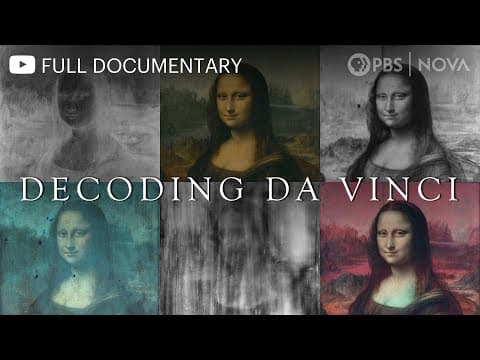
This blog post explores the intricate relationship between art and science in Leonardo da Vinci's work, particularly focusing on the Mona Lisa. It delves into the techniques, materials, and scientific investigations that reveal the depth of Leonardo's genius, showcasing how his understanding of anatomy, optics, and engineering contributed to the creation of one of the world's most famous paintings.
Leonardo da Vinci is celebrated as a legendary artist, scientist, and inventor whose genius transcends time. His most famous painting, the "Mona Lisa," continues to captivate millions, drawing visitors to the Louvre each year. But what makes this painting so extraordinary? This blog post explores the intricate relationship between art and science in Leonardo's work, particularly focusing on the Mona Lisa.
The Mona Lisa has become an icon, often regarded as the most famous painting in the world. Each viewer experiences a different emotion when gazing at her enigmatic smile. Art historian Vincent Delieuvin notes that every encounter with the painting evokes a unique feeling, suggesting that the Mona Lisa is more than just a portrait; it is a demonstration of how painting can convey life.
Recent advancements in scientific techniques have allowed researchers to investigate the Mona Lisa like never before. Using high-tech cameras and imaging methods, scientists are peeling back the layers of the painting to uncover its secrets. Margaret Livingstone, a neurophysiologist, explains that the Mona Lisa appears to change depending on where one looks, contributing to her lifelike quality.
Leonardo worked on the Mona Lisa for approximately 16 years, and his meticulous approach is evident in the layers of paint he applied. Art historian Bruno Mottin describes how Leonardo's use of oil paint allowed for a depth and translucency that creates an illusion of three dimensions. The painting's base was made of wood, covered with a reflective white layer, followed by semi-translucent paint that built up over time.
The Mona Lisa began as a commission in 1503 from a wealthy merchant to paint his wife, Lisa Gherardini. Over time, it evolved into a manifesto of Leonardo's artistic ability and worldview. The painting's journey from a simple portrait to a universal masterpiece reflects Leonardo's genius.
To understand how the Mona Lisa has changed over the centuries, scientists have utilized ultraviolet and infrared imaging. These techniques reveal modern restorations and the original colors obscured by yellowed varnish. The infrared images show that the painting's outlines were not clearly defined, indicating that Leonardo made continuous adjustments throughout the painting process.
Leonardo da Vinci was known for his experimental approach to art. Unlike many artists of his time, he felt free to change his mind during the creation process. This freedom allowed him to explore the interplay between art and science, leading to groundbreaking innovations in both fields.
Born in 1452 to an unwed mother, Leonardo's illegitimate status afforded him a unique perspective. He was self-taught and not bound by the traditional educational constraints of his time. His apprenticeship in Florence, a hub of Renaissance thought, further shaped his artistic evolution.
Leonardo's notebooks reveal a mind deeply engaged with scientific inquiry. His sketches and writings encompass a wide range of topics, from anatomy to engineering. His fascination with human flight and civil engineering proposals demonstrate his forward-thinking approach.
Leonardo's understanding of anatomy significantly influenced his art. He dissected human bodies to study muscles and tendons, which informed his realistic portrayals of the human form. His anatomical drawings, while not always accurate by modern standards, were groundbreaking for their time.
The Mona Lisa's smile has intrigued viewers for centuries. Livingstone's research suggests that the smile's ambiguity is a result of how our eyes perceive the painting. When viewed peripherally, the smile appears more pronounced, while direct focus diminishes it. This interplay of perception adds to the painting's allure.
As restoration techniques evolve, questions arise about how to treat masterpieces like the Mona Lisa. Recent efforts to digitally restore the painting have revealed its original colors and details, allowing us to appreciate Leonardo's work as he intended.
Leonardo da Vinci's genius lies in his ability to merge art and science seamlessly. The Mona Lisa is not just a painting; it is a testament to his innovative spirit and profound understanding of the world. As we continue to explore the depths of his work, we are reminded that the allure of the Mona Lisa remains as elusive as her smile, inviting us to ponder the mysteries of art and life itself.