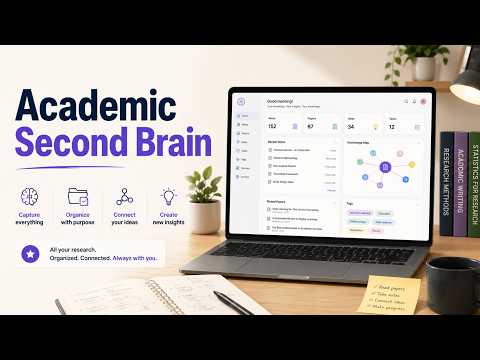
This article explores the five levels of building an AI second brain using Claude and other AI models. It covers organizing data from simple file routing to advanced knowledge graphs and autonomous systems, emphasizing the importance of context, routing, semantic search, and relationship mapping to optimize information retrieval and usability.
In the rapidly evolving world of artificial intelligence, building your own AI second brain has become a popular and powerful way to manage and utilize your data effectively. This article delves into the five distinct levels of constructing an AI second brain, primarily using Claude but applicable to other AI models as well. Whether you are starting from scratch or looking to scale your existing system, understanding these levels will help you optimize your data organization and retrieval.
An AI second brain is essentially a system where you offload your knowledge, notes, meeting recordings, project details, and other important information into an organized digital structure. The goal is to create a system that not only stores your data but also understands the context and relationships within it, enabling efficient recall and use.
Your data is your intellectual property and your competitive advantage. However, the true value lies in how well you organize this data so that AI models can access and recall it accurately without hallucinating or wasting resources.
As you build your second brain, you start with simple data storage and gradually add layers of context and relationships. Initially, you might have isolated files and folders. As you scale, clusters of related nodes form, and eventually, you develop a relationship map that shows how everything connects, moving beyond simple file linking to a comprehensive knowledge graph.
At this foundational level, your second brain consists of markdown files organized in folders with a key routing file (e.g., claw.mmd for Claude or agents.mmd for Codex). This routing file acts as a system prompt and directs the AI where to find specific information.
Building on level one, this stage introduces wiki-style organization where files are grouped by topics or projects, creating a more interconnected structure.
Features:
Benefits: Easier research on specific topics and better context management.
Tools: Visualization tools like Obsidian can help visualize the wiki but are optional.
This level introduces semantic search capabilities, allowing the AI to find information based on meaning rather than exact keywords.
How It Works:
Advantages:
Considerations:
At this advanced level, the second brain incorporates knowledge graphs that explicitly map entities and their relationships.
Features:
Use Cases:
Challenges:
The highest level involves creating an autonomous AI second brain that continuously syncs, updates, and manages data without manual intervention.
Example: GBrain by Gary Tan, CEO of Y Combinator.
Capabilities:
Considerations:
Design your second brain based on how you want to use the data. For example, just as a basketball must fit through a hoop, your data structure must fit your retrieval needs.
Think about the questions you want to ask your AI and design your data organization to support those queries effectively.
Your second brain should be flexible enough to work with different AI models and tools. For instance, switching between Claude and Codex involves minor changes like renaming routing files.
Be aware that using cloud-based AI models like Claude involves sending your data to external servers. If privacy is a concern, consider open-source or local AI models.
Include only evergreen, valuable data in your second brain. Avoid transient data like emails or Slack threads that change frequently and add noise.
When building a team second brain, focus on habit shifts and process ownership to ensure everyone updates and uses the shared knowledge base effectively.
claw.mmd or agents.mmd to direct AI where to find information.Building an AI second brain is a journey that involves progressively enhancing your data organization and retrieval capabilities. From simple file routing to sophisticated knowledge graphs and autonomous systems, each level serves different needs and use cases. The key is to identify your pain points and choose the level that best fits your requirements without overcomplicating your system.
Remember, the effectiveness of your AI second brain depends not just on technology but also on thoughtful design, clear routing, and mindful data management. Start simple, iterate, and scale as your needs evolve.
If you are interested in building your own AI operating system, consider exploring free courses and communities that provide resources and challenges to help you get started.
This comprehensive guide aims to equip you with the knowledge to build and optimize your AI second brain effectively, leveraging Claude or any other AI model of your choice.