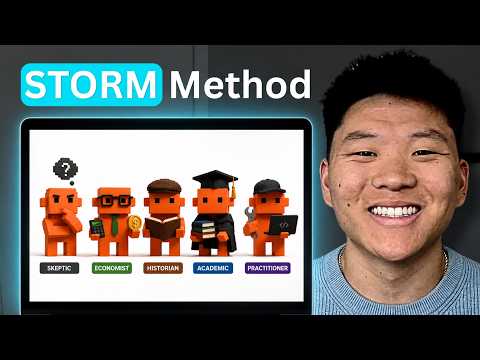
Stanford's STORM research method, integrated into the Claude AI system, produces highly organized, multi-perspective research reports by simulating five expert lenses and verifying sources. This approach outperforms traditional single-prompt research by identifying blind spots and contradictions, resulting in reliable, actionable, and tailored HTML briefings. The method is accessible via a free Claude skill, enabling users to customize and enhance research quality efficiently.
Stanford University has developed a research method called STORM, which has been peer-reviewed and shown to produce articles that are 25% more organized than the next best method. This innovative approach has been integrated into the Claude AI system, resulting in a powerful research skill that simulates multiple expert perspectives to generate comprehensive and verified research reports.
STORM stands for a research methodology that leverages multiple perspectives to analyze a topic thoroughly. Instead of relying on a single prompt or angle, STORM utilizes five distinct expert lenses:
Each perspective identifies gaps or blind spots that others might miss, ensuring a holistic and well-rounded analysis.
The STORM skill in Claude AI orchestrates a multi-agent system where each agent role-plays one of the five expert perspectives. These agents independently research the topic, then their findings are mapped to identify contradictions and agreements. Following this, the system synthesizes the information into a single, self-contained HTML report.
A key feature of this method is the adversarial peer review process, where the outputs are critically evaluated and verified against primary sources. This verification step ensures that any incorrect information is corrected or demoted, enhancing the reliability of the final report.
Claude AI also offers a native deep research feature that can spin up hundreds of agents to gather information. However, when compared to STORM, the latter provides several benefits:
An evaluation using Codex, a different AI model, confirmed that STORM's HTML briefing outperformed the deep research output in evidence quality, source diversity, thesis strength, risk control, and suitability for content creation.
The process involves four main prompts:
This pipeline is packaged into a Claude skill, allowing users to input a research topic and receive a verified, multi-perspective HTML briefing automatically.
The STORM skill is freely available and can be integrated into Claude AI by placing the skill files in the appropriate .Claude folder. Users can customize the skill by modifying the HTML report template or adding additional expert lenses to suit their specific needs.
For example, adding a "customer" or "frontline employee" lens could provide insights from those directly affected by the topic. Similarly, including a "beginner in AI" or "content creator" perspective might be valuable depending on the user's focus.
When running the STORM skill on the topic of voice AI agents, the system first scopes the topic and may ask clarifying questions if the input is vague. Then, it spins up the five expert agents in parallel, each conducting research from their unique viewpoint.
Users can observe each subagent's activity, including the prompts they receive and their research progress. Unlike agent teams, these subagents do not communicate with each other but report back to the main session.
After gathering initial findings, the system maps contradictions, synthesizes the report, and performs verification. The final output is an HTML report featuring:
The STORM method uses subagents, which are individual agents working under a main session without inter-agent communication. In contrast, agent teams consist of multiple agents that can interact and debate with each other, potentially reaching consensus through argumentation.
While agent teams offer richer collaboration, they are more resource-intensive and costly. Subagents provide a balance of efficiency and multi-perspective analysis suitable for many research tasks.
Users are encouraged to tailor the STORM skill to their specific context by:
This flexibility makes STORM a versatile tool for deep, reliable research across various domains.
Stanford's STORM method, when integrated into Claude AI, transforms the research process by combining multiple expert perspectives, contradiction mapping, synthesis, and rigorous verification. This approach produces highly organized, reliable, and actionable research reports that outperform traditional single-angle deep research.
By adopting STORM, users can overcome blind spots, enhance the quality of their research, and gain insights tailored to their unique needs. The freely available Claude skill makes it accessible for anyone to leverage this advanced methodology.
For those interested, the skill and related resources are available through the creator's free school community, enabling easy setup and experimentation.
Embracing multi-perspective AI research like STORM represents a significant step forward in harnessing artificial intelligence for comprehensive and trustworthy knowledge discovery.