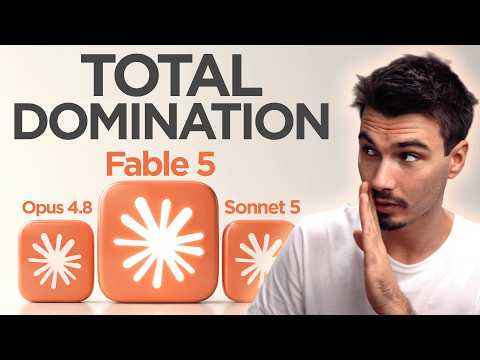
Fable 5, a powerful AI model, has returned after a brief removal due to government restrictions. Alongside Sonnet 5 and Opus 4.8, it offers distinct advantages for different use cases. This article breaks down their differences, usage tips, and practical prompts to maximize productivity, especially with Fable 5’s superior ability to organize complex tasks and plan AI-driven workflows.
Fable 5, once considered the best AI model available to the public before being taken down, has made a triumphant return. Alongside it, Sonnet 5 has been released as the new default model inside Claude, and Opus 4.8 remains a strong contender. With multiple models available, it can be confusing for users to decide which to use and when. This article aims to clarify the differences, suggest the best use cases, and provide practical prompts to help you get the most out of these AI models.
Fable 5 was initially released a few weeks ago but was quickly taken down by the US government due to concerns over its power and accessibility. However, with export controls lifted on June 30th, Fable 5 became available again as of July 1st, though only temporarily until July 7th. It is accessible via claude.ai, but users should note that usage is capped at 50% of their weekly limits due to the model’s high token consumption.
Fable 5 is the most resource-intensive model, consuming roughly 70% more tokens than Opus 4.8, which was previously the best model. Additionally, Fable 5 has enhanced cybersecurity safeguards, meaning some prompts that were previously accepted may now be flagged and automatically fall back to Opus 4.8.
Sonnet 5 is an upgrade from Sonnet 4.8 and serves as a smaller, faster, and more cost-efficient alternative to Opus 4.8. While Opus 4.8 remains the smarter model, the gap between Opus and Sonnet has narrowed significantly. Sonnet 5 is now the default model for both free and pro users due to its speed and efficiency, making it ideal for everyday tasks.
Opus 4.8 is still available and is suitable for users who prioritize performance over cost or usage limits. An Opus 5 model is expected soon, promising further improvements.
Fable 5 excels at turning chaos into a structured plan. It can process a variety of documents, such as launch materials or business context, and help sequence and organize tasks effectively. It identifies decisions that need to be made, the order of tackling tasks, missing elements, and the first steps to take.
One exciting application is building a simple AI operating system for your business or personal life. This involves creating a hub where different AI applications, prompts, and workflows coexist to enhance productivity.
A practical prompt for Fable 5 includes:
This approach helps users get actionable, specific plans rather than abstract ideas.
When tested with identical prompts, Sonnet 5 provides good suggestions but tends to be less specific and actionable compared to Fable 5. For example, Fable 5 recommended building a "call converter" workflow first, which uses Zoom transcripts to generate same-day recaps with clear next steps, requiring minimal preparation and providing immediate value.
Sonnet 5 suggested workflows that required more steps and preparation, making Fable 5’s recommendations more practical for immediate implementation.
To maximize Fable 5’s effectiveness, it is beneficial to provide detailed context about your business, products, clients, and goals. Including documentation or support articles related to tools you use (e.g., Claude Co-work) helps ground the AI’s responses in reality and improves accuracy.
Planning and Improving Applications or Tools: Fable 5 is excellent at planning and improving personalized tools or applications, making the process smoother and more efficient.
Complex Task Planning: For any complex project or workflow, Fable 5’s ability to organize and sequence tasks is unmatched.
Gemini Study Notebooks: An adaptive AI tutor within the Gemini app that quizzes users and adjusts to their learning pace. It is a promising free tool for personalized tutoring, especially for children.
Gemini Omni Flash: A new conversational video editing tool currently in developer-only API access. While intriguing, it remains to be seen how practical it will be for professional video editing.
Upcoming OpenAI Models: OpenAI announced GPT 5.6 models, currently available to select organizations in the US. These models will upgrade from GPT 5.5 and are expected to be comparable to Opus 4.8 or Sonnet 5 in performance.
Fable 5 is a groundbreaking AI model that is best suited for complex and high-value tasks requiring deep organization and planning. Sonnet 5 offers a fast, cost-effective solution for everyday AI needs, while Opus 4.8 remains a solid choice for users unconcerned with usage limits.
Users are encouraged to try Fable 5 while it is available for free, especially for tasks involving chaotic information that needs structuring or for building AI-driven workflows. Providing detailed context and grounding information enhances the AI’s output quality.
For those interested in mastering context management and AI workflows, further resources and courses are available to deepen understanding and practical skills.
Stay tuned for more updates in the AI space and explore how these powerful models can transform your productivity and business operations.