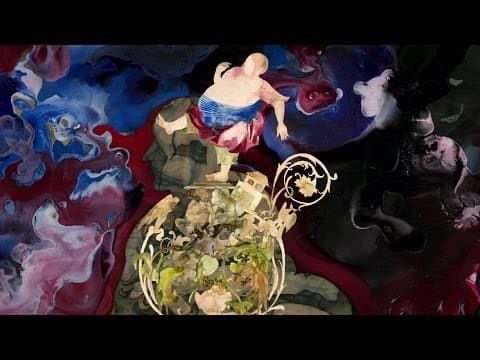
Shahzia Sikander's 'The Last Post' delves into the complexities of colonial trade relations, particularly between China and the East India Company, using animation to explore themes of transformation and narrative.
Shahzia Sikander's work often navigates the intricate landscapes of cultural and political boundaries, and her piece "The Last Post" is no exception. This animation serves as a profound exploration of historical narratives, particularly focusing on the colonial trade relations between China and the East India Company during the opium trade era.
In "The Last Post," Sikander examines the oscillating dynamics of colonial trade, highlighting the complex interactions between the East India Company and China. The narrative is not presented in a straightforward manner; instead, it oscillates between abstract concepts and illustrative political ideas. This duality allows viewers to engage with the material on multiple levels, prompting deeper reflection on the implications of colonialism.
Central to the animation is the figure of the company man, who serves as the protagonist. This character embarks on a journey throughout India and into China, symbolizing the reach and influence of the East India Company. Sikander uses this character to embody the historical context of the opium trade, which was pivotal in shaping the colonial landscape of the time.
A significant moment in the animation occurs when the company man explodes, symbolizing the end of Anglo-Saxon hegemony over China. This explosion is not merely a dramatic effect; it encapsulates the broader themes of transformation and the dismantling of colonial power structures. Sikander's work invites viewers to consider the implications of such transformations, both historically and in contemporary contexts.
Sikander's choice to utilize animation stems from her background in drawing, where narrative and movement are integral components. The animation process mirrors her previous work with murals and wall installations, which were often large and layered. This layering technique is also evident in her animation, created using Photoshop, where images are constructed in layers to build depth and complexity.
A core aspect of Sikander's artistic practice is her interest in deconstructing forms and then reconstructing them. This process of breaking apart and rebuilding is not limited to visual elements; it extends to the transformation of genres and mediums. For Sikander, transformation is a fundamental notion that stabilizes her artistic exploration, allowing her to engage with various themes and ideas in innovative ways.
Shahzia Sikander's "The Last Post" is a compelling examination of cultural and political boundaries through the lens of colonial history. By intertwining narrative, symbolism, and animation, Sikander invites viewers to reflect on the complexities of the past and the transformations that continue to shape our understanding of cultural interactions today. Through her work, she challenges us to reconsider the narratives we inherit and the ways in which they inform our present and future.