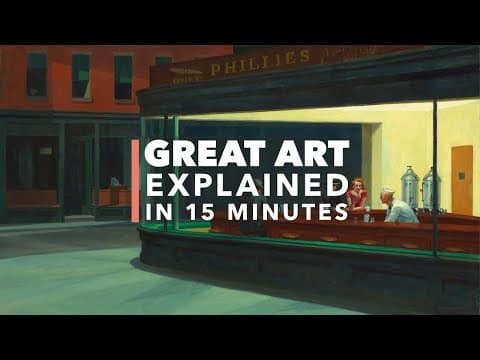
Edward Hopper's painting Nighthawks captures the essence of loneliness and isolation in urban life, reflecting his personal struggles and the emotional disconnect in relationships. Completed in 1942, the artwork is influenced by Hopper's life experiences, his tumultuous marriage, and the socio-political climate of the time, making it a profound commentary on human existence.
Edward Hopper's world was New York, a city he understood deeply. Despite being one of the most crowded and busy places on earth, Hopper recognized that it is possible to feel entirely alone. His iconic painting, Nighthawks, completed on January 21, 1942, just weeks after the bombing of Pearl Harbor, encapsulates this sentiment. While the war may not have directly influenced the painting, the pervasive feeling of dread among Americans surely infused its creation. During this time, New York experienced blackout drills, streets emptied, and the city became dark and silent.
Hopper took the elevated El-train to work for decades. In his forties, he faced significant struggles as a painter, unable to sell his work and feeling trapped in a job as a magazine illustrator, which he loathed. Despite his financial difficulties and the lack of recognition from critics, Hopper remained convinced of his talent. He only accepted illustration work three days a week, dedicating the rest of his time to painting.
In 1924, at the age of 42, Hopper had his first sellout show, which allowed him to abandon illustration and focus solely on his art. That same year, he married Jo, who played a crucial role in his career by introducing him to curators and helping to launch his success. However, their marriage was fraught with conflict, characterized by explosive arguments and periods of silence, which is reflected in the emotionally disconnected couples depicted in his paintings.
Hopper's works often portray couples who share the same space yet inhabit different worlds. His paintings reveal a profound sense of emotional disconnection, where characters do not communicate or display affection. This theme of isolation is particularly evident in Nighthawks, where the figures seem trapped in their own worlds, radiating tension and unresolved emotions.
Jo and Edward Hopper shared a love for theater and cinema, and Nighthawks suggests a scene on an illuminated stage, reminiscent of a darkened theater. Hopper's compositions were influenced by set design and cinematic techniques, showcasing his meticulous preparation process. He created numerous sketches for Nighthawks, using life drawings to establish a visual understanding before refining the final composition.
Hopper's preparation for Nighthawks was extensive. He storyboarded the painting like a film director, planning every detail, from the positioning of the characters to the angle of the diner's window. The use of strong diagonal lines in the diner creates a sense of space that leads the viewer's eye toward the figures inside. The contrasting colors—dark tones outside and bright yellow inside—further emphasize the isolation of the diner, which appears devoid of life.
The large window serves as a barrier, enhancing the voyeuristic aspect of the painting. The characters are depicted as specimens in a jar, trapped in their own emotional turmoil. Hopper's fascination with windows and the act of looking through them is a recurring motif in his work, inviting viewers to engage with the narrative.
Although often categorized as an American realist painter, Hopper identified more with Impressionism. His work was influenced by artists like Gustav Caillebotte, whose use of light and urban settings resonated with Hopper. The year before Nighthawks was painted, Vincent van Gogh's Cafe Terrace at Night was exhibited in New York, which Hopper admired for its artificial lighting.
The eerie glow of the neon lights in Nighthawks, a relatively new phenomenon in the 1940s, adds to the melancholic atmosphere of the painting. Hopper often depicted specific times of day, with nighttime representing a period of anxiety for him. The diner in Nighthawks is hermetically sealed, preventing any entry or exit, which symbolizes the emotional barriers between the characters.
The characters in Nighthawks are physically close yet psychologically distant. The couple appears to be touching at first glance, but their hands do not connect. The steaming coffee cup of the woman contrasts with the cold cup of the man, suggesting a deeper emotional disconnect. The title of the painting, suggested by Jo, refers to a character with a hawk-like nose, adding another layer to the narrative.
The solitary man in the diner, holding an unlit cigarette and a newspaper, adds to the sense of isolation. The waiter, too, is disengaged, staring out the window rather than interacting with the patrons. This lack of communication among the characters creates an open-ended narrative that invites viewers to ponder the stories behind the figures.
Nighthawks has inspired countless interpretations and recreations in popular culture. Hopper's influence extends beyond the art world into cinema, where filmmakers have drawn inspiration from his use of light, urban settings, and character dynamics. The painting has become synonymous with emotional dysfunction and loneliness, capturing the essence of the human experience.
Hopper himself acknowledged the loneliness reflected in his work, stating, "It's probably a reflection of my own - I may say loneliness - I don't know." Nighthawks remains a powerful exploration of isolation, a theme that resonates with many. Despite the artist's personal struggles, his paintings remind us that feelings of loneliness and disconnection are universal experiences.
Edward Hopper's Nighthawks is more than just a painting; it is a profound commentary on the human condition. Through his meticulous preparation and unique artistic vision, Hopper captures a world filled with loneliness, isolation, and quiet anguish. His work serves as a reminder that even in a bustling city, one can feel utterly alone, and that these feelings are a shared part of the human experience.