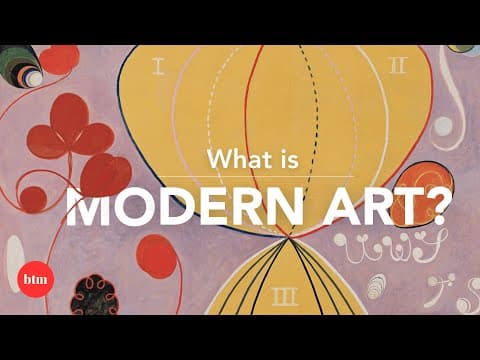
This blog post delves into the evolution of modern art from the 1860s to the 1970s, highlighting key movements and masterpieces that challenged traditional norms and redefined artistic expression. It discusses the contributions of artists like Manet, Cézanne, Van Gogh, Matisse, Picasso, and others, illustrating how their works reflect the emotional and conceptual shifts in art during this transformative period.
You're standing in a gallery, the lights dimmed. You see Van Gogh's Starry Night, its swirls of blues and yellows embodying the ethereal beauty of the night sky, almost vibrating right in front of you. Across the room, a Jackson Pollock piece catches your eye. The intricate web of colors and textures, formed by paint dripped and flung across the canvas, pulls you in. Both these masterpieces, distinct as they are, represent the diverse and boundless scope of the modern art movement.
Some criticize modern art, dismissing it as elitist or overly abstract. They argue that it lacks the technical skill of the Old Masters, and it's not rare for some to think, "I could have done that." However, modern art is much more than that. People often struggle with modern art because it can be challenging to understand, which can be frustrating. Dismissing it as an inferior form of expression undermines its significant contributions.
The modern art movement spanned from the 1860s to the 1970s, a period marked by the transformative effects of the Industrial Revolution and two world wars. Just as the world was spinning on its axis a little faster, the wheel of modern art was spinning along with it, producing an array of different artistic styles in quick succession. With photography becoming more popular, artists faced a dilemma: if a camera could mirror reality, where did they stand? This led them to question reality rather than merely recreate it.
Previously, art was largely governed by the rigid norms of academic institutions and the preferences of a select group of wealthy patrons. They dictated what was considered "good art," favoring historical or mythological themes and meticulous techniques. Modern art emerged as a rebellion against these restrictions, democratizing the artistic landscape and broadening its appeal beyond the elites, ushering in an era of innovation.
While it might be confusing to find the common thread within all of these art movements, a few characteristics emerge repeatedly:
Today, we will explore the progression of modern art by looking at the masterpieces that best illustrate these characteristics.
Historians frequently debate the precise origins of modern art. Édouard Manet's The Luncheon on the Grass and Paul Cézanne's The Large Bathers stand out in these discussions. As art historian H. Harvard Arnason observed, "Each of these dates has significance for the development of modern art, but none categorically marks a completely new beginning. A gradual metamorphosis took place in the course of 100 years."
Manet's The Luncheon on the Grass, painted in 1863, presents a vivid scene: two fully dressed men in the company of a starkly nude woman casually picnicking on a sunlit glade. The curious play of light and shadows, along with an oddly proportioned background featuring a woman in a sheer dress bathing in a pond, challenges societal norms and redefines art's scope. The ambiguous gaze of the central woman draws us in, enhancing the painting's allure. Manet's bold brushwork and portrayal of realism were groundbreaking, resulting in the painting's rejection by the Paris Salon in 1863. Ironically, this rejection amplified its influence, setting the stage for the modern art movements that followed.
Paul Cézanne's The Large Bathers, crafted over nearly a decade and left unfinished at his death, marks a decisive shift toward modern art. This masterpiece depicts a group of women immersed in nature, framed by trees that evoke the grandeur of a cathedral. Cézanne reduces his subjects into geometric shapes and arranges them in triangular patterns, foreshadowing the geometric abstraction of Cubism. Unlike traditional works where a prominent figure takes center stage, the central space here is almost empty, creating a sense of balance and calm.
As Impressionism faded, Post-Impressionism emerged, with artists like Vincent van Gogh, Henri Rousseau, and Henri de Toulouse-Lautrec using bolder forms and two-dimensional perspectives. Among the most recognizable artworks of this period is Van Gogh's Starry Night, painted in 1889 during his stay at the Saint-Rémy Asylum. This piece goes beyond traditional landscape art, focusing on a vibrantly pulsating night sky that reflects the artist's emotional struggles and longing for connection.
Next came Fauvism, led by Henri Matisse. The Fauves created a visual language dominated by vibrant color planes and sensual forms. Matisse's The Joy of Life exemplifies Fauvist principles, brimming with intense hues that construct an almost dreamlike landscape. This colossal painting captures the essence of an idyllic world, where colors of nature fuse with the raw energy of humanity, embodying the uninhibited celebration of life’s vitality.
Cubism, conceived by Pablo Picasso and Georges Braque, represents a radical departure from traditional representation. Picasso's Les Demoiselles d’Avignon features five nude female forms disintegrating into geometric shapes, while Braque's Bottle and Fishes presents overlapping planes and fragmented objects. These works invite viewers to engage with art in new ways, challenging them to see the world from multiple perspectives.
The Dada movement emerged amidst the chaos of World War I, characterized by its satirical and nonsensical nature. Artists like Marcel Duchamp challenged the very concept of art with pieces like Fountain, a urinal turned into an artwork. This audacious challenge to conventional wisdom opened up a new world of artistic freedom and began a discussion that still reverberates in the art world today.
Wassily Kandinsky is often considered a pioneer of abstract art, but Swedish artist Hilma af Klint painted some of the earliest abstractions. Her series Group IV: The Ten Largest reflects her spiritual journey and the stages of life. Kandinsky's Untitled (First Abstract Watercolor) from 1910 showcases his belief in the emotional power of colors and forms, resonating with the ideals of the modern art movement.
Kazimir Malevich's Black Square represents a significant chapter in abstract art. This piece, which may seem oversimplified, is a bold declaration of Suprematism, focusing on the supremacy of colors and shapes. Its radical departure from artistic conventions mirrors the sociopolitical changes in Russia during the early 20th century.
Founded in 1917, the De Stijl movement, led by Piet Mondrian, celebrated geometric abstraction and simplicity. Mondrian's Composition C (No. III) with Red, Yellow, and Blue exemplifies this approach, inviting viewers to experience the beauty of balance and harmony in abstraction.
Georgia O’Keeffe made groundbreaking contributions to American art, known for her paintings of flowers and landscapes. Her masterpiece Black Iris magnifies a single flower, transforming it into an abstract form that invites viewers to engage with its shapes and lines in new ways.
Jackson Pollock pushed abstraction to its furthest extreme with works like Autumn Rhythm (Number 30). His technique of pouring and splattering paint onto large canvases emphasizes the process of creation, inviting viewers to experience the energy and spontaneity of his work.
As we stand on the precipice of the 21st century, the legacy of modern art is far from fading. It has reshaped artistic expression, continuously reinventing itself and reflecting societal shifts. The heart and soul of this movement lie in its inherent subjectivity. The true value of art doesn’t hinge on universal understanding; it resembles classical music, where appreciation comes from the willingness to engage with it.
Kurt Vonnegut said it best in his 1973 novel Breakfast of Champions: "The painting did not exist until I made it. I would love for your children to find pleasantly and playfully what it took me many angry years to find."